
Sikkim Becomes India’s First Paperless State Judiciary India’s judicial system has entered a new era of digital governance with Sikkim becoming the country’s first fully paperless state judiciary. Declared by the Chief Justice of India, this milestone reflects the success of the e-Courts Mission Mode Project, a nationwide initiative aimed at modernising courts through technology. By replacing physical files with …
Supreme Court (Number of Judges) Amendment Bill, 2026
Supreme Court (Number of Judges) Amendment Bill, 2026 The Union Cabinet has approved the Supreme Court (Number of Judges) Amendment Bill, 2026, proposing an increase in the sanctioned strength of judges of the Supreme Court of India from 33 to 37 judges (excluding the Chief Justice of India). The move aims to strengthen the country’s highest judicial institution, reduce the …
Disqualification of MPs under the Tenth Schedule: Anti-Defection Law
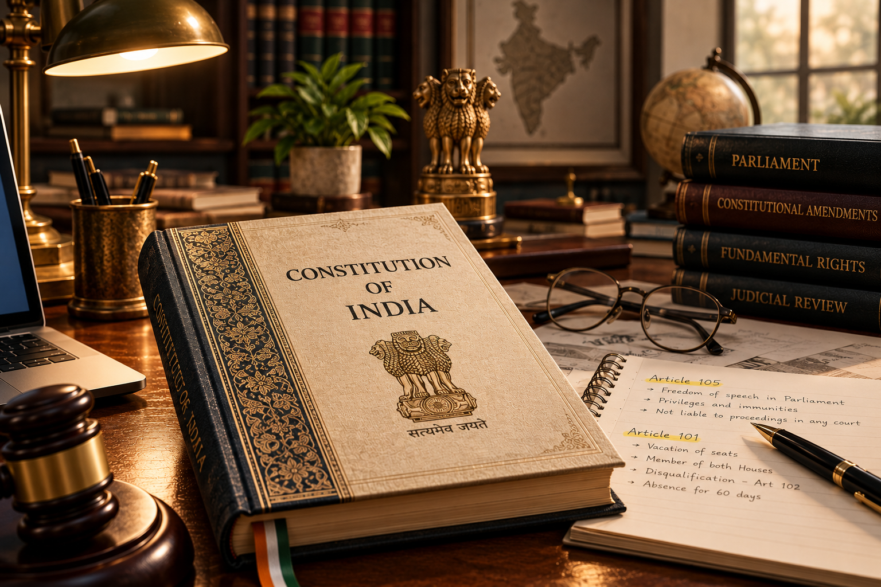
Disqualification of Members of Parliament (MPs) The Anti-Defection Law, incorporated under the Tenth Schedule of the Constitution, seeks to preserve political stability by discouraging elected representatives from changing political allegiance after elections. Recently, the issue has once again come into focus following a disqualification petition arising from the resignation of Rajya Sabha Members from one political party and their subsequent …
Citizenship (Amendment) Rules, 2026
Citizenship (Amendment) Rules, 2026 The Ministry of Home Affairs has notified the Citizenship (Amendment) Rules, 2026, introducing significant reforms to the Overseas Citizen of India (OCI) framework and citizenship procedures. The amendments seek to digitize OCI-related services, simplify administrative processes, strengthen passport regulations for minors, and improve transparency in citizenship administration. Why is it in News? The Ministry of Home …
Election Commission of India (ECI): Constitutional Provisions, Anoop Baranwal Case & 2023 Act
Appointment Procedure of the Election Commission of India (ECI) The Election Commission of India (ECI) is one of the most important constitutional institutions responsible for ensuring free, fair, and impartial elections in the country. The appointment process of the Chief Election Commissioner (CEC) and Election Commissioners (ECs) has recently become the subject of constitutional debate after the Supreme Court described …
Public Interest Litigation (PIL) in India: Meaning, Evolution, Constitutional Basis, Types, Importance & Misuse
Public Interest Litigation (PIL) in India Public Interest Litigation (PIL) is one of the most significant judicial innovations in India. It transformed the traditional justice delivery system by enabling public-spirited individuals and organizations to approach courts on behalf of disadvantaged sections of society. PIL has strengthened constitutional governance, protected fundamental rights, and enhanced government accountability. However, the Supreme Court has …
NCERT Declared Deemed-to-be University:
NCERT Declared Deemed-to-be University The National Council of Educational Research and Training (NCERT) has been granted the status of a Deemed-to-be University, marking a significant milestone in India’s education sector. The new status is expected to strengthen educational research, teacher education, curriculum development, and innovation while enhancing the institution’s academic autonomy. Why is it in News? The Central Government has …
Recusal of Judges : Meaning, Grounds & Legal Position
⚖️ Recusal of Judges in India: Meaning, Grounds & Legal Position Explained The concept of recusal of judges has once again come into public discussion after a former Chief Minister of Delhi sought the recusal of a Delhi High Court judge from hearing a particular matter. Although requests for recusal occasionally arise in judicial proceedings, the decision ultimately rests with …
Deputy Chairman of Rajya Sabha & Nominated Members
🏛️ Deputy Chairman of the Rajya Sabha & Nominated Members Explained The election of a nominated member as the Deputy Chairman of the Rajya Sabha for the third consecutive term has once again highlighted the constitutional position of nominated members in India’s parliamentary system. The development has generated interest regarding the powers, privileges and constitutional status of nominated members of …
Removal of Supreme Court and High Court Judges in India Explained
⚖️ Removal of Supreme Court & High Court Judges in India: Constitutional Process Explained The resignation of Justice Yashwant Varma during the pendency of impeachment proceedings has once again brought public attention to the constitutional mechanism for the removal of judges in India. The incident has highlighted the safeguards built into the Constitution to preserve judicial independence while ensuring accountability …
- Page 1 of 2
- 1
- 2