
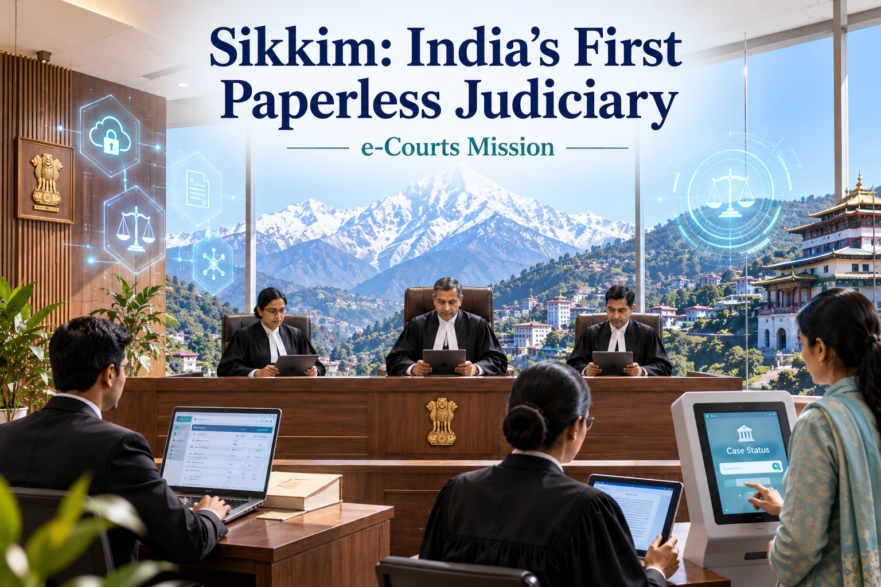
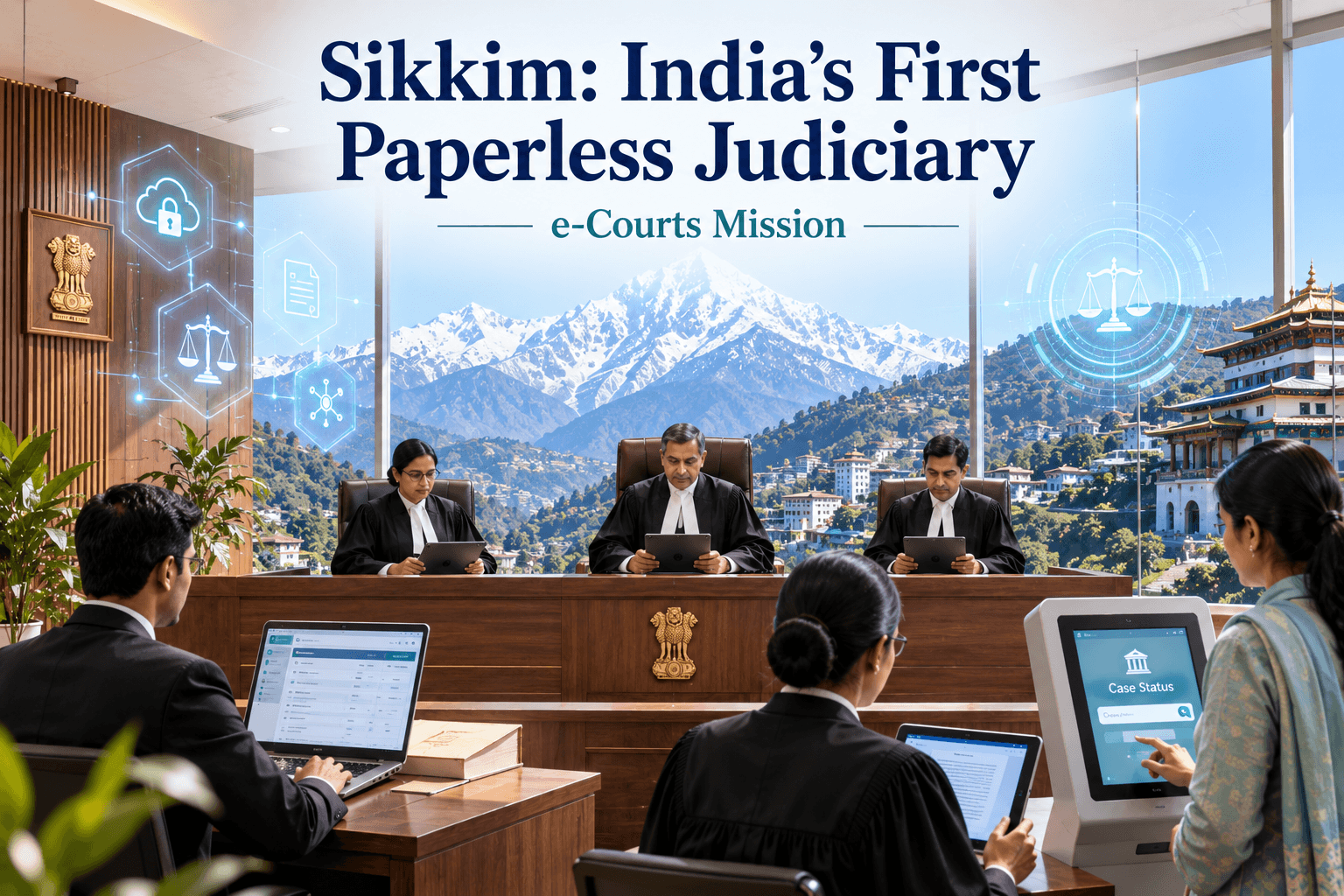
Sikkim Becomes India's First Paperless State Judiciary
India's judicial system has entered a new era of digital governance with Sikkim becoming the country's first fully paperless state judiciary. Declared by the Chief Justice of India, this milestone reflects the success of the e-Courts Mission Mode Project, a nationwide initiative aimed at modernising courts through technology. By replacing physical files with digital records, electronic filing, online hearings, and integrated case management systems, the judiciary is moving towards faster, transparent, and citizen-friendly justice delivery.
Why is it in News?
The Chief Justice of India (CJI) recently declared Sikkim as the first fully paperless state judiciary in India. This achievement marks a major milestone in the country's judicial reforms and demonstrates the growing success of the e-Courts Mission Mode Project, which aims to digitise courts across India.
With this transformation, judicial processes such as filing cases, maintaining records, accessing case files, conducting hearings, and monitoring proceedings can now be performed digitally, reducing dependence on physical paperwork.
What is a Paperless Judiciary?
A paperless judiciary is a judicial system where legal and administrative processes are conducted digitally instead of relying on physical paper documents. It leverages information and communication technology (ICT) to improve efficiency, transparency, accessibility, and speed in the justice delivery system.
Instead of maintaining bulky case files and paper records, courts use secure digital platforms to store, process, and retrieve judicial documents electronically.
Key Features of a Paperless Judiciary
- Electronic filing (e-Filing) of cases.
- Digital storage of case records and judicial documents.
- Virtual or hybrid court hearings.
- Online access to case status and orders.
- Electronic payment of court fees.
- Digital cause lists and notices.
- Real-time case tracking.
- Electronic communication between courts, lawyers, and litigants.
What is the e-Courts Mission Mode Project?
The e-Courts Mission Mode Project is one of India's flagship judicial reform initiatives aimed at transforming the justice delivery system through the extensive use of digital technology. It seeks to create an efficient, transparent, accessible, and citizen-centric judiciary by computerising courts and integrating digital services across the country.
The project forms an important component of the Government of India's larger vision of Digital India and good governance through technology.
Key Facts: e-Courts Mission Mode Project
| Feature | Details |
|---|---|
| Launch | 2007 |
| Programme | National e-Governance Plan (NeGP) |
| Implementing Ministry | Department of Justice, Ministry of Law & Justice |
| Guiding Authority | e-Committee of the Supreme Court of India |
| Objective | Digitisation and computerisation of courts across India |
Objectives of the e-Courts Mission
The primary objective of the e-Courts Project is to make justice delivery more efficient, transparent, and accessible through the adoption of digital technologies.
- Digitise judicial records and court proceedings.
- Reduce delays in disposal of cases.
- Improve transparency in judicial administration.
- Provide citizens with easy online access to court services.
- Enable paperless and cashless court operations.
- Strengthen judicial data management.
- Enhance coordination among different courts across India.
Evolution of the e-Courts Mission
The e-Courts Project has been implemented in multiple phases, with each phase introducing new digital capabilities to strengthen India's judicial infrastructure.
| Phase | Major Focus |
|---|---|
| Phase I (2007–2015) | Computerisation of district and subordinate courts, installation of hardware, networking, and digitisation of basic judicial records. |
| Phase II (2015–2023) | Expansion of online judicial services including e-Filing, National Judicial Data Grid (NJDG), e-Payments, virtual courts, and mobile applications. |
| Phase III (2023–2027) | Towards a fully digital and paperless judiciary with integrated digital courts, AI-enabled services, cloud-based records, and seamless digital justice delivery. |
Did You Know?
The e-Committee of the Supreme Court of India, established in 2004, is responsible for guiding and monitoring the implementation of technology in the Indian judiciary. It plays a pivotal role in planning and executing the e-Courts Mission Mode Project across the country.
Major Digital Services under the e-Courts Project
The e-Courts Mission has introduced several citizen-centric digital platforms that have significantly improved access to justice and reduced the dependence on physical court visits.
| Digital Service | Purpose |
|---|---|
| e-Filing | Online filing of cases and legal documents. |
| e-Pay | Digital payment of court fees, fines, and penalties. |
| Virtual Courts | Online adjudication of specific categories of cases without physical appearance. |
| National Judicial Data Grid (NJDG) | Real-time database providing information on pending and disposed cases. |
| e-Sewa Kendras | Citizen assistance centres for accessing digital court services. |
| Case Information System (CIS) | Integrated software for digital case management and court administration. |
Benefits of a Paperless Judiciary
The transition to a paperless judiciary is one of the most significant judicial reforms undertaken in India. By replacing manual processes with digital technologies, courts can improve efficiency, transparency, accessibility, and environmental sustainability.
| Benefit | Impact |
|---|---|
| Faster Disposal of Cases | Digital records enable quicker retrieval of files, reducing delays in hearings and judgments. |
| Greater Transparency | Litigants can track case status, orders, and hearing dates online. |
| Better Accessibility | Lawyers and citizens can access court services remotely through digital platforms. |
| Cost Reduction | Significantly lowers expenditure on paper, printing, storage, and physical record management. |
| Environmental Sustainability | Reduced paper consumption contributes to greener judicial administration. |
| Improved Data Security | Digital records can be securely backed up and protected against physical damage or loss. |
Major Challenges in Building a Digital Judiciary
- Digital infrastructure varies significantly across different states and districts.
- Reliable internet connectivity remains a challenge in many remote and rural areas.
- Training judges, lawyers, and court staff in new technologies requires continuous investment.
- Cybersecurity and protection of sensitive judicial data remain critical concerns.
- The digital divide may limit access for economically weaker and technologically inexperienced litigants.
- Large-scale digitisation of legacy case records requires substantial time and financial resources.
Why is Sikkim's Achievement Significant?
Sikkim becoming India's first fully paperless state judiciary demonstrates that digital transformation of courts is not merely a policy objective but an achievable reality. It provides a successful model for other states to replicate while strengthening public confidence in technology-enabled justice delivery.
The achievement also aligns with broader national initiatives such as Digital India, Ease of Doing Business, and judicial reforms aimed at making justice more efficient, transparent, and citizen-centric.
Significance at a Glance
- Sets a benchmark for other High Courts and subordinate courts.
- Promotes paperless governance within the judiciary.
- Reduces administrative delays.
- Improves transparency and accountability.
- Strengthens public access to justice through digital platforms.
- Supports environmentally sustainable governance.
Future of Digital Courts in India
The future of India's judiciary lies in deeper integration of technology with judicial administration. Under Phase III of the e-Courts Mission Mode Project, the focus is shifting from simple computerisation to intelligent digital justice systems.
Emerging technologies such as Artificial Intelligence (AI), cloud computing, machine learning, digital evidence management, multilingual translation tools, and predictive analytics are expected to assist—not replace—judicial decision-making by improving efficiency and reducing administrative burdens.
Future reforms are expected to strengthen interoperability between courts, police, prisons, forensic laboratories, and prosecution agencies, thereby creating a seamless justice delivery ecosystem.
Exam Focus
Prelims
- e-Courts Mission Mode Project
- National e-Governance Plan (NeGP)
- e-Committee of the Supreme Court
- National Judicial Data Grid (NJDG)
- Virtual Courts
- e-Filing and e-Pay
- Paperless Judiciary
Mains
- Role of technology in judicial reforms.
- Digital governance and access to justice.
- Challenges in implementing e-governance in the judiciary.
- Impact of digital courts on judicial efficiency.
- Technology as an instrument for reducing pendency of cases.
Key Takeaways
- Sikkim has become India's first fully paperless state judiciary.
- A paperless judiciary replaces physical records with digital workflows, including e-Filing, electronic records, online hearings, and digital case management.
- The e-Courts Mission Mode Project was launched in 2007 under the National e-Governance Plan (NeGP).
- The project is implemented by the Department of Justice under the guidance of the e-Committee of the Supreme Court of India.
- Major digital initiatives include e-Filing, e-Pay, Virtual Courts, National Judicial Data Grid (NJDG), e-Sewa Kendras, and the Case Information System (CIS).
- Digital courts improve transparency, accessibility, efficiency, and environmental sustainability while reducing delays in justice delivery.
- Cybersecurity, digital infrastructure, and digital literacy remain important implementation challenges.
Conclusion
Sikkim's emergence as India's first paperless state judiciary marks a significant milestone in the country's judicial reform journey. It reflects the growing success of the e-Courts Mission Mode Project and demonstrates how technology can make the justice delivery system faster, more transparent, and citizen-friendly. As India advances towards a fully digital judiciary, investments in infrastructure, cybersecurity, digital literacy, and institutional capacity will be essential to ensure that technology enhances both efficiency and access to justice while preserving the fairness and integrity of the judicial process.
Frequently Asked Questions (FAQs)
1. Which is India's first paperless state judiciary?
Sikkim has become India's first fully paperless state judiciary, marking a major milestone in judicial digitalisation.
2. What is a paperless judiciary?
A paperless judiciary is a court system where legal processes are conducted digitally using electronic filing, digital records, online hearings, and electronic case management instead of physical documents.
3. What is the e-Courts Mission Mode Project?
It is a nationwide initiative launched in 2007 under the National e-Governance Plan to computerise and digitise courts across India for efficient and accessible justice delivery.
4. Which authority guides the e-Courts Mission?
The project is implemented by the Department of Justice under the guidance of the e-Committee of the Supreme Court of India.
5. What are the benefits of digital courts?
Digital courts improve efficiency, transparency, accessibility, reduce paperwork, enable faster case disposal, and make judicial services more citizen-centric.
6. Why is this topic important for competitive examinations?
Questions related to e-Governance, judicial reforms, Digital India, e-Courts Mission, NJDG, and paperless judiciary are frequently asked in UPSC, Judiciary, CLAT, CUET LLB, APO, JLO, and State PSC examinations.
📘 Stay Ahead with Delhi Law Academy!
Get access to free monthly current affairs, read our insightful blogs,
and explore free study resources prepared by experts at DLA Jaipur. 🚀