

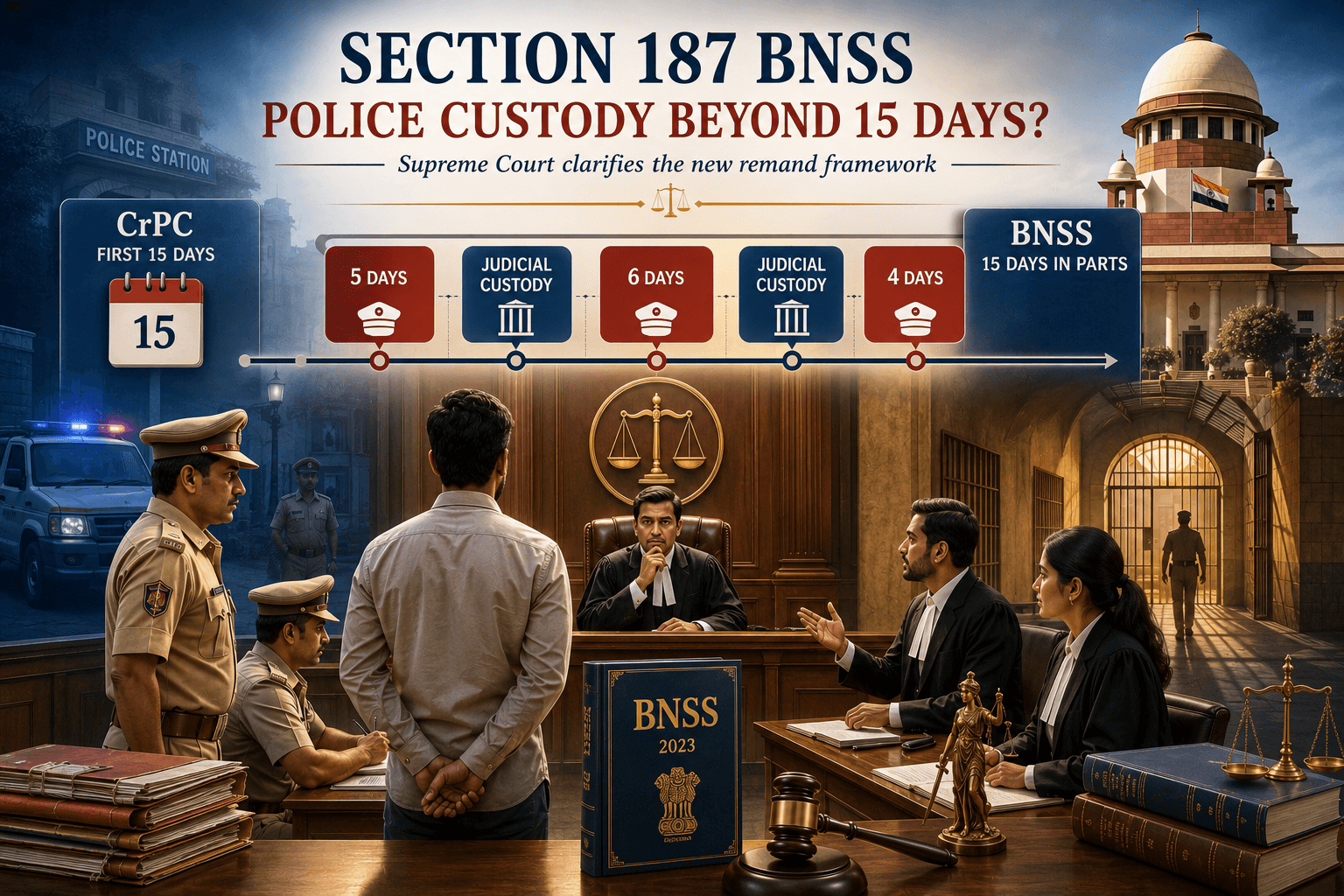
Section 187 BNSS: Police Custody Beyond 15 Days & Supreme Court's 2026 Judgment
The Bharatiya Nagarik Suraksha Sanhita, 2023 (BNSS) introduced an important change in the law relating to police custody and remand. Unlike the position under Section 167 of the Code of Criminal Procedure, 1973 (CrPC), Section 187 BNSS permits the maximum 15 days of police custody to be taken in parts during a wider initial period of detention. The Supreme Court's recent judgment in State of Andhra Pradesh v. Suda Suresh Veera Venkata Naga Raju has now clarified the scope of this provision.
Why in News?
On 27 July 2026, the Supreme Court delivered its judgment in State of Andhra Pradesh v. Suda Suresh Veera Venkata Naga Raju and clarified the scope of Section 187(2) of the BNSS concerning police custody. The Court held that, unlike the position under the erstwhile Section 167 CrPC, the 15 days of police custody under the BNSS are not confined to the first 15 days of remand.
Instead, police custody may be sought in parts within the first 40 days in cases where the overall permissible detention period is 60 days, or within the first 60 days where the overall permissible detention period is 90 days, subject to the aggregate police custody not exceeding 15 days. :contentReference[oaicite:2]{index=2}
Case at a Glance
| Particular | Details |
|---|---|
| Case | State of Andhra Pradesh v. Suda Suresh Veera Venkata Naga Raju |
| Date of Judgment | 27 July 2026 |
| Bench | Justice Vikram Nath and Justice Sandeep Mehta |
| Key Provision | Section 187(2) & (3), BNSS |
| Earlier Provision | Section 167, Code of Criminal Procedure, 1973 |
| Core Issue | Whether police custody can be granted after the first 15 days of remand under the BNSS. |
| Ruling | Yes. Police custody can be granted in parts within the statutory 40/60-day window, subject to a total maximum of 15 days. |
What is Police Custody?
Police custody refers to a situation in which an accused person is placed under the custody of the investigating police pursuant to an order of a Magistrate. It is primarily sought when investigators believe that custodial interrogation is necessary for an effective investigation.
Police custody may facilitate activities such as:
- Interrogation of the accused.
- Confrontation of the accused with evidence or other suspects.
- Recovery of material objects.
- Discovery of information relevant to the investigation.
- Reconstruction of the scene of an offence.
- Identification of other persons involved in the offence.
Police custody is, however, subject to judicial oversight. The investigating agency cannot simply decide to take an accused into police custody; the relevant Magistrate must authorise such custody in accordance with Section 187 BNSS.
Section 187 BNSS: The New Remand Framework
Section 187 BNSS broadly deals with the procedure to be followed when investigation cannot be completed within the initial period prescribed after arrest and the accused has to be produced before a Magistrate.
The provision replaced Section 167 of the CrPC when the new criminal laws came into force on 1 July 2024.
The Crucial Change
Under the old Section 167 CrPC, the Supreme Court's interpretation in CBI v. Anupam J. Kulkarni treated the first 15 days as the period within which police custody could be authorised. Section 187(2) BNSS changes this framework by expressly allowing the aggregate 15 days of police custody to be taken in parts within the specified initial detention window.
What Does Section 187(2) BNSS Provide?
Section 187(2) permits a Magistrate to authorise detention in custody for a total period of up to 15 days. The significant change is that this 15-day police custody does not necessarily have to be completed at the beginning of the remand period.
Depending upon the maximum permissible period of detention applicable to the offence, the police custody can be sought during a wider window:
| Type of Case | Maximum Detention Period | Window for 15 Days of Police Custody |
|---|---|---|
| Serious offences attracting the 90-day period | 90 days | First 60 days |
| Other offences attracting the 60-day period | 60 days | First 40 days |
In both situations, the aggregate police custody cannot exceed 15 days.
Understanding the 15-Day Rule with an Example
Suppose an offence falls within the 60-day detention category. Under Section 187 BNSS, the police could potentially seek custody in separate spells within the first 40 days, provided that the total period of police custody does not exceed 15 days.
Illustration
Day 1–5: Police custody – 5 days
Day 6–20: Judicial custody
Day 21–26: Police custody – 6 days
Day 27–35: Judicial custody
Day 36–39: Police custody – 4 days
Total police custody = 15 days.
The precise period and necessity of each spell remain subject to judicial authorisation. The provision does not give the police an automatic right to obtain 15 days of custody.
Police Custody vs Judicial Custody
| Police Custody | Judicial Custody |
|---|---|
| Accused remains under investigating agency's custody. | Accused is ordinarily lodged in prison under judicial custody. |
| Primarily facilitates custodial interrogation and investigation. | Ensures detention under the supervision of the court. |
| Maximum aggregate police custody: 15 days. | May continue up to the applicable 60/90-day limit, subject to law. |
The 60-Day and 90-Day Rule
Section 187(3) BNSS provides the broader framework governing the maximum period of detention during investigation.
- 90 days: Where the investigation relates to an offence punishable with death, imprisonment for life, or imprisonment for a term of ten years or more.
- 60 days: In other cases.
If the investigation is not completed and the charge-sheet is not filed within the applicable period, the accused may become entitled to default bail, subject to the statutory conditions.
Important Distinction
The 15-day limit applies to police custody. The 60/90-day limit applies to the overall permissible period of detention during investigation. The 15 days are therefore not added on top of the 60 or 90 days.
What Was the Issue Before the Supreme Court?
The case arose from an investigation concerning the alleged custodial death of a person in Andhra Pradesh. The respondent, a police officer, was arrested in connection with the investigation and the prosecution sought his police custody for custodial interrogation, recovery of evidence, identification of other persons involved and reconstruction of the circumstances surrounding the alleged offence.
The Magistrate granted police custody but imposed several safeguards, including restrictions on where interrogation could take place and requirements concerning videography and the safety of the accused. The Andhra Pradesh High Court subsequently modified some of these conditions.
The State approached the Supreme Court, arguing that the restrictions were so extensive that they made effective custodial interrogation and recovery of evidence practically impossible.
Supreme Court's Interpretation of Section 187 BNSS
The Supreme Court held that Section 187(2) and Section 187(3) BNSS represent a significant departure from the position under the erstwhile Section 167 CrPC.
Under the BNSS, the maximum 15 days of police custody can be availed of in parts during the statutory initial detention window. It is therefore incorrect to assume that police custody must necessarily be completed within the first 15 days following arrest.
The New Rule
Police custody may be granted in separate spells, subject to an aggregate maximum of 15 days, during the first 40 days in cases carrying the 60-day detention period and during the first 60 days in cases carrying the 90-day detention period.
CrPC vs BNSS: What Changed?
| Section 167 CrPC | Section 187 BNSS |
|---|---|
| Police custody was generally understood, following Supreme Court precedent, to be confined to the first 15 days of remand. | Police custody can be taken in parts during the specified 40/60-day window. |
| The Anupam J. Kulkarni principle restricted police custody to the initial 15 days. | The statutory scheme expressly permits the 15 days to be availed of in parts. |
| Later emergence of new investigative leads could not ordinarily reopen police custody after the first 15 days. | Fresh developments during investigation may justify a later spell of police custody, subject to judicial authorisation and the aggregate 15-day limit. |
The Earlier Supreme Court Position: CBI v. Anupam J. Kulkarni
Under the old CrPC regime, the leading decision was CBI v. Anupam J. Kulkarni (1992). The Supreme Court held that police custody could be authorised only during the first 15 days of remand. After that period, the Magistrate could authorise judicial custody, but could not subsequently send the accused back to police custody merely because further interrogation became necessary.
The BNSS has now legislatively altered this position. Section 187 expressly expands the period during which the aggregate 15 days of police custody can be utilised.
Important Exam Comparison
CrPC: 15 days of police custody confined to the initial 15-day period under the Anupam J. Kulkarni interpretation.
BNSS: Aggregate 15 days of police custody may be taken in parts within the first 40 or 60 days, depending on whether the applicable overall detention period is 60 or 90 days.
Why Did the Supreme Court Uphold the Wider Custody Window?
The Court recognised that investigations do not always proceed in a predictable sequence. New evidence, fresh leads, recoveries or information may emerge after the initial period of detention.
If the law completely prohibited any subsequent police custody after the first 15 days, investigators could be prevented from properly acting upon such developments even when custodial interrogation was legitimately necessary.
The wider statutory window under Section 187 BNSS therefore allows investigators to seek custody when genuine investigative requirements arise, while keeping the overall police custody capped at 15 days.
But Does Section 187 Give Police an Automatic Right to Custody?
No.
The provision does not give investigating agencies an unrestricted power to keep an accused in police custody whenever they wish. Police custody continues to require judicial authorisation.
The Magistrate must consider the reasons put forward by the investigating agency and determine whether custodial interrogation is justified in the circumstances of the case.
The change introduced by Section 187 is therefore about the time window within which police custody can be sought, not about removing judicial control over remand.
Section 38 BNSS: Right to Meet an Advocate During Interrogation
Another important issue considered by the Supreme Court was the scope of Section 38 BNSS.
Section 38 provides an arrested person with the right to meet an advocate of their choice during interrogation, though not throughout the interrogation.
The Supreme Court clarified that this provision does not mean that an advocate has a right to remain physically present throughout the entire interrogation session.
Section 38 – Remember This
| Right Guaranteed | Right NOT Guaranteed |
|---|---|
| Right to meet an advocate of one's choice during interrogation. | Continuous physical presence of the advocate throughout the entire interrogation. |
Balancing Investigation and Constitutional Rights
The judgment is important because the Court did not treat effective investigation and protection of accused persons as mutually exclusive objectives.
Police custody is a powerful investigative tool, but it operates within the constitutional framework of Article 21. An accused person continues to possess the right to life, personal liberty and dignity while in custody.
At the same time, safeguards cannot be designed in such an impractical manner that they completely defeat the purpose of lawful custodial interrogation.
Constitutional Balance
Effective investigation + Judicial supervision + Protection of personal liberty
The Court's approach seeks to ensure that police custody remains an effective investigative mechanism without permitting custodial abuse or arbitrary deprivation of liberty.
What About Videography of Interrogation?
The lower courts had imposed extensive videography-related safeguards in the case. The Supreme Court found that requiring uninterrupted videography in circumstances such as lengthy transit could become impractical because of issues including battery limitations, connectivity and other logistical difficulties.
The Court therefore emphasised that safeguards must be effective and workable. A safeguard that is impossible or excessively difficult to implement may ultimately become counterproductive.
At the same time, the Court did not reject the importance of transparency and protection of the accused during police custody. The investigation must continue to comply with constitutional and statutory safeguards.
Default Bail Under Section 187 BNSS
The 60-day and 90-day periods under Section 187 are also important because they are connected with the accused's right to default bail.
Where the investigation is not completed and the charge-sheet is not filed within the applicable statutory period, the accused may acquire a right to default bail, subject to fulfilment of the statutory requirements.
| Category | Maximum Period |
|---|---|
| Offences punishable with death, imprisonment for life, or imprisonment for a term of 10 years or more | 90 days |
| Other offences | 60 days |
Remember: The 15-day police custody limit and the 60/90-day overall detention period are two different concepts.
Practical Example for RJS Aspirants
Suppose an accused is arrested for an offence falling within the 90-day category. The police initially obtain 8 days of custody.
After the accused is placed in judicial custody, investigators discover new evidence that makes further custodial interrogation necessary. Under Section 187 BNSS, the police may seek another spell of police custody within the permissible statutory window.
If the Magistrate considers the request justified, another spell may be granted. However, the total police custody across all spells cannot exceed 15 days.
Example
First spell: 8 days police custody
Second spell: 4 days police custody
Third spell: 3 days police custody
Total = 15 days
Why is This Judgment Important?
- It provides the Supreme Court's first major interpretation of the revised police-custody framework under Section 187 BNSS.
- It marks a significant departure from the Anupam J. Kulkarni position under Section 167 CrPC.
- It confirms that the 15 days of police custody may be taken in separate spells.
- It clarifies the 40-day and 60-day windows within which such custody may be sought.
- It preserves judicial oversight over every request for police custody.
- It clarifies the scope of the accused's right to meet an advocate under Section 38 BNSS.
- It emphasises the need to balance effective investigation with Article 21 safeguards.
Exam Focus
Prelims
- Section 187 BNSS – Procedure when investigation cannot be completed within 24 hours.
- Section 187(2) BNSS – Police/judicial custody during remand.
- Section 187(3) BNSS – 60-day and 90-day detention periods.
- Section 38 BNSS – Right of arrested person to meet an advocate during interrogation.
- Article 21 – Life and personal liberty.
- CBI v. Anupam J. Kulkarni – Earlier CrPC position on police custody.
- State of Andhra Pradesh v. Suda Suresh Veera Venkata Naga Raju – BNSS position.
Mains / Interview
- Compare police custody under Section 167 CrPC and Section 187 BNSS.
- Discuss the constitutional safeguards applicable during police custody.
- Does the BNSS strike an appropriate balance between investigation and personal liberty?
- Explain the significance of judicial oversight over custodial interrogation.
Key Takeaways
- Section 187 BNSS has changed the traditional 15-day police custody framework under the CrPC.
- Police custody remains capped at an aggregate of 15 days.
- The 15 days can be taken in parts during the first 40 days where the overall detention limit is 60 days.
- The 15 days can be taken in parts during the first 60 days where the overall detention limit is 90 days.
- Every spell of police custody continues to require judicial authorisation.
- Section 38 BNSS gives an arrested person the right to meet an advocate during interrogation, but not continuous presence of the advocate throughout interrogation.
- Article 21 continues to protect the life, liberty and dignity of persons in police custody.
- The judgment marks an important departure from the Anupam J. Kulkarni rule under the CrPC.
Conclusion
The Supreme Court's judgment in State of Andhra Pradesh v. Suda Suresh Veera Venkata Naga Raju is an important clarification of the new remand regime under the BNSS. By permitting the 15 days of police custody to be taken in parts within the statutory 40-day or 60-day window, the Court has recognised the realities of modern criminal investigation and the possibility that important leads may emerge after the initial stage of investigation.
At the same time, the judgment makes clear that the expanded statutory window does not eliminate judicial control or constitutional safeguards. Police custody remains subject to judicial authorisation, while Article 21 continues to protect the dignity and personal liberty of the accused. The judgment therefore illustrates the central challenge of criminal procedure: ensuring that investigators have sufficient tools to discover the truth while preventing those tools from becoming instruments of arbitrary or abusive State power.
Frequently Asked Questions (FAQs)
1. Can police custody be granted after the first 15 days under BNSS?
Yes. Under Section 187 BNSS, the aggregate 15 days of police custody can be granted in parts during the first 40 or 60 days of detention, depending on whether the applicable overall detention period is 60 or 90 days.
2. What is the maximum police custody under Section 187 BNSS?
The aggregate police custody cannot exceed 15 days.
3. What is the difference between the 15-day and 60/90-day periods?
The 15-day period refers specifically to the maximum aggregate police custody. The 60-day or 90-day period refers to the maximum statutory detention period during investigation in the applicable category of offences.
4. What was the position under Section 167 CrPC?
Under the interpretation laid down in CBI v. Anupam J. Kulkarni, police custody could be authorised only during the first 15 days of remand. Section 187 BNSS has changed this position by permitting the 15 days to be availed of in parts within the wider statutory window.
5. Can an advocate remain present throughout police interrogation under Section 38 BNSS?
No. Section 38 gives the arrested person the right to meet an advocate of their choice during interrogation, but the Supreme Court has clarified that it does not provide for the advocate's continuous physical presence throughout the interrogation.
6. Why is this judgment important for RJS aspirants?
It is a significant current-affairs development in criminal procedure because it directly interprets Section 187 BNSS and changes the traditional understanding of police custody under Section 167 CrPC. It is highly relevant for questions on remand, police custody, judicial custody, default bail and constitutional safeguards.
📘 Stay Ahead with Delhi Law Academy!
Get access to free monthly current affairs, read our insightful blogs,
and explore free study resources prepared by experts at DLA Jaipur. 🚀