
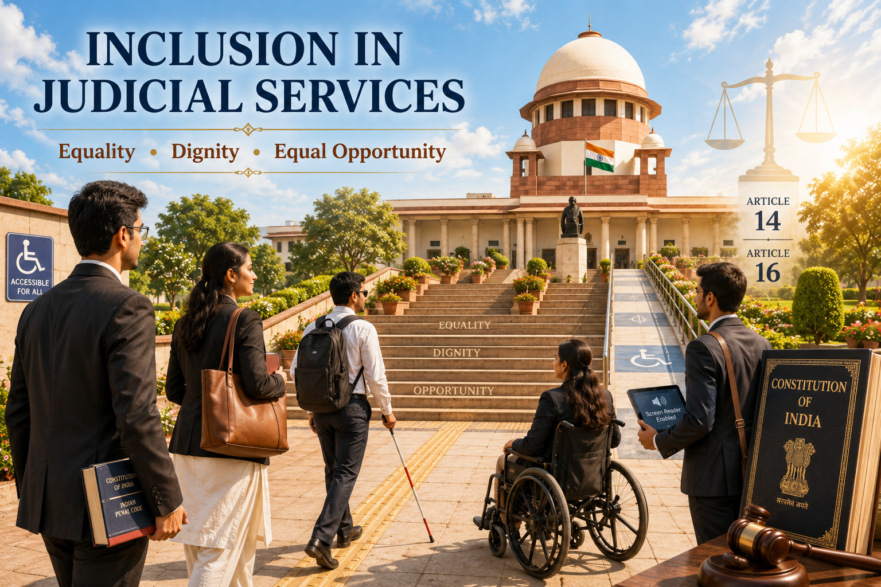
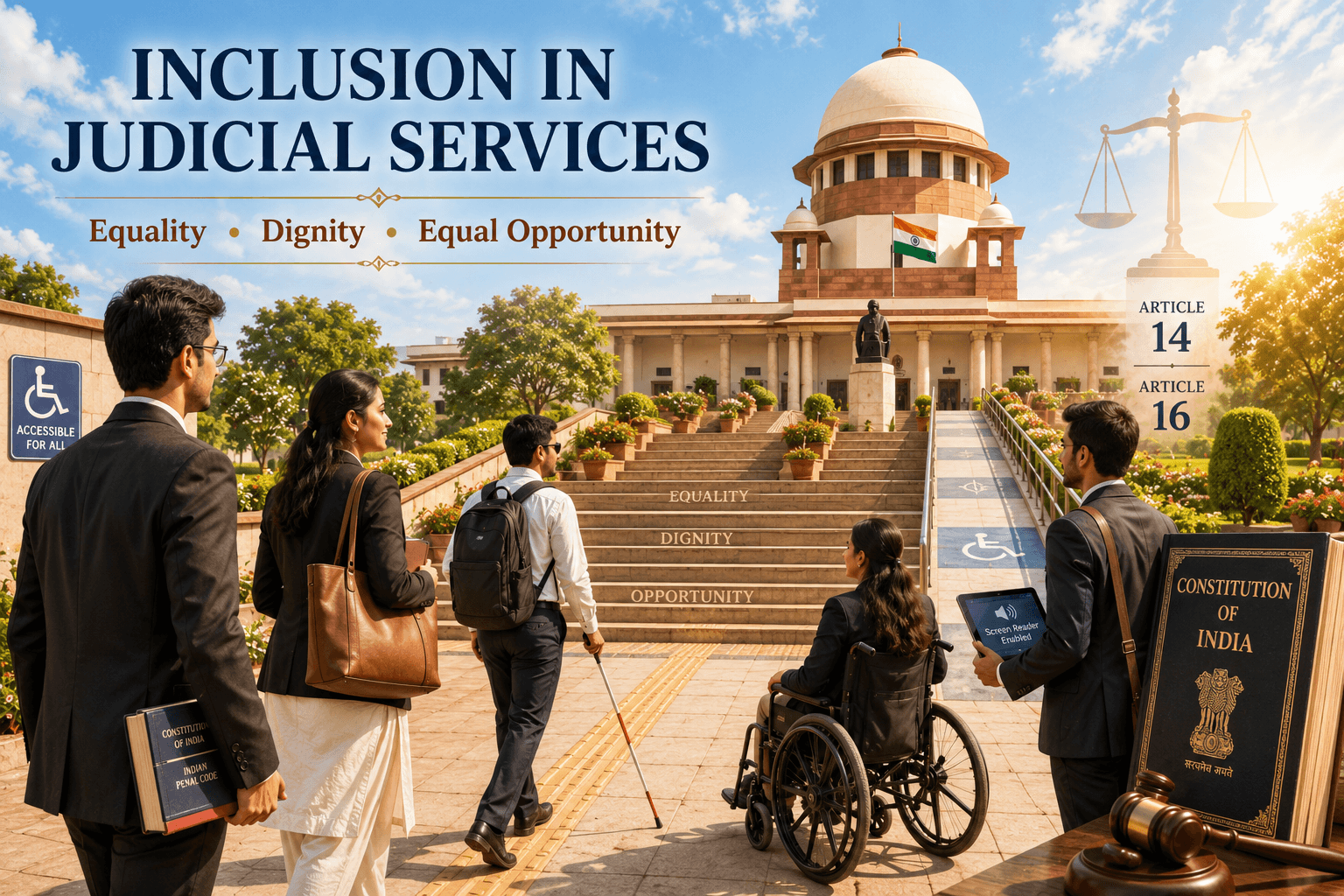
Inclusion of Persons with Disabilities in Judicial Services: Supreme Court's Landmark Judgment
The inclusion of Persons with Disabilities (PwD) in judicial services is an important aspect of equality, non-discrimination and access to justice. In a landmark judgment delivered on 3 March 2025, the Supreme Court of India held that visually impaired candidates cannot be treated as unsuitable for judicial service merely because of their disability. The Court struck down exclusionary recruitment rules and emphasised the constitutional principle of reasonable accommodation and substantive equality.
Why in News?
In In Re: Recruitment of Visually Impaired in Judicial Services, the Supreme Court examined rules governing the recruitment of persons with disabilities to judicial services, particularly provisions in the Madhya Pradesh Judicial Service Rules that excluded visually impaired candidates from consideration. The proceedings were also connected with a separate matter concerning the recruitment of PwD candidates in the Rajasthan Judicial Service.
The Supreme Court held that visually impaired candidates are eligible to participate in judicial service examinations and that disability, by itself, cannot be treated as evidence that a candidate is unsuitable to become a judicial officer. The Court emphasised that equality requires the State to provide appropriate accommodation and remove discriminatory barriers to participation.
Case at a Glance
| Particular | Details |
|---|---|
| Case | In Re: Recruitment of Visually Impaired in Judicial Services |
| Date of Judgment | 3 March 2025 |
| Case Number | Suo Motu Writ Petition (Civil) No. 2 of 2024 |
| Bench | Justice J.B. Pardiwala and Justice R. Mahadevan |
| Important Laws | Articles 14, 16 and 21 of the Constitution; Rights of Persons with Disabilities Act, 2016 |
| Related Matter | In Re: Recruitment of PwD Candidates in Rajasthan Judicial Services |
Background of the Case
The Supreme Court took suo motu cognizance after receiving a letter from the mother of a visually impaired judicial service aspirant. The petition challenged an amendment to the Madhya Pradesh Judicial Service (Recruitment and Conditions of Service) Rules, 1994, under which visually impaired and low-vision candidates were excluded from appointment to judicial service.
The matter raised a fundamental question: Can a person who is visually impaired be considered inherently unsuitable for appointment as a judicial officer?
The Court answered this question in the negative. It held that a candidate's disability cannot, by itself, be used as a basis for excluding the candidate from the recruitment process when the person possesses the requisite educational qualifications.
The Madhya Pradesh Rules Under Challenge
The controversy arose primarily from Rule 6A of the Madhya Pradesh Judicial Service Rules, 1994, as amended in 2023. The rule excluded visually impaired and low-vision candidates from judicial service.
Another important provision was Rule 7, which imposed additional requirements relating to judicial service eligibility, including either a period of practice or a specified level of academic performance in the first attempt. The Supreme Court examined whether applying such requirements identically to PwD candidates could result in indirect discrimination.
Constitutional Provisions Involved
| Provision | Relevance |
|---|---|
| Article 14 | Guarantees equality before the law and equal protection of laws. |
| Article 16 | Guarantees equality of opportunity in matters of public employment. |
| Article 21 | Protects life and personal liberty and encompasses dignity and substantive equality. |
Article 14 and Substantive Equality
Article 14 does not merely require the State to treat everyone identically. In appropriate circumstances, achieving genuine equality may require the State to recognise differences in circumstances and provide additional support or accommodation.
This principle is particularly important in the context of persons with disabilities. Applying an apparently identical rule to candidates who face substantially different barriers may produce discriminatory outcomes. The Supreme Court therefore approached the issue through the concept of substantive equality.
Key Principle
Formal equality means treating everyone alike; substantive equality seeks to ensure that people actually have an equal opportunity to participate.
Article 16 and Equal Opportunity in Public Employment
Article 16(1) guarantees equality of opportunity for all citizens in matters relating to employment or appointment to an office under the State. Judicial service is a form of public employment and therefore falls within the constitutional guarantee of equality of opportunity.
The Supreme Court's judgment reinforces the principle that recruitment rules cannot create arbitrary barriers that exclude otherwise qualified candidates solely because of disability.
Rights of Persons with Disabilities Act, 2016
The Rights of Persons with Disabilities Act, 2016 (RPwD Act) provides the statutory framework for protecting the rights of persons with disabilities and promoting their inclusion in education, employment and public life.
The Act adopts a rights-based approach rather than treating disability merely as a medical condition. The Supreme Court relied extensively on this framework while examining the validity of exclusionary judicial recruitment rules.
Reasonable Accommodation
Reasonable accommodation is one of the central concepts in disability rights jurisprudence. It requires appropriate modifications, adjustments or support measures that enable persons with disabilities to participate on an equal basis with others, provided that such measures do not impose a disproportionate or undue burden.
In the context of judicial service examinations, reasonable accommodation may include appropriate examination facilities, assistive technology, accessible material, additional time where applicable, and other measures necessary to ensure that disability does not itself become a barrier to participation.
The Supreme Court treated reasonable accommodation as an essential component of substantive equality rather than as a matter of administrative charity or discretion.
The Court's Rights-Based Approach
The Court emphasised that persons with disabilities should not be viewed through a lens of sympathy or charity. The constitutional approach must instead be based on equality, dignity, autonomy, inclusion and equal opportunity.
The judgment therefore rejected the assumption that visual impairment automatically makes a person incapable of performing judicial functions. Suitability must be assessed on the basis of the candidate's actual ability to perform the functions of the post, taking reasonable accommodation into account.
The Core Constitutional Question
Can disability alone be treated as proof of unsuitability for public employment?
The Supreme Court's answer was clear: no. A visually impaired candidate possessing the necessary educational qualifications cannot be excluded from judicial service merely because of visual impairment.
What Did the Supreme Court Hold?
The Supreme Court categorically rejected the idea that visual impairment, by itself, makes a candidate unsuitable for judicial service. It held that blanket exclusion of visually impaired candidates from judicial recruitment violates the constitutional guarantees of equality and equal opportunity.
The Court therefore struck down the exclusionary provision contained in the Madhya Pradesh Judicial Service Rules and directed that visually impaired candidates must be permitted to participate in the recruitment process, subject to the applicable requirements and reasonable accommodation.
Core Ruling
A disability cannot be treated as an automatic disqualification for judicial service. The suitability of a candidate must be assessed on the basis of their ability to perform the functions of the post, with reasonable accommodation wherever required.
Striking Down the Blanket Exclusion
The Court found that a rule excluding visually impaired and low-vision candidates from judicial service merely on account of their disability was inconsistent with the constitutional guarantee of equality.
Such an exclusion effectively creates a presumption that every visually impaired person is incapable of performing judicial functions. The Court rejected this approach and emphasised that eligibility must be determined through an individualised assessment rather than a blanket assumption about disability.
The judgment therefore represents an important shift from a medical model of disability, which focuses on an individual's impairment, towards a rights-based and social model, which focuses on removing barriers that prevent persons with disabilities from participating equally in society.
Rajasthan Judicial Service: Separate Cut-Offs for PwD Candidates
The judgment is particularly significant for Rajasthan Judicial Service aspirants because the Supreme Court also dealt with the issue of recruitment of Persons with Disabilities in the Rajasthan Judicial Service.
The Court directed that candidates belonging to the PwD category should not be required to compete on the same cut-off as candidates in the general category in a manner that defeats the purpose of reservation and substantive equality. The Court directed the authorities to provide a separate cut-off for PwD candidates, consistent with the statutory framework governing reservation and disability rights.
This is particularly relevant for judiciary aspirants because recruitment rules must be interpreted in a manner that gives meaningful effect to the rights guaranteed to persons with disabilities.
Reasonable Accommodation is a Right, Not a Favour
A major contribution of the judgment is its treatment of reasonable accommodation as an essential component of equality.
Reasonable accommodation means making appropriate adjustments to enable persons with disabilities to participate equally. It does not mean lowering professional standards or compromising the essential functions of a judicial officer. Rather, it seeks to remove unnecessary barriers that have no legitimate connection with a candidate's ability to perform the job.
| Without Reasonable Accommodation | With Reasonable Accommodation |
|---|---|
| Identical conditions may create unequal opportunities. | Necessary adjustments enable meaningful participation. |
| Disability itself becomes a barrier. | Focus shifts to the candidate's actual ability. |
| Formal equality. | Substantive equality. |
Indirect Discrimination
The judgment also illustrates the concept of indirect discrimination. A rule may appear neutral on its face but may disproportionately disadvantage persons belonging to a particular group.
For example, a recruitment requirement that is formally identical for all candidates may nevertheless create a disproportionate barrier for persons with disabilities. In such circumstances, merely arguing that "the same rule applies to everyone" is insufficient to establish substantive equality.
Exam Point
Formal equality asks whether everyone has been treated in the same manner. Substantive equality asks whether the treatment actually provides an equal opportunity to participate.
Rights of Persons with Benchmark Disabilities
The Rights of Persons with Disabilities Act, 2016 uses the concept of a "person with benchmark disability" for several statutory benefits, including specified reservation provisions.
Under the Act, a person with benchmark disability generally refers to a person with not less than 40% of a specified disability, where the specified disability has been certified by the appropriate authority.
The Act seeks to ensure that persons with disabilities are able to participate in education, employment and public life on an equal basis with others.
Why is the Judgment Important?
- It strengthens equality of opportunity in public employment.
- It prevents blanket exclusion of visually impaired candidates from judicial services.
- It reinforces the principle of reasonable accommodation.
- It promotes substantive rather than merely formal equality.
- It recognises disability rights as constitutional rights rather than matters of charity or sympathy.
- It has direct significance for recruitment to judicial services, including the Rajasthan Judicial Service.
- It strengthens implementation of the Rights of Persons with Disabilities Act, 2016.
Significance for Judicial Services
The judgment carries particular significance because the judiciary itself is an institution responsible for protecting constitutional rights. Excluding qualified persons with disabilities from becoming judicial officers merely because of their disability would undermine the constitutional commitment to equality and inclusion.
The Court's approach therefore goes beyond recruitment policy. It sends a broader constitutional message that institutions of the State must themselves reflect the principles of equality, dignity and inclusion that they are constitutionally bound to protect.
Exam Focus
Prelims
- Article 14 – Equality before law and equal protection of laws.
- Article 16 – Equality of opportunity in public employment.
- Article 21 – Right to life and dignity.
- Rights of Persons with Disabilities Act, 2016.
- Concept of reasonable accommodation.
- Concept of benchmark disability.
- 73rd and 104th Constitutional Amendments should not be confused with disability reservation provisions.
Mains / Interview
- Substantive equality versus formal equality.
- Reasonable accommodation as a component of Article 14.
- Disability rights and equality of opportunity under Article 16.
- Role of the judiciary in eliminating structural discrimination.
- Inclusion of persons with disabilities in judicial services.
Key Takeaways
- The Supreme Court's judgment was delivered on 3 March 2025 in In Re: Recruitment of Visually Impaired in Judicial Services.
- Blanket exclusion of visually impaired candidates from judicial services is incompatible with Articles 14 and 16.
- Disability cannot be treated as automatic proof of professional unsuitability.
- Reasonable accommodation is an important component of substantive equality.
- The judgment is connected with the recruitment of PwD candidates in the Rajasthan Judicial Service.
- The Rights of Persons with Disabilities Act, 2016 provides the principal statutory framework for disability rights.
- The judgment reflects a shift from a charity-based approach to a rights-based approach towards persons with disabilities.
Conclusion
The Supreme Court's decision in In Re: Recruitment of Visually Impaired in Judicial Services is a significant step towards making public employment genuinely inclusive. By rejecting blanket exclusion and emphasising reasonable accommodation, the Court reaffirmed that equality does not always mean identical treatment. Instead, constitutional equality may require the State to remove barriers that prevent persons with disabilities from enjoying equal opportunities.
For judicial services in particular, the judgment carries special significance. A constitutional institution entrusted with protecting equality and fundamental rights must itself embody those values. The decision therefore represents not merely a ruling on recruitment rules, but an important affirmation of dignity, inclusion, substantive equality and equal opportunity in India's constitutional democracy.
Frequently Asked Questions (FAQs)
1. Which Supreme Court case dealt with visually impaired candidates in judicial services?
The Supreme Court dealt with the issue in In Re: Recruitment of Visually Impaired in Judicial Services, decided on 3 March 2025.
2. Can visually impaired candidates be excluded from judicial services solely because of their disability?
No. The Supreme Court rejected blanket exclusion based solely on visual impairment and held that disability cannot automatically be treated as proof of unsuitability.
3. What is reasonable accommodation?
Reasonable accommodation refers to appropriate adjustments or modifications that enable persons with disabilities to participate equally, without imposing a disproportionate or undue burden.
4. Which Fundamental Rights are particularly relevant to the judgment?
Articles 14 and 16 are central to the judgment, while Article 21 also informs the broader constitutional principles of dignity and inclusion.
5. Which legislation protects the rights of persons with disabilities in India?
The Rights of Persons with Disabilities Act, 2016 is the principal legislation governing disability rights in India.
6. Why is this judgment particularly relevant for RJS aspirants?
The judgment includes a connected matter concerning recruitment of PwD candidates in the Rajasthan Judicial Service and raises important issues involving Articles 14 and 16, reservation, reasonable accommodation and disability rights.
📘 Stay Ahead with Delhi Law Academy!
Get access to free monthly current affairs, read our insightful blogs,
and explore free study resources prepared by experts at DLA Jaipur. 🚀