
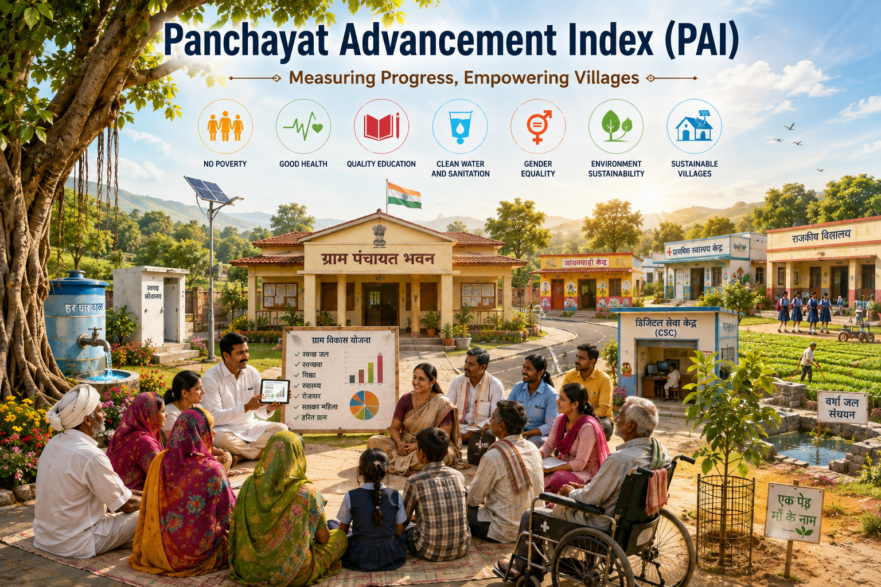
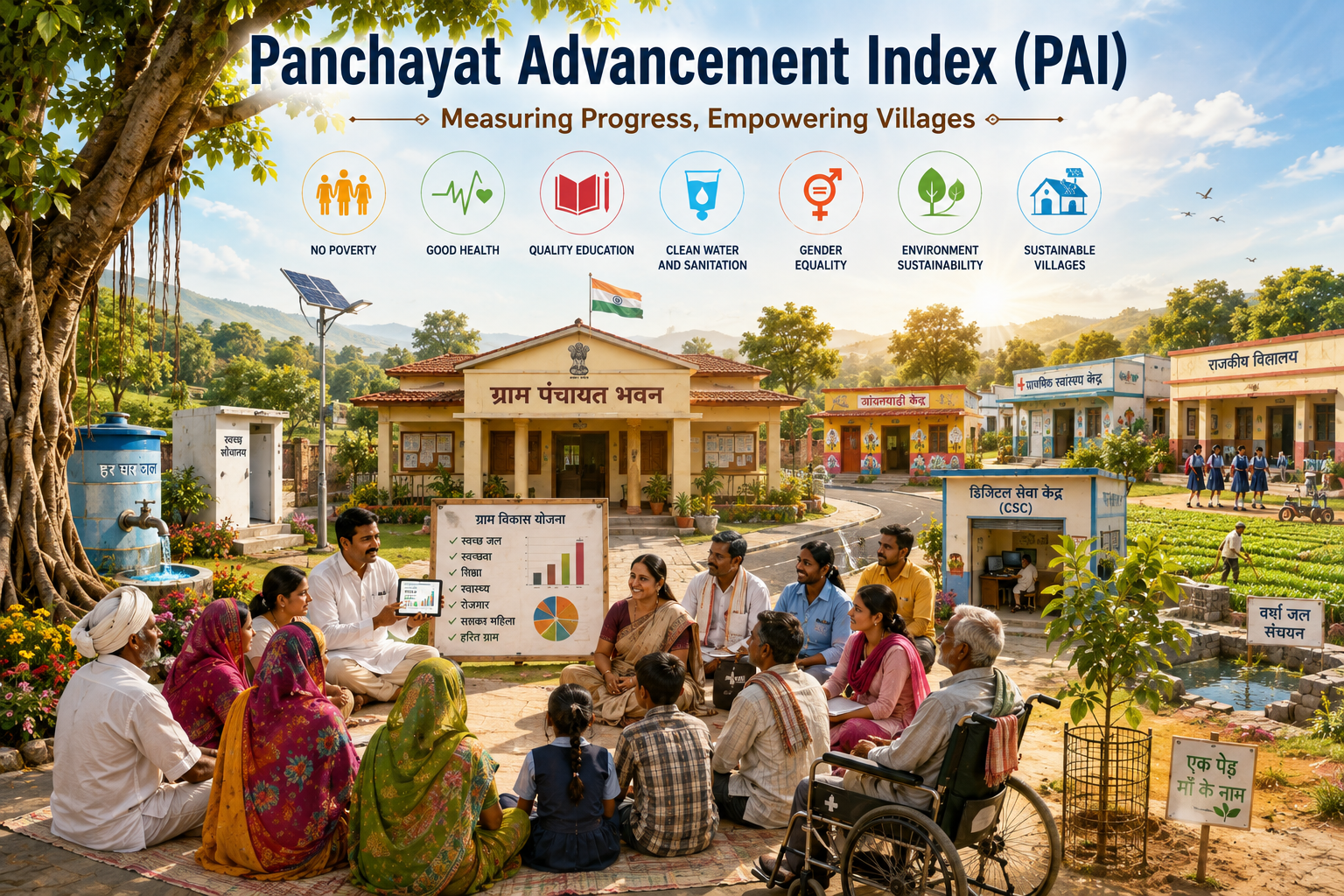
Panchayat Advancement Index (PAI): Measuring the Performance of Gram Panchayats
The Panchayat Advancement Index (PAI) is an important governance initiative of the Government of India aimed at strengthening grassroots democracy through evidence-based planning and performance assessment. By measuring the development outcomes achieved by Gram Panchayats across various sectors, the Index encourages better governance, accountability, and sustainable rural development.
Why in News?
The Government of India has developed the Panchayat Advancement Index (PAI) to assess the performance of Gram Panchayats across the country. The Index aims to strengthen evidence-based governance, improve service delivery, and encourage Panchayats to achieve measurable development outcomes aligned with the Sustainable Development Goals (SDGs).
What is the Panchayat Advancement Index (PAI)?
The Panchayat Advancement Index (PAI) is a comprehensive performance assessment framework developed by the Ministry of Panchayati Raj to evaluate the functioning and developmental progress of Gram Panchayats. Instead of merely assessing financial expenditure or scheme implementation, the Index measures the actual outcomes achieved by Panchayats in improving the quality of life of rural citizens.
The Index aligns local governance with India's commitment to achieving the United Nations Sustainable Development Goals (SDGs) by encouraging Panchayats to adopt outcome-oriented planning and monitoring.
Nodal Ministry
Ministry of Panchayati Raj, Government of India.
Objectives of the Panchayat Advancement Index
The Panchayat Advancement Index has been designed to promote effective local governance and improve development outcomes at the grassroots level.
- Improve governance and public service delivery at the village level.
- Promote evidence-based and outcome-oriented planning.
- Encourage transparency, accountability, and good governance.
- Strengthen Panchayati Raj Institutions as institutions of local self-government.
- Facilitate better monitoring of rural development programmes.
- Support India's progress towards achieving the Sustainable Development Goals (SDGs).
Assessment Areas
The Panchayat Advancement Index evaluates Gram Panchayats across multiple dimensions of rural development. These indicators collectively measure the overall quality of governance and developmental progress.
| Theme | Focus Area |
|---|---|
| Poverty Reduction | Livelihoods, income enhancement and social protection. |
| Health | Healthcare services, nutrition and public health. |
| Education | School education, literacy and learning outcomes. |
| Water & Sanitation | Safe drinking water, sanitation and hygiene. |
| Gender Equality | Women's participation and empowerment. |
| Environment | Natural resource management and sustainability. |
| Infrastructure | Roads, electricity, housing and digital connectivity. |
| Social Justice | Inclusion, welfare and protection of vulnerable groups. |
| Local Economic Development | Employment generation, entrepreneurship and local economy. |
Constitutional Background
The constitutional foundation of Panchayati Raj Institutions was laid through the 73rd Constitutional Amendment Act, 1992, which transformed Panchayats into constitutional bodies and strengthened democratic decentralisation in India.
| Provision | Details |
|---|---|
| 73rd Constitutional Amendment Act, 1992 | Conferred constitutional status on Panchayati Raj Institutions. |
| Part IX | Articles 243 to 243-O dealing with Panchayats. |
| Eleventh Schedule | Contains 29 subjects that may be devolved to Panchayats. |
How Does the Panchayat Advancement Index Work?
The Panchayat Advancement Index (PAI) is designed as an outcome-based assessment tool rather than merely measuring financial expenditure or the number of schemes implemented. It evaluates whether Gram Panchayats are actually improving the quality of life of rural citizens through better governance and service delivery.
The Index enables Panchayats to identify development gaps, prioritize interventions, and prepare evidence-based Gram Panchayat Development Plans (GPDPs).
Link with Sustainable Development Goals (SDGs)
One of the unique features of the Panchayat Advancement Index is that it aligns local governance with the United Nations Sustainable Development Goals (SDGs). Since Panchayats are responsible for delivering many essential public services, their performance directly contributes to India's progress towards achieving the SDGs by 2030.
| PAI Theme | Related SDGs |
|---|---|
| Poverty Reduction | SDG 1 – No Poverty |
| Health | SDG 3 – Good Health and Well-being |
| Education | SDG 4 – Quality Education |
| Gender Equality | SDG 5 – Gender Equality |
| Water & Sanitation | SDG 6 – Clean Water and Sanitation |
| Infrastructure & Economy | SDGs 8, 9 & 11 |
| Environment | SDGs 13, 14 & 15 |
Significance of the Panchayat Advancement Index
The Panchayat Advancement Index represents a shift from expenditure-based governance to results-oriented governance. It encourages Panchayats to focus on measurable developmental outcomes rather than merely implementing government schemes.
- Improves the quality of public service delivery.
- Encourages evidence-based planning and informed decision-making.
- Promotes transparency, accountability and good governance.
- Strengthens democratic decentralisation and local self-government.
- Facilitates effective monitoring of rural development programmes.
- Supports India's commitment towards achieving the Sustainable Development Goals.
- Encourages healthy competition among Gram Panchayats for better governance.
Challenges
- Variations in administrative capacity across Panchayats.
- Limited availability and reliability of village-level data.
- Inadequate financial and technical resources in many rural areas.
- Differences in digital infrastructure affecting data collection.
- Need for regular capacity-building of elected Panchayat representatives.
- Variations in devolution of powers across States.
Way Forward
- Strengthen data collection and digital governance systems.
- Enhance capacity-building programmes for Panchayat representatives.
- Increase financial and functional devolution to Panchayats.
- Promote citizen participation through Gram Sabhas.
- Integrate PAI findings into Gram Panchayat Development Plans (GPDPs).
- Regularly monitor progress using measurable performance indicators.
Exam Focus
Prelims
- Panchayat Advancement Index (PAI).
- 73rd Constitutional Amendment Act, 1992.
- Part IX of the Constitution.
- Articles 243–243O.
- Eleventh Schedule (29 Subjects).
- Gram Panchayat Development Plan (GPDP).
- Sustainable Development Goals (SDGs).
Mains / Interview
- Role of Panchayati Raj Institutions in democratic decentralisation.
- Importance of evidence-based governance at the grassroots.
- Contribution of Panchayats towards achieving the SDGs.
- Challenges in strengthening local self-government in India.
Key Takeaways
- The Panchayat Advancement Index is a performance assessment framework developed by the Ministry of Panchayati Raj.
- It measures the developmental performance of Gram Panchayats through outcome-based indicators.
- The Index aligns rural governance with the Sustainable Development Goals.
- It promotes transparency, accountability and evidence-based planning.
- The constitutional foundation of Panchayats lies in the 73rd Constitutional Amendment and Part IX of the Constitution.
- The PAI aims to strengthen grassroots democracy and improve rural governance across India.
Conclusion
The Panchayat Advancement Index marks an important step towards strengthening local self-government through measurable and evidence-based governance. By assessing Gram Panchayats on development outcomes rather than merely financial inputs, the Index encourages better planning, greater accountability and improved public service delivery. As India continues to pursue inclusive and sustainable rural development, the PAI has the potential to become a valuable instrument for empowering Panchayati Raj Institutions and achieving the Sustainable Development Goals at the grassroots level.
Frequently Asked Questions (FAQs)
1. What is the Panchayat Advancement Index (PAI)?
The Panchayat Advancement Index is a performance assessment framework developed by the Ministry of Panchayati Raj to evaluate the developmental performance of Gram Panchayats.
2. Which Ministry developed the PAI?
The Ministry of Panchayati Raj, Government of India.
3. Which Constitutional Amendment gave constitutional status to Panchayats?
The 73rd Constitutional Amendment Act, 1992.
4. Which Part of the Constitution deals with Panchayats?
Part IX (Articles 243 to 243-O).
5. How many subjects are included in the Eleventh Schedule?
The Eleventh Schedule contains 29 subjects that may be devolved to Panchayats.
6. Why is the Panchayat Advancement Index important?
It promotes evidence-based governance, improves accountability, strengthens grassroots democracy, and aligns Panchayat performance with the Sustainable Development Goals.
📘 Stay Ahead with Delhi Law Academy!
Get access to free monthly current affairs, read our insightful blogs,
and explore free study resources prepared by experts at DLA Jaipur. 🚀