
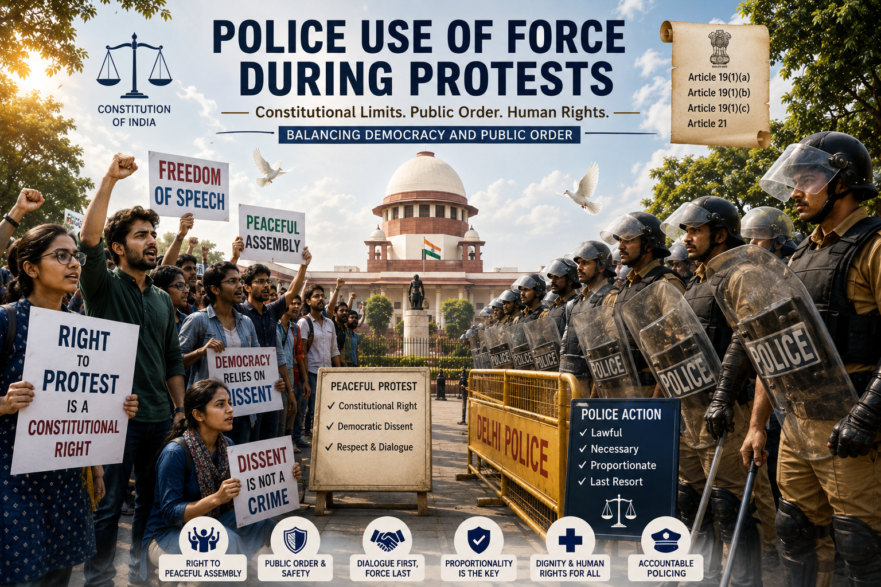
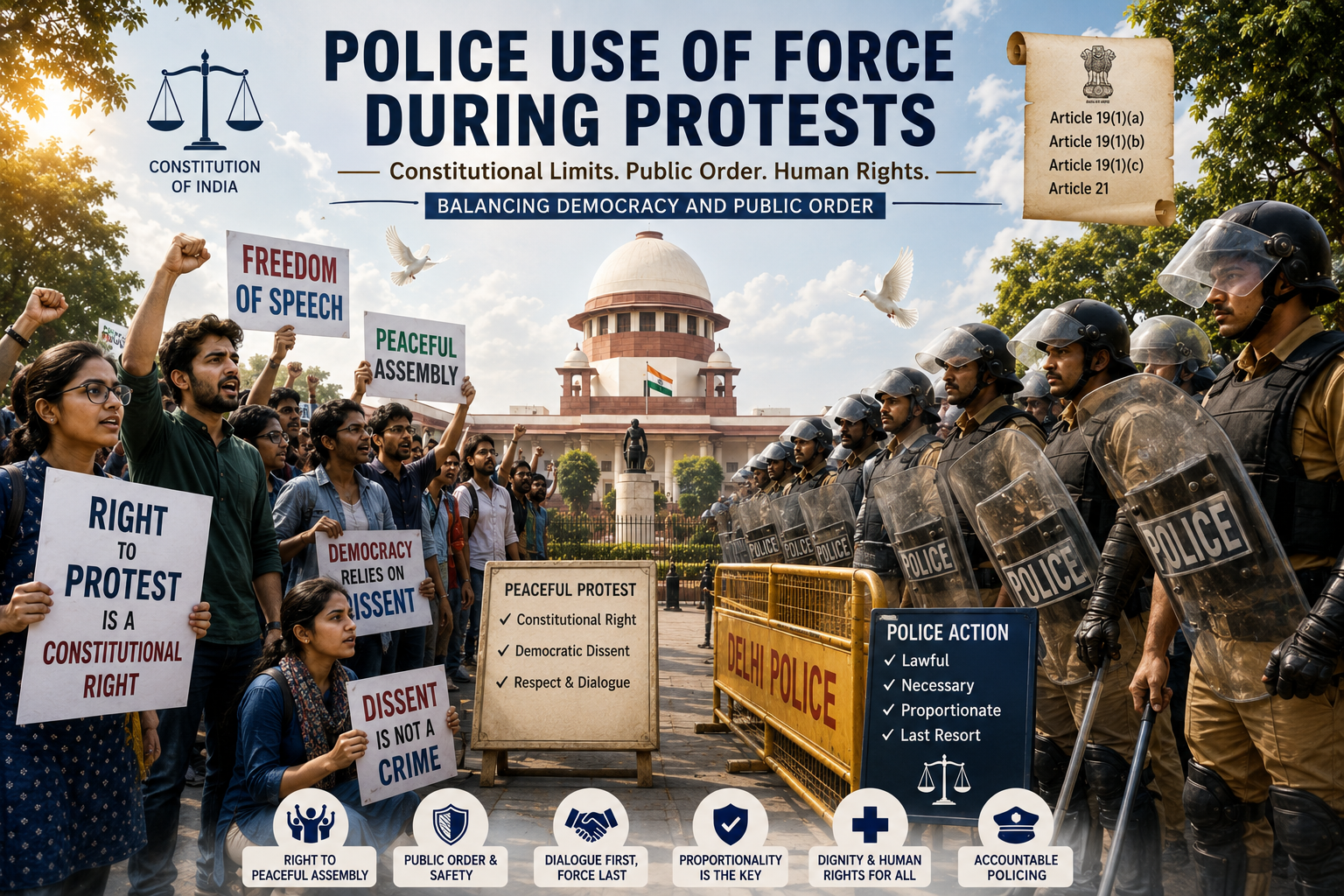
Police Use of Force During Protests in India: Constitutional Limits & Supreme Court Guidelines
Peaceful protests are one of the strongest expressions of democracy. The Constitution of India guarantees citizens the right to express their opinions, assemble peacefully, and voice dissent against government policies. At the same time, the State has a constitutional duty to maintain public order, protect life and property, and ensure that protests do not turn violent. Balancing these competing interests often becomes one of the most challenging tasks for law enforcement agencies and constitutional courts.
Why in News?
The Supreme Court recently heard petitions concerning the alleged use of force by the Delhi Police during student protests over the NEET Paper Leak. During the hearing, the Court observed that "Agitation does not mean lathi-charge", emphasizing that while police are empowered to maintain law and order, any use of force must remain lawful, necessary, and proportionate. The Court also directed that injured protesters receive appropriate medical treatment.
Right to Protest: A Constitutional Right
The Constitution does not explicitly mention the "Right to Protest." However, the Supreme Court has consistently held that the right to peacefully protest is derived from several Fundamental Rights guaranteed under Part III of the Constitution.
| Article | Constitutional Right |
|---|---|
| Article 19(1)(a) | Freedom of Speech and Expression. |
| Article 19(1)(b) | Right to assemble peacefully and without arms. |
| Article 19(1)(c) | Freedom to form associations or unions. |
| Article 21 | Protection of life and personal liberty, including the right to live with dignity. |
The Supreme Court has repeatedly recognised that peaceful dissent is an essential component of democracy. Citizens have the right to express disagreement with governmental policies, provided such protests remain peaceful and within the limits prescribed by law.
Are These Rights Absolute?
No. The freedoms guaranteed under Article 19 are subject to reasonable restrictions. The Constitution authorises the State to regulate protests whenever such restrictions become necessary to protect larger public interests.
| Provision | Grounds of Restriction |
|---|---|
| Article 19(2) | Security of the State, sovereignty, public order, decency, morality, contempt of court, defamation and incitement to an offence. |
| Article 19(3) | Reasonable restrictions on peaceful assemblies in the interest of public order and sovereignty of India. |
Police Powers During Public Protests
The police have a statutory duty to maintain law and order, prevent violence, safeguard public property, and ensure the safety of both protesters and the general public. However, these powers must always be exercised in accordance with constitutional principles and established legal procedures.
Depending upon the situation, police may:
- Regulate the route and location of protests.
- Issue lawful directions to maintain public order.
- Disperse unlawful assemblies where permitted by law.
- Arrest persons committing cognizable offences.
- Use minimum necessary force when absolutely unavoidable.
Fundamental Principle
The use of force by police is considered a measure of last resort. Before resorting to physical force, authorities are expected to attempt dialogue, persuasion, warnings, and other non-violent methods for maintaining public order.
Doctrine of Proportionality
One of the most important constitutional principles governing police action is the Doctrine of Proportionality. Under this doctrine, any restriction imposed on Fundamental Rights must be proportionate to the objective sought to be achieved.
In the context of public protests, this means that police action should always be:
- Lawful.
- Necessary.
- Reasonable.
- Proportionate to the threat faced.
- The least restrictive measure available.
For example, a peaceful demonstration generally cannot justify immediate use of lathi-charge or other coercive measures unless there is an imminent threat to public safety.
Important Supreme Court Judgments
| Case | Principle Established |
|---|---|
| Himat Lal K. Shah v. Commissioner of Police (1973) | Citizens possess a constitutional right to hold public meetings, subject to reasonable regulation. |
| Ramlila Maidan Incident v. Home Secretary (2012) | Police force must be reasonable, proportionate and exercised only when absolutely necessary. |
| Mazdoor Kisan Shakti Sangathan v. Union of India (2018) | Balanced the right to protest with the rights of residents and commuters. |
When Can Police Use Force During Protests?
The law does not prohibit the use of force by the police. However, force may be used only when it becomes absolutely necessary to prevent violence, disperse an unlawful assembly, protect life and property, or restore public order. Courts have consistently held that the degree of force employed must always be proportionate to the situation.
Before resorting to physical force, police authorities are generally expected to:
- Engage in dialogue with protest organisers.
- Issue clear warnings to disperse.
- Provide sufficient opportunity for voluntary compliance.
- Use non-violent crowd-control measures wherever possible.
- Resort to force only if peaceful methods fail.
Lathi-Charge: Is It Legal?
A lathi-charge is not specifically defined under any statute but is recognised as one of the methods available to law enforcement agencies for dispersing unlawful assemblies. Since it directly affects the fundamental rights of citizens, courts have repeatedly emphasised that it must be used only in exceptional circumstances.
Supreme Court Observation
During the recent hearing relating to the Delhi student protest, the Supreme Court observed that "Agitation does not mean lathi-charge." The observation reinforces the constitutional principle that peaceful protest cannot automatically justify the use of physical force by the police.
Use of Tear Gas, Water Cannons and Pellet Guns
Modern crowd-control techniques include tear gas shells, water cannons, rubber bullets, pellet guns and other non-lethal measures. These methods are intended to minimise fatalities while restoring public order. However, they too must satisfy the constitutional requirement of proportionality.
Courts have repeatedly stressed that even non-lethal weapons may violate Article 21 if used indiscriminately or without necessity.
| Crowd Control Measure | Legal Principle |
|---|---|
| Verbal Warnings | Preferred first response. |
| Barricading | Preventive and minimally restrictive. |
| Water Cannons | Permissible where proportionate. |
| Tear Gas | May be used where necessary to disperse violent crowds. |
| Lathi-Charge | Measure of last resort. |
| Firearms | Only in the rarest situations involving imminent threat to life. |
Rights of Protesters
Even where police disperse an unlawful assembly, every individual continues to enjoy constitutional protections under Article 21. Police action must respect human dignity and follow due process.
- Right to life and personal liberty.
- Protection against arbitrary arrest.
- Access to medical treatment if injured.
- Right to legal representation.
- Protection against custodial violence.
- Fair investigation into allegations of excessive force.
International Standards
International human rights principles also recognise the right to peaceful assembly while permitting limited use of force only when absolutely necessary.
| Instrument | Key Principle |
|---|---|
| Universal Declaration of Human Rights (UDHR) | Freedom of peaceful assembly. |
| International Covenant on Civil and Political Rights (ICCPR) | Restrictions must be lawful, necessary and proportionate. |
| UN Basic Principles on the Use of Force by Law Enforcement Officials | Minimum force, necessity and accountability. |
Balancing Rights and Public Order
Courts have consistently emphasised that neither the right to protest nor the duty of the State to maintain public order is absolute. A constitutional democracy requires a careful balance between individual freedoms and collective security. Police authorities must act with restraint, while protesters must exercise their rights peacefully and responsibly.
Way Forward
- Prioritise dialogue and mediation before using force.
- Provide regular training to police on constitutional rights and crowd management.
- Use body cameras and video recording to enhance transparency and accountability.
- Ensure prompt medical assistance to injured protesters.
- Conduct independent inquiries into allegations of excessive force.
- Strengthen public confidence through transparent policing and respect for civil liberties.
Exam Focus
Prelims
- Articles 19(1)(a), 19(1)(b), 19(2), 19(3) and 21.
- Doctrine of Proportionality.
- Reasonable Restrictions.
- Rights of peaceful assembly.
- Police powers relating to unlawful assemblies.
- Himat Lal Shah, Ramlila Maidan and Mazdoor Kisan Shakti Sangathan cases.
Mains / Interview
- Right to protest in a constitutional democracy.
- Balancing civil liberties with public order.
- Judicial control over police use of force.
- Doctrine of proportionality in policing.
Key Takeaways
- The right to peaceful protest flows from Articles 19 and 21 of the Constitution.
- Police possess the legal authority to maintain public order but must exercise restraint.
- Use of force must satisfy the tests of legality, necessity and proportionality.
- Lathi-charge is a measure of last resort and cannot be the default response to peaceful protests.
- The Supreme Court has repeatedly affirmed that democratic dissent deserves constitutional protection.
- Transparency, accountability and respect for human rights are essential for constitutional policing.
Conclusion
The recent Supreme Court observations on the Delhi Police's handling of student protests reaffirm an important constitutional principle: democracy flourishes when citizens are free to express dissent peacefully, and the State responds with restraint and respect for the rule of law. While maintaining public order is a legitimate governmental responsibility, any use of force must remain lawful, proportionate and accountable. The constitutional balance between civil liberties and public order ultimately strengthens both democratic governance and public confidence in law enforcement.
Frequently Asked Questions (FAQs)
1. Is the right to protest a Fundamental Right?
Yes. It flows primarily from Articles 19(1)(a), 19(1)(b), 19(1)(c) and is protected subject to reasonable restrictions.
2. Can police use lathi-charge on peaceful protesters?
No. Courts have consistently held that force should be used only when absolutely necessary and must always be proportionate to the situation.
3. What is the Doctrine of Proportionality?
It requires that any restriction on Fundamental Rights or use of force must be lawful, necessary, reasonable and proportionate to the objective sought to be achieved.
4. Which constitutional provisions are most relevant to public protests?
Articles 19(1)(a), 19(1)(b), 19(2), 19(3) and Article 21.
5. Which Supreme Court cases are important on the right to protest?
Himat Lal K. Shah v. Commissioner of Police, Ramlila Maidan Incident v. Home Secretary, and Mazdoor Kisan Shakti Sangathan v. Union of India are among the leading decisions.
6. Why is this topic important for RJS and other judiciary examinations?
It integrates constitutional law, police powers, human rights, judicial review and current affairs, making it highly relevant for prelims, mains and interviews.
📘 Stay Ahead with Delhi Law Academy!
Get access to free monthly current affairs, read our insightful blogs,
and explore free study resources prepared by experts at DLA Jaipur. 🚀