
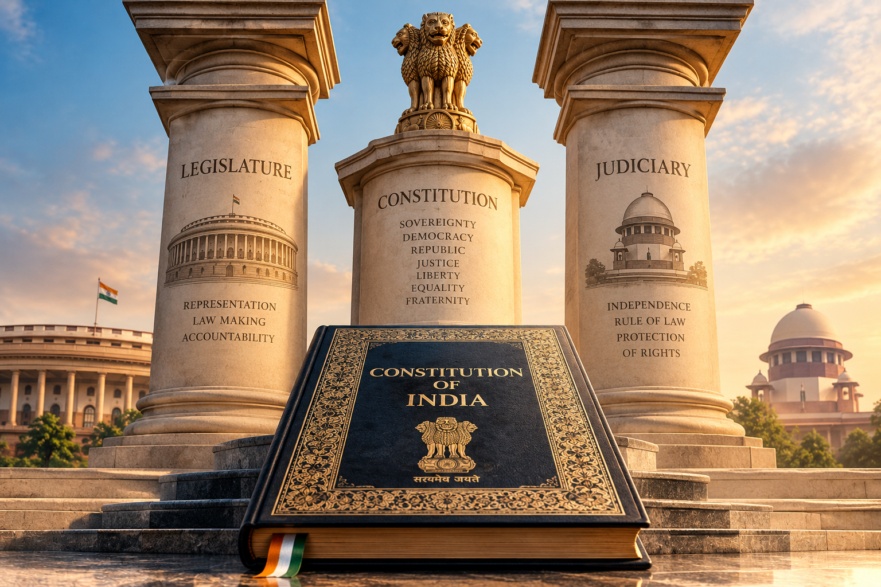
CONSTITUTIONAL PROVISIONS RELATING TO PARLIAMENT
Preparation for RJS, DJS, PCS (J) and other Judicial Service exams
CONSTITUTION OF INDIA EXPLAINED
The Constitution of India forms the bedrock of any and every Judicial Service exam in the country. Its thorough knowledge is a must for all aspirants of RJS, DJS, PCS (J) and every other Judicial Service exam. To help such aspirants DELHI LAW ACADEMY JAIPUR has launched a series of study material modules on all important aspects of this vital part of their syllabus:
PART V: PARLIAMENT
Constitution of Parliament Article 79
- Parliament consists of
- The President
- House of People
- Council of States
Composition of Council of States Article 80
- Council of States shall consist of
- 12 members to be nominated by President
- maximum of 238 members representing States and UTs
- Allocation of seats in Rajya Sabha to States and UTs
- is specified in the Fourth Schedule
Requirement for nomination:
- Special knowledge or practical experience in
- Literature
- Science
- Art
- Social service
- Representatives of a State in Rajya Sabha are to be elected
- by elected members of Legislative Assembly
- Representatives of UTs
- are to be chosen as per law made by Parliament
Composition of Lok Sabha Article 81
- Lok Sabha shall consist of
- not more than 530 members chosen by direct election
- from territorial constituencies in States
- not more than 20 members to represent UTs
- not more than 530 members chosen by direct election
- Number of seats to be allocated to each State
- is to be in proportion to its population
- Ratio between number of seats and population of the State
- should be the same for all States
- Population here is
- as determined by 1971 census
- Each State is to be divided
- into territorial constituencies
- Each constituency
- is to have practically the same population
- Population here is
- as determined by 2001 census
Readjustment after each census Article 82
- Allocation of seats to States and
- division of each State into territorial constituencies
- is to be readjusted after every census
- by an authority determined by Parliament [Delimitation Commission]
- No readjustment is now required
- till the first census taken after 2026
Duration of Houses Article 83
Council of States:
- Not subject to dissolution
- 1/3rd of its members shall retire every second year
House of People:
- Normal term: 5 years
- Expiration of 5 years shall operate as dissolution
- Can be dissolved sooner than 5 years
- During Emergency: term may be extended by Parliament by 1 year at a time
Extension of Lok Sabha term
- Term of 5th Lok Sabha was extended
- by 1 year, from March 1976 to March 1977
- by House of People (Extension of Duration) Act, 1976
📘 Free Study Material for Judiciary Aspirants!
Download our FREE study material prepared by Delhi Law Academy’s expert faculty.
Qualification for members Article 84
- Should be a citizen of India
- Should make an oath before Election Commission
- Should not be less than 30 years for RS and 25 years for LS
- Should possess other qualifications as prescribed by Parliament
Sessions of Parliament Article 85
- President to summon Houses from time to time
- 6 months shall not intervene
- between the last and first sittings of two sessions
- President to prorogue Houses from time to time
- President may dissolve Lok Sabha
Right to address and send messages to Houses Article 86
- President has the right
- to address either House of Parliament
- President has the right
- to send messages to either House, relating to a pending bill, or otherwise
Special address by President Article 87
- President shall address
- both Houses assembled together
- at the start of
- first session after each general election to LS
- first session of each calendar year
Rights of Ministers Article 88
- Every Minister has the right
- to speak in and take part in proceedings of either House
- but not entitled to vote
- Attorney General of India
- also has similar right
Officers of Council of States Article 89
- Chairman:
- Vice-President of India, ex-officio
- Deputy Chairman:
- to be chosen by the Council from amongst its members
Removal of Dy. Chairman Article 90
- Chairman to vacate his office
- if he ceases to be a member of the Council
- Removal
- by a resolution of the Council
- by a majority of all the then members of the Council
- 14 days notice to be given
- to move the resolution
Explore More Free Resources from Delhi Law Academy
Stay updated with our monthly current affairs and explore more important legal and judicial-service articles from Delhi Law Academy.
Contact us
📍 Delhi Law Academy – Jaipur Branch
6C, Tower 2, Coaching Hub, Pratap Nagar, Jaipur – 302033
📞 Phone:
+91 9911916552
+91 8447285606
✉️ Email:
contactus@delhilawacademy.com