

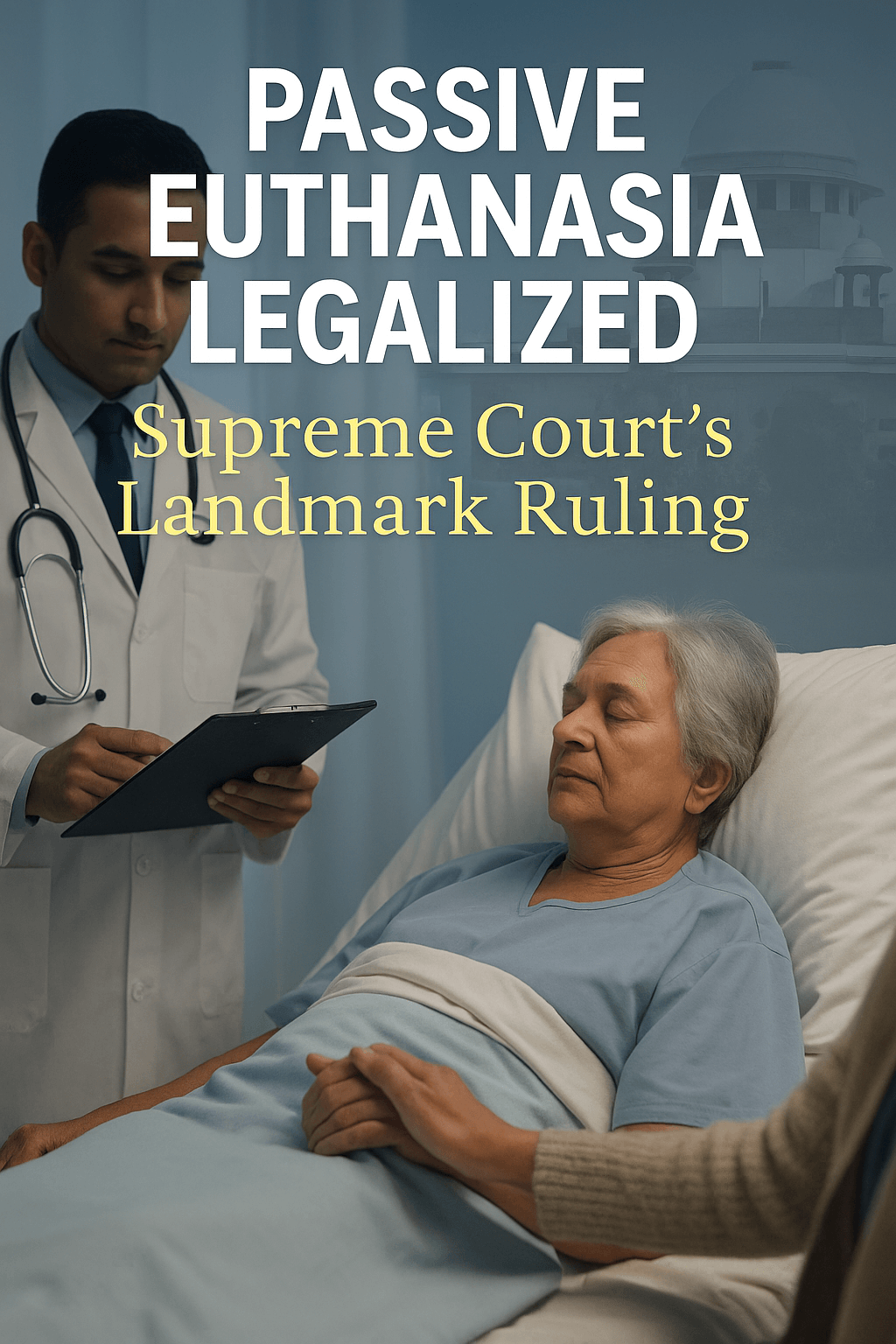
WITHDRAWL OF MEDICAL TREATMENT, INCLUDING CANH
SUPREME COURT RULING:
(i) it is established that CANH [Clinically Assisted Nutrition and Hydration] currently being administered to the applicant constitutes “medical treatment”.
(ii) it has been conclusively determined that the continued administration of the same is no longer in the “best interests” of the applicant.
Delhi Law Academy Jaipur presents below for aspirants of Rajasthan Judicial Service (RJS), DJS, PCS (J) and other Judicial Services throughout India a very important judgment of the Supreme Court of India, delivered on 11 March, 2026.
Presented below: Summarized version [by Delhi Law Academy Jaipur] of the Supreme Court Judgment in the case of Harish Rana v. Union of India [2026 INSC 222] delivered on 11 March, 2026.
Original language of the judgment has been maintained; it has not been disturbed or replaced.
This judgment comprising of 338 pages has been summarized in 4 pages by Delhi Law Academy while retaining the original language and original content.
HARISH RANA v. UNION OF INDIA [2026]
J U D G M E N T
2.
The present Miscellaneous Application (“MA”) has been filed by a mentally and physically incapacitated applicant, namely, Harish Rana, through his parents, in the captioned SLP that came to be disposed of by this Court vide order dated 08.11.2024. By way of the said order, this Court resolved the matter between the parties by ensuring that adequate care and necessary treatment are provided to the applicant, including but not limited to the provision of home care, at the expense of the respondents.
3.
The captioned SLP had arisen from the order dated 02.07.2024 passed by the High Court of Delhi in Writ Petition (C) No. 4927 of 2024, whereby the High Court had dismissed the writ petition on the ground that the applicant was not being kept alive mechanically and that he was able to sustain himself without any extra or external medical aid. In the High Court’s opinion, such a condition did not require any judicial intervention.
4.
While disposing of the captioned SLP, this Court had granted liberty to the applicant to move this Court through his parents for obtaining any further directions should it become necessary to do so. Accordingly, owing to the applicant’s continued vegetative existence, which violates his right to live with dignity as enshrined under Article 21 of the Constitution of India, the parents have moved this Court once again vide the present MA inter alia seeking: (i) constitution and referral of the applicant’s case to the primary medical board; and (ii) declaration that the provision of Clinically Assisted Nutrition and Hydration (hereinafter referred to as “CANH”) which is currently being administered to him through a Percutaneous Endoscopic Gastrostomy tube (hereinafter referred to as “PEG tube”) is “medical treatment”.
5.
Further, the parents have also prayed that the suitability of continuation of CANH be assessed in accordance with the ruling of the five- judge Constitution Bench of this Court in Common Cause v. Union of India, reported in (2018) 5 SCC 1 (hereinafter referred to as “Common Cause 2018”) and the guidelines ascribed therein, which were later modified to some extent by Common Cause v. Union of India, reported in (2023) 14 SCC 131 (hereinafter referred to as “Common Cause 2023”).
6.
The applicant, presently aged 32 years, was once a young man of 20 years with a promising future, pursuing a B. Tech. degree at Punjab University, when he met with a tragic and life-altering accident. On the fateful evening of 20.08.2013, at around 6 p.m., the applicant is stated to have fallen from the fourth floor of his paying guest accommodation, as a result of which he sustained a diffuse axonal injury. He was initially rushed to the Garhwal local hospital, but within a few hours, he had to be shifted to the Postgraduate Institute of Medical Education & Research, Chandigarh (“PGI, Chandigarh”) due to the severity of his medical condition. From 21.08.2013 to 27.08.2013, he remained admitted at the PGI, Chandigarh, where he was administered treatment in the form of conservative management, including AED, analgesics, ventilating support, antibiotics, tracheostomy, and feeding through a Ryle’s tube (nasogastric tube). Although he was discharged from PGI, Chandigarh, on 27.08.2013, yet unfortunately, his condition remained far from recovery.
8.
Ever since the incident, the applicant has been on tracheostomy, urinary catheter and CANH administered through the PEG tube. The applicant’s medical records also indicate that he had a history of seizures in the year 2014, for which he was put on medication. The last seizure occurred in the year 2016, and since then, he has been receiving anti-seizure drugs for its prevention.
📘 Free Study Material for Judiciary Aspirants!
Download our FREE study material prepared by Delhi Law Academy’s expert faculty.
The Final Order
324.
In the facts and circumstances of the present case, we record our satisfaction that the twin legal requirements for the withdrawal and withholding of medical treatment have been unequivocally met. First, it is established that the CANH currently being administered to the applicant constitutes “medical treatment”. Secondly, it has been conclusively determined that the continued administration of the same is no longer in the “best interests” of the applicant. In light of the unanimous consensus arrived at by the parents/next of kin and the constituted medical boards respectively, we are of the opinion that the medical treatment ought not to be prolonged any further.
325.
The right to die with dignity is inseparable from the right to receive quality palliative and EOL care. It is imperative to ensure that the withdrawal process is not marred by pain, agony, or suffering. Therefore, we deem it necessary to issue certain directions to the respondent no. 2/AIIMS as regards the further steps to be undertaken for giving effect to the withdrawal or withholding of the applicant’s medical treatment.
326.
Further, as discussed above, the nomination of a registered medical practitioner by the CMO may also cause administrative delays in the process of constitution of the secondary medical board, largely owing to the failure of the CMOs to make such nominations in a timely manner. Therefore, we are also of the opinion that certain directions are required to be made to the CMOs of all concerned districts across the country for the purpose of maintaining a panel of registered medical practitioners.
327.
For the reasons stated hereinabove and in the concurring opinion, we hereby dispose of the present MA with the following directions:
(a) The medical treatment, including CANH, being administered to the applicant shall be withdrawn and/or withheld.
(c) The respondent no. 2/AIIMS shall grant admission to the applicant in its Palliative Care department so that the withdrawal and/or withholding of the applicant’s medical treatment, including CANH, can be given effect to. For this purpose, respondent no. 2/AIIMS shall provide all necessary facilities for shifting the applicant from his residence to the said Palliative Care department.
(d) The respondent no. 2/AIIMS shall ensure that such withdrawal and/or withholding is carried out through a robust palliative and EOL care plan, which is specifically tailored to manage symptoms without causing any discomfort to the applicant, and ensuring that his dignity is preserved to the highest degree.
(e) The High Courts of all States shall issue appropriate directions to all Judicial Magistrates of First Class (JMFC) within their jurisdiction to receive intimation from the hospital, in accordance with the guidelines as laid down in Common Cause (supra), in the event the primary medical board and secondary medical board are unanimous in their decision to withdraw and/or withhold the medical treatment of any patient.
(f) The respondent no.1/Union of India in coordination with the respective Secretaries of Health & Family Welfare of all States/UTs, shall ensure that the CMOs of all concerned districts across the country, forthwith prepare and maintain a panel consisting of registered medical practitioners possessing qualifications in accordance with the guidelines as laid down in Common Cause (supra), for the purpose of nomination to the secondary medical board. The panel so prepared shall be periodically reviewed and updated by the CMOs at regular intervals not exceeding twelve months, so as to ensure availability, suitability, and continued compliance with the requirements under the guidelines as laid down in Common Cause (supra).
Explore More Free Resources from Delhi Law Academy
Stay updated with our monthly current affairs and explore more important legal and judicial-service articles from Delhi Law Academy.
Contact us
📍 Delhi Law Academy – Jaipur Branch
6C, Tower 2, Coaching Hub, Pratap Nagar, Jaipur – 302033
📞 Phone:
+91 9911916552
+91 8447285606
✉️ Email:
contactus@delhilawacademy.com