
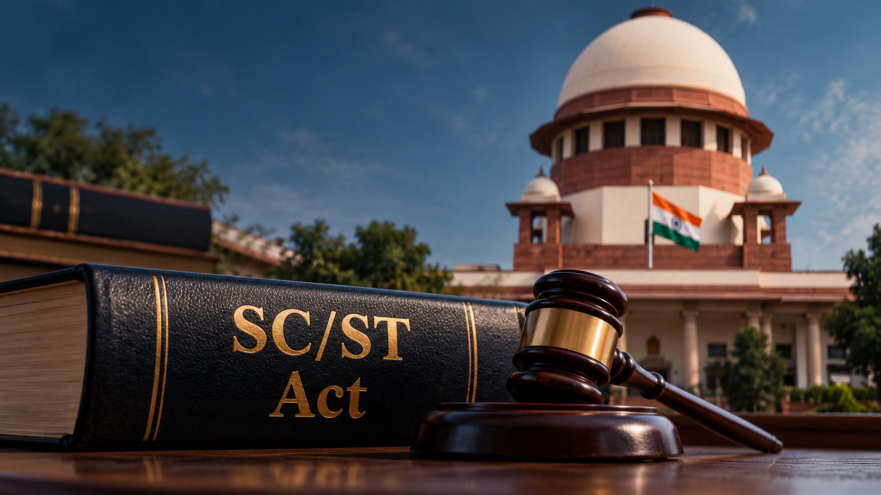
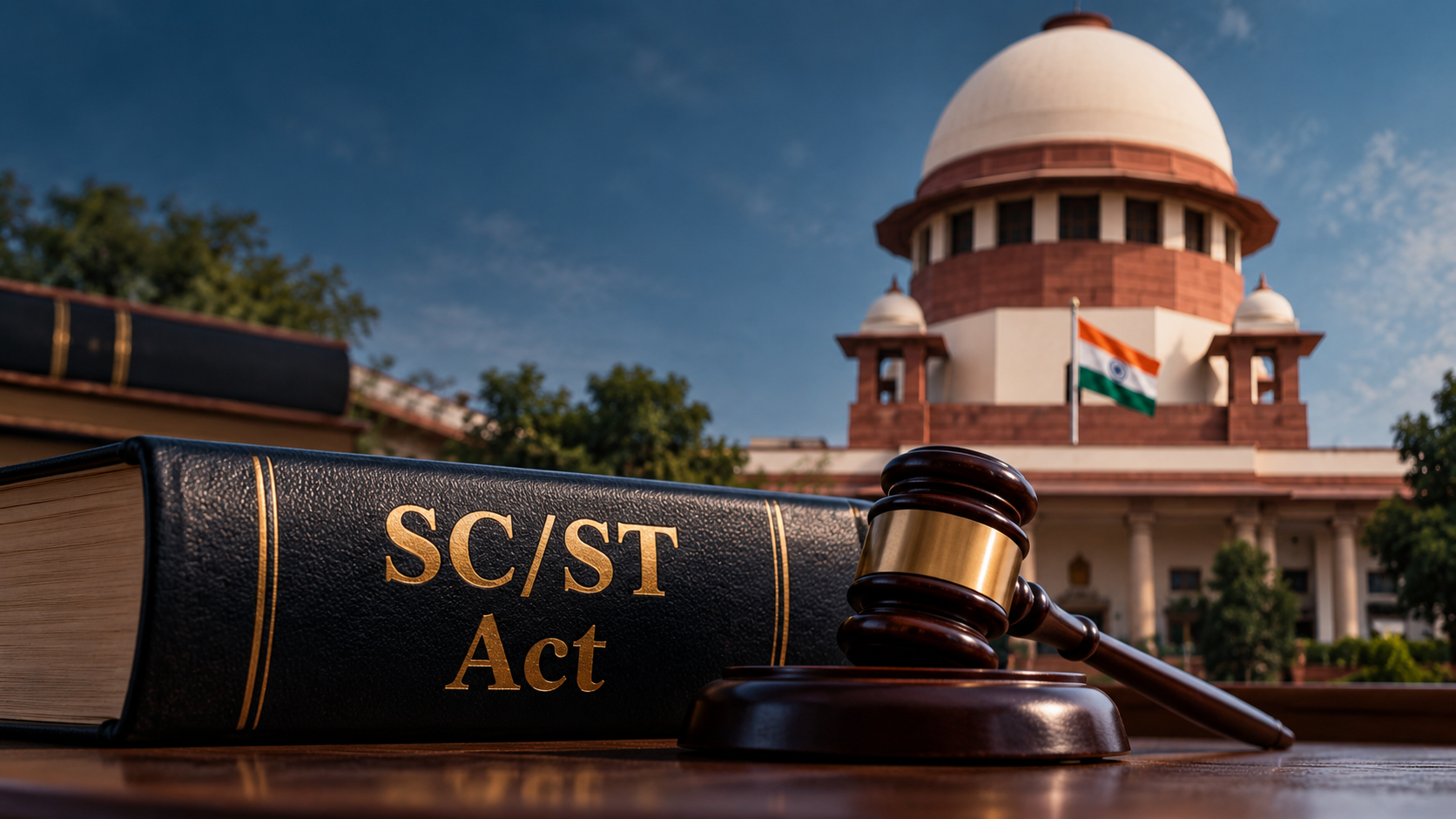
SC/ST Act Explained: 2018 Judgment, 2018 Amendment, 2020 Supreme Court Ruling & Latest Position
The Scheduled Castes and the Scheduled Tribes (Prevention of Atrocities) Act, 1989, commonly known as the SC/ST Act, is a special law enacted to prevent atrocities against members of the Scheduled Castes and Scheduled Tribes and to provide for Special Courts, as well as relief and rehabilitation of victims.
The Act contains a number of special provisions dealing with offences, investigation, trial and the rights of victims and witnesses. Some of its provisions, particularly those concerning arrest and anticipatory bail, have also been the subject of important litigation before the Supreme Court of India.
One of the most significant developments came in 2018, when the Supreme Court delivered its judgment in Dr. Subhash Kashinath Mahajan v. State of Maharashtra. Parliament subsequently amended the Act in 2018. The constitutional validity of that amendment was then considered by the Supreme Court in Prathvi Raj Chauhan v. Union of India in 2020.
In September 2026, the Supreme Court was again asked to reconsider the validity of the 2018 amendment. The Court declined to reopen the issue and dismissed the fresh challenge.
This article explains this legal journey in simple terms.
1. What is the SC/ST (Prevention of Atrocities) Act, 1989?
The SC/ST (Prevention of Atrocities) Act was enacted in 1989 with the object of preventing offences of atrocities against members of the Scheduled Castes and Scheduled Tribes.
The Act also provides for Special Courts and Exclusive Special Courts for the trial of offences under the Act and contains provisions relating to the relief and rehabilitation of victims. It also contains provisions concerning the rights of victims and witnesses.
The Act therefore does more than merely define certain offences. It creates a special legal framework intended to deal with offences covered by the legislation.
Among its provisions are Section 18 and Section 18A, which are particularly important in relation to anticipatory bail, preliminary inquiry and arrest.
2. Section 18 and Anticipatory Bail
Section 18 of the Act provides that Section 438 of the Code of Criminal Procedure, which dealt with anticipatory bail, would not apply to a person accused of an offence under the SC/ST Act.
In simple terms, the Act contains a special restriction on seeking anticipatory bail in cases involving an accusation under the Act.
This provision became particularly important when the Supreme Court considered whether, despite Section 18, courts could grant anticipatory bail in appropriate cases.
3. The 2018 Supreme Court Judgment: Subhash Kashinath Mahajan v. State of Maharashtra
On 20 March 2018, the Supreme Court decided Dr. Subhash Kashinath Mahajan v. State of Maharashtra.
The case concerned the operation of the SC/ST Act and the manner in which its provisions relating to arrest and bail should operate.
The Supreme Court expressed concern about the possibility of misuse of the law in individual cases and issued several directions.
What did the Supreme Court say?
The Court held that there was no absolute bar on anticipatory bail in cases under the SC/ST Act where no prima facie case was made out or where, upon judicial scrutiny, the complaint was found to be prima facie mala fide.
The Court also issued directions concerning arrest and preliminary inquiry. In particular, it directed that:
- In the case of a public servant, arrest could be made only after approval of the appointing authority.
- In the case of a non-public servant, approval of the Senior Superintendent of Police was required before arrest in the circumstances specified by the Court.
- A preliminary inquiry could be conducted by a Deputy Superintendent of Police to determine whether the allegations made out a case under the Act and whether they were frivolous or motivated.
The judgment therefore attempted to introduce safeguards against what the Court perceived as possible misuse of the arrest provisions.
Subhash Kashinath Mahajan v. State of Maharashtra (2018)
4. What Happened After the 2018 Judgment?
The 2018 judgment generated significant controversy and criticism. The Union Government sought review of the judgment.
Importantly, the Supreme Court subsequently recalled the directions concerning prior approval for arrest and preliminary inquiry in review proceedings decided on 1 October 2019. The 2020 Prathvi Raj Chauhan judgment records this development.
However, Parliament had already responded to the 2018 judgment through legislation.
5. The 2018 Amendment to the SC/ST Act
Parliament enacted the Scheduled Castes and the Scheduled Tribes (Prevention of Atrocities) Amendment Act, 2018.
The amendment inserted Section 18A into the SC/ST Act.
What did Section 18A provide?
Section 18A expressly provided that:
- No preliminary inquiry would be required for registration of an FIR against a person under the Act.
- The investigating officer would not require prior approval for arrest, if arrest was necessary, of a person against whom an accusation under the Act had been made.
- The provisions relating to anticipatory bail would not apply to a case under the Act, notwithstanding any judgment, order or direction of any court.
Thus, the amendment was Parliament’s legislative response to the directions that had been issued by the Supreme Court in Subhash Kashinath Mahajan.
The 2018 amendment sought to make it clear that registration of an FIR under the Act would not require a preliminary inquiry, that prior approval would not be required for arrest where arrest was necessary, and that the statutory restriction on anticipatory bail would continue to operate.
6. The 2020 Supreme Court Judgment: Prathvi Raj Chauhan v. Union of India
The 2018 amendment itself was challenged before the Supreme Court.
The principal question was whether the provisions inserted by Parliament, particularly Section 18A, were constitutionally valid.
The Supreme Court decided the matter on 10 February 2020 in Prathvi Raj Chauhan v. Union of India.
What did the Supreme Court decide?
The Court upheld the legal position created by the 2018 amendment and clarified the manner in which Sections 18 and 18A were to operate.
The Court noted that the directions concerning preliminary inquiry and prior approval for arrest issued in Subhash Kashinath Mahajan had already been recalled in the review proceedings of 2019.
With respect to anticipatory bail, the Court made an important clarification.
Although Section 18 and Section 18A exclude the application of the ordinary provision for anticipatory bail in cases under the Act, the bar does not apply where the complaint does not make out a prima facie case attracting the provisions of the SC/ST Act.
In exceptional cases, constitutional courts may also exercise their powers to prevent abuse of the process of law.
The 2020 judgment did not strike down Section 18A. Instead, it upheld the amended legal framework while clarifying that the statutory bar on anticipatory bail does not operate where the complaint itself does not make out a prima facie case under the SC/ST Act.
Prathvi Raj Chauhan v. Union of India (2020)
📘 Free Study Material for Judiciary Aspirants!
Download our FREE study material prepared by Delhi Law Academy’s expert faculty.
7. The Importance of a Prima Facie Case
The expression prima facie essentially means that, on the face of the material before the court, there appears to be a case requiring consideration.
This concept is important in the context of the SC/ST Act because the Supreme Court has clarified that merely mentioning or invoking the Act does not by itself prevent courts from examining whether the allegations actually disclose a prima facie offence under the Act.
Therefore, the law contains a distinction between:
- a case in which the allegations, on their face, disclose a prima facie offence under the SC/ST Act; and
- a case in which the allegations do not disclose such an offence.
In the latter situation, the statutory bar concerning anticipatory bail does not operate in the same manner, as clarified by the Supreme Court.
The Supreme Court has also recognised that constitutional courts can, in exceptional circumstances and on settled principles, intervene to prevent abuse of the process of law.
8. What Happened After the 2020 Judgment?
The legal position established by Prathvi Raj Chauhan has continued to be relevant in subsequent cases.
The Supreme Court has continued to examine whether the allegations in a particular case disclose a prima facie offence under the SC/ST Act while considering the consequences of Sections 18 and 18A.
Thus, the existence of the statutory bar on anticipatory bail does not mean that every allegation invoking the SC/ST Act is completely beyond judicial scrutiny.
At the same time, the existence of a prima facie case remains important. Where the allegations disclose an offence under the Act, the special statutory restrictions continue to have effect.
9. The Latest Supreme Court Development — September 2026
The issue returned to the Supreme Court in September 2026.
In Brijbhushan Saini & Ors. v. Union of India & Ors., a fresh Public Interest Litigation challenged provisions of the SC/ST Act, including the provisions strengthened by the 2018 amendment.
The petitioners raised concerns regarding the operation of the stringent provisions, including the restriction on anticipatory bail and the absence of a requirement for preliminary inquiry before registration of an FIR.
The Supreme Court considered the fact that the constitutional validity of the 2018 amendment had already been examined and upheld in Prathvi Raj Chauhan.
What did the Supreme Court do?
On 22 September 2026, a three-judge Bench comprising Chief Justice Surya Kant, Justice Joymalya Bagchi and Justice V. Mohana dismissed the fresh challenge.
The Court declined to reconsider the constitutional validity of the 2018 amendment, observing that sufficient safeguards had already been laid down by the Supreme Court.
The Court also emphasised that individual cases can still be examined by courts. In particular, courts can consider whether a prima facie case under the SC/ST Act is actually made out and can exercise their powers in appropriate cases where the legal requirements for intervention are satisfied.
The Court also referred to the safeguards governing arrest under the general criminal procedure framework. In the context of the present legal framework, the Bench referred to Section 35 of the Bharatiya Nagarik Suraksha Sanhita (BNSS), 2023, in relation to arrest under special laws.
The dismissal therefore did not invalidate Section 18A or reopen the constitutional question decided in 2020.
Brijbhushan Saini & Ors. v. Union of India & Ors. (2026)
10. The Legal Journey in One View
The development of the law can be understood chronologically:
1989 — SC/ST (Prevention of Atrocities) Act
Parliament enacted a special law to prevent atrocities against members of the Scheduled Castes and Scheduled Tribes and to provide a special legal framework for dealing with such offences.
2018 — Subhash Kashinath Mahajan v. State of Maharashtra
The Supreme Court issued safeguards concerning arrest and preliminary inquiry and clarified that anticipatory bail was not absolutely barred where no prima facie case was made out.
2018 — Amendment to the SC/ST Act
Parliament inserted Section 18A, providing that no preliminary inquiry was required for registration of an FIR and no prior approval was required for arrest where arrest was necessary. It also reaffirmed the restriction on anticipatory bail.
2019 — Review of the 2018 Judgment
The Supreme Court recalled the directions concerning prior approval for arrest and preliminary inquiry that had been issued in Subhash Kashinath Mahajan.
2020 — Prathvi Raj Chauhan v. Union of India
The Supreme Court upheld the amended legal framework and clarified that the bar on anticipatory bail does not apply where the complaint does not make out a prima facie case under the Act. It also recognised exceptional judicial intervention to prevent abuse of process.
2026 — Brijbhushan Saini & Ors. v. Union of India & Ors.
The Supreme Court dismissed a fresh challenge to the 2018 amendment and declined to reconsider the position already upheld in Prathvi Raj Chauhan.
11. What Is the Position Today?
The present legal position can be understood through a few basic points.
- The SC/ST (Prevention of Atrocities) Act, 1989 remains in force as a special legislation for preventing and dealing with atrocities against members of the Scheduled Castes and Scheduled Tribes.
- Section 18A, inserted by the 2018 amendment, remains part of the Act.
- The Act does not require a preliminary inquiry merely as a precondition for registration of an FIR under Section 18A.
- The statutory restriction on anticipatory bail continues to operate in cases falling within the Act.
- However, the Supreme Court has clarified that where the complaint does not make out a prima facie case under the Act, the bar contained in Sections 18 and 18A does not operate in the same manner.
- Courts retain powers to examine individual cases and, in appropriate circumstances, to prevent abuse of the process of law.
- The Supreme Court’s September 2026 decision has left the 2018 amendment and the legal position established in Prathvi Raj Chauhan undisturbed.
12. Conclusion
The history of the SC/ST Act’s arrest and bail provisions shows an important interaction between the judiciary and Parliament.
In 2018, the Supreme Court introduced safeguards in Subhash Kashinath Mahajan. Parliament subsequently amended the Act and inserted Section 18A. The constitutional validity of that amendment was then considered in Prathvi Raj Chauhan in 2020, where the Supreme Court upheld the amended framework while clarifying the importance of a prima facie case and exceptional judicial intervention.
In September 2026, the Supreme Court declined to reopen that constitutional question when a fresh challenge was brought before it.
The result is that the SC/ST Act continues to contain strong statutory protections and restrictions, while the courts retain the ability to examine the facts of individual cases and determine whether the legal requirements of the Act are actually satisfied.
For anyone trying to understand the SC/ST Act, it is therefore important to look at both sides of the legal framework: the protective purpose of the legislation and the judicial safeguards that apply when the provisions are invoked in an individual case.
Explore More Free Resources from Delhi Law Academy
Stay updated with our monthly current affairs and explore more important legal and judicial-service articles from Delhi Law Academy.
Contact us
📍 Delhi Law Academy – Jaipur Branch
6C, Tower 2, Coaching Hub, Pratap Nagar, Jaipur – 302033
📞 Phone:
+91 9911916552
+91 8447285606
✉️ Email:
contactus@delhilawacademy.com