
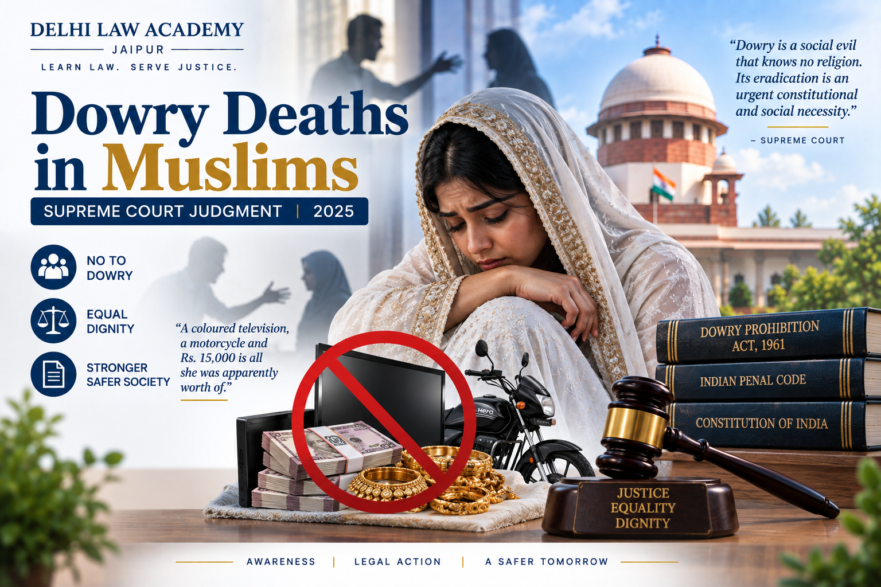
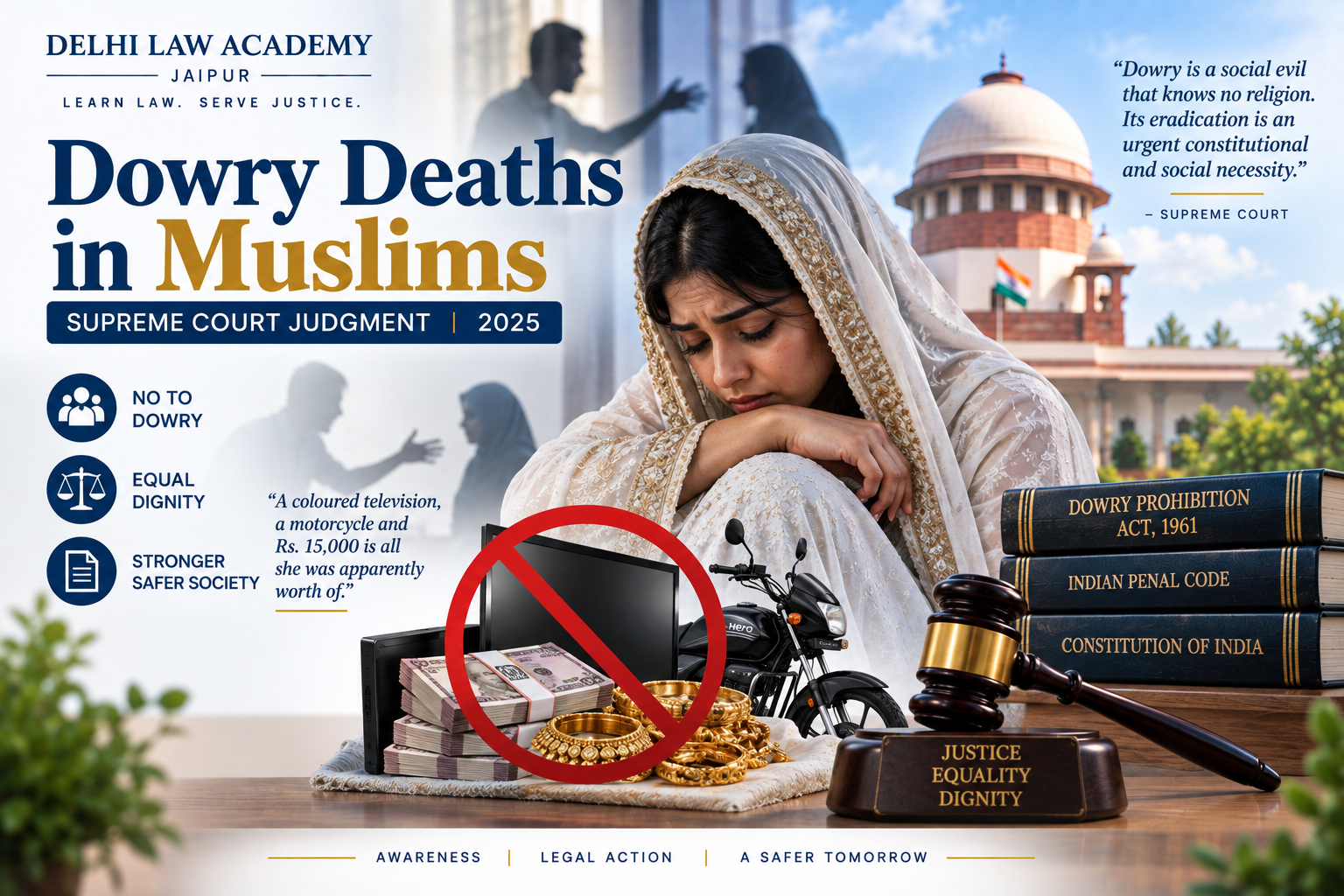
DOWRY DEATHS IN MUSLIMS
Supreme Court Judgment in State of U.P. v. Ajmal Beg
Question:
·
Is the menace of dowry also prevalent amongst Muslims?
Ans: YES
Delhi Law Academy Jaipur presents below for aspirants of Rajasthan Judicial Service (RJS), DJS, PCS (J) and other Judicial Services throughout India a very important judgment of the Supreme Court of India, delivered on 15 December, 2025.
Presented below: Summarized version [by Delhi Law Academy Jaipur] of the Supreme Court Judgment in the case of State of U.P. v. Ajmal Beg delivered on 15 December, 2025.
Original language of the judgment has been maintained; it has not been disturbed or replaced.
STATE OF U.P. v. AJMAL BEG
J U D G M E N T
2.
In this case, a young girl, barely of twenty, when she was sent away from the world of the living by way of a most heinous and painful death, met this unfortunate end simply because her parents did not have the material means and resources to satisfy the wants or the greed of her family by matrimony. A coloured television, a motorcycle and Rs. 15,000 is all she was apparently worth of.
4.
As this case represents, however, dowry is not a feature only amongst the Hindus, but it can also be found in other communities professing different faiths and religions. In Islam, dowry, stricto senso, is prohibited. What is prescribed is, in fact, the reverse. ‘mehr’ is a compulsory gift that the groom is required to give to the bride at the time of marriage. It is an essential part of the nikah (marriage contract), without which the contract is considered incomplete. The mehr can take many forms – money, jewellery, property, or any valuable as agreed upon by the couple – but what defines it is that it belongs solely to the bride and cannot be taken back by the husband or his family. The Quran makes this obligation explicit in Surah An-Nisa (4:4)7: و ء اتُوا ٱلن ِس آء ص دُق ـ ٰتِهِن نِحْ ل ة ۚ ف إ ِن طِ بْن ْل كُم ه نِيٓـ ا ف كُل ُوه ُ ن فْس ا م ِ نْه ُ ش ىْء ع ن “And give the women [upon marriage] their bridal gifts graciously. But if they of themselves remit to you a portion of it, then you may enjoy it with pleasure and goodwill”. The purpose of mehr is both symbolic and practical: it signifies respect for the woman and ensures her financial security in the marriage.
7.
The eradication of dowry is an urgent constitutional and social necessity. Dowry, legally defined under Section 2 of the DPA, 1961, refers to “any property or valuable security given or agreed to be given directly or indirectly” by one party to a marriage to the other, or by the parents of either party, in connection with the marriage. Although the law sought to prohibit the practice, dowry has persisted in society, slipping through the statutory definition, cloaked as “gifts” and social expectations. This practice is, at the most basic level, at odds with the values enshrined in the Constitution, i.e., the constitutional ethos of justice, liberty, and fraternity, and more particularly, Article 14, which guarantees equality before the law and equal protection of the laws, a principle directly undermined by a system that treats women as a source of financial extraction and reinforces structural discrimination.
10.
The facts of this case are as follows: (i) Nasrin (hereinafter referred to as ‘the deceased’), who was married to Ajmal Beg12, was the daughter-in-law of Jamila Beg13. The deceased and Ajmal had been married just over a year prior to the incident.
(ii) Repeatedly, Ajmal, Jamila and other family members had demanded from the deceased and her father Taslim Beg (PW1)14, a coloured television, a motorcycle and Rs. 15,000/-.
(iii) Ajmal reiterated his demand to PW1 on 4th June 2001 and, in similar fashion to the previous times that this demand had been made, later had expressed his inability to comply.
(iv) The next day, on 5th June 2001 Ajmal, Jamila (the two Respondents before us) Aslam, Shakila @Wakila, Shabina and Akbar Beg – all accused persons before the Trial Court, allegedly assaulted the deceased and threatened her that if she doesn’t fulfil their demands, they would kill her.
(v) Alarmed at such threat, the deceased called for help and certain persons namely, Fahmid Beg and Khaliq Beg (PW2)15 reached the spot but by that time the accused persons had set her on fire by pouring kerosene oil, and she could not be saved.
(vi) PW2 informed PW1 who reached the spot of crime and found the deceased lying burnt, dead. An FIR was lodged, setting in motion the machinery of criminal law. (vii) Upon completion of investigation, challan was presented for trial.
While on the one hand, the law suffers from ineffectiveness and so, the malpractice of dowry remains rampant, on the other hand, the provisions of this Act have also been used to ventilate ulterior motives along with Section 498-A, IPC. This oscillation between ineffectiveness and misuse creates a judicial tension which needs urgent resolution. While this urgent resolution cannot be stressed upon enough, at the same time it is necessary to be recognized that particularly when it comes to the giving and taking of dowry, this practice unfortunately has deep roots in society, hence, it not being a matter of swift change, instead needs concentrated effort on part of all the involved parties, be it Legislature, law enforcement, Judiciary, civil society organizations etc.
📘 Free Study Material for Judiciary Aspirants!
Download our FREE study material prepared by Delhi Law Academy’s expert faculty.
26.
With an intent to further this change, we issue the following directions: –
(a) to ensure that the change brought in is able to make an impact on the efforts to eradicate this evil, it is to be ensured that the future generation, youngsters of today, are informed and made aware about this evil practice and the necessity to eschew it. As such, it is directed that States and even the Union Government consider changes as are necessary to the educational curricula across levels, reinforcing the constitutional position that parties to a marriage are equal to one another and one is not subservient to the other as is sought to be established by giving and taking of money and or articles at the time of marriage;
(b) The law provides for the appointment of Dowry Prohibition Officers40 in States. It is to be ensured that these officers are duly deputed, aware of their responsibilities and given the necessary wherewithal to carry out the duties entrusted to them. The contact details (name, official phone number and email ID) of such an officer designated to this position are disseminated adequately by the local authorities ensuring awareness of citizens of the area;
(c) the police officials, as also the judicial officers dealing with such cases, should periodically be given training, equipping them to fully appreciate the social and psychological implications which are often at the forefront of these cases. This would also ensure a sensitivity of the concerned officials towards genuine cases versus those which are frivolous and abusive of the process of law;
(d) it is not lost on us that the instant case began in 2001 and could only be concluded 24 years later by way of this judgment. It is but obvious that there would be many such similar cases. The High Courts are requested to take stock of the situation, ascertain the number of cases pending dealing with Section 304-B, 498-A from the earliest to the latest for expeditious disposal; and
(e) in furtherance of (a) above, we also recognize that many people today are/have been outside the education fold, and that it is equally, if not more so, important to reach them and make accessible and comprehensible, the relevant information regarding the act of giving or taking of dowry as also other acts sometimes associated therewith, other times independent thereof (mental and physical cruelty) is an offence in law. The District Administration along with the District Legal Services Authorities, by engaging and involving civil society groups and dedicated social activists, is requested to conduct workshops/awareness programs at regular intervals. This is to ensure change at the grass-root level.
Explore More Free Resources from Delhi Law Academy
Stay updated with our monthly current affairs and explore more important legal and judicial-service articles from Delhi Law Academy.
Contact us
📍 Delhi Law Academy – Jaipur Branch
6C, Tower 2, Coaching Hub, Pratap Nagar, Jaipur – 302033
📞 Phone:
+91 9911916552
+91 8447285606
✉️ Email:
contactus@delhilawacademy.com