

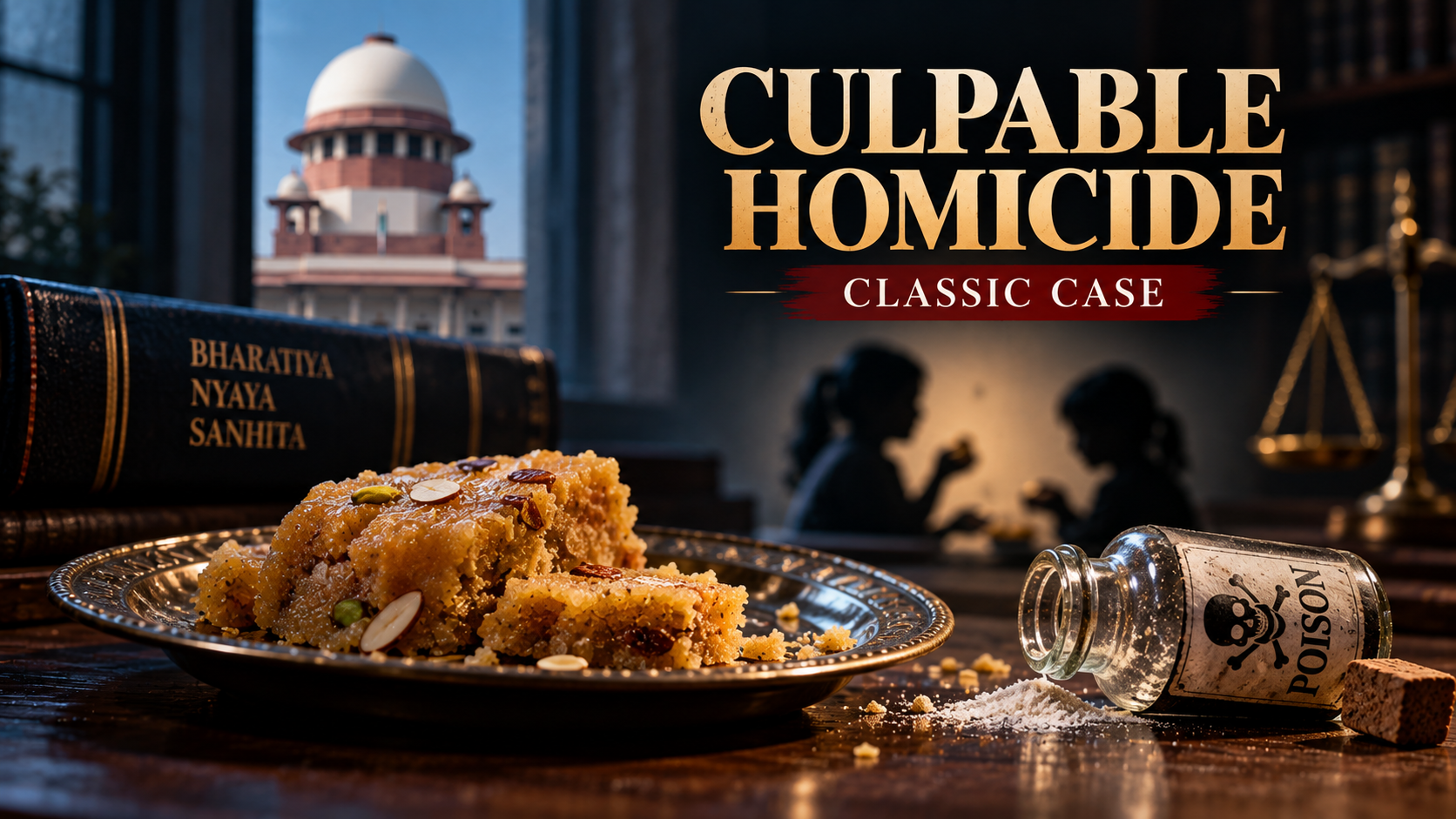
BHARATIYA NYAYA SANHITA: CLASSIC CASE ON CULPABLE HOMICIDE
Emperor v. Mushnooru Suryanarayana Murthy [1912 Mad]
Preparation for RJS, DJS, PCS (J) and other Judicial Service exams
BHARATIYA NYAYA SANHITA EXPLAINED
The Bharatiya Nyaya Sanhita forms the bedrock of any and every Judicial Service exam in the country. Its thorough knowledge is a must for all aspirants of RJS, DJS, PCS (J) and every other Judicial Service exam. To help such aspirants DELHI LAW ACADEMY JAIPUR has launched a series of study material modules on all important aspects of this vital part of their syllabus:
CULPABLE HOMICIDE DEFINED
Section 100 BNS
- Whoever causes death by doing an act
- with the intention of causing death or
- with the intention of causing such bodily injury as is likely to cause death or
- with the knowledge that he is likely by such act to cause death
- commits the offence of culpable homicide
Case Study 3
Facts of the case:
- The accused gives a person some halva in which a poison containing arsenic and mercury had been mixed with the intention of killing him.
- He ate a portion of the sweetmeat and threw the rest away.
- A girl, aged 8 years, took some of the sweetmeat and ate it and gave some to another little child who also ate it.
- This girl was a niece of the accused.
- The two children who had eaten the poisoned sweetmeat died from the effects of it, but the person who was intended to be killed eventually recovered.
Question:
Is the accused guilty of the offence of culpable homicide for causing death of the two girls?
Ans:
We need to settle the following three issues before we can answer this question:
Issue 1: Contributory action of the victim
- There is contributory action of the girls in picking up the sweetmeat and eating it.
Question:
What is the effect of this contributory action of the girls?
Illustration (a) to section 100
- A lays sticks and turf over a pit
- with the intention of thereby causing death or
- with the knowledge that death is likely to be thereby caused
- Z believing the ground to be firm treads on it, falls in and is killed
What offence has A committed?
A has committed the offence of culpable homicide.
Intention towards whom?
The first illustration shows that:
(1)
- It is not necessary that the intention to cause death should be towards any particular person. It could be quite general in nature.
- Here, the intention is to cause death of whoever comes that way and walks on the trap.
Contributory Action by the Victim
The first illustration shows that
(2)
- Contributory action by the person whose death is caused will not prevent the act of the offender from being culpable homicide even if the death could not have occurred without such contributory action.
The fact situation of this case is fully covered by the first illustration:
There, the man who laid the turf and sticks over the pit with the intention of causing death has been held to be the cause of the death of the man who ignorantly fell into the pit although death would not have occurred if he had not of his own free will walked to the spot where the pit was.
📘 Free Study Material for Judiciary Aspirants!
Download our FREE study material prepared by Delhi Law Academy’s expert faculty.
Issue 2: Contributory action of a third party
- There is contributory action of the person intended to be killed in throwing away part of the sweetmeat.
Question:
What is the effect of the contributory action of a third person?
Illustration (b) to section 100 BNS
- A knows Z to be behind a bush. B does not know it
- A induces B to fire at the bush intending to cause Z’s death or knowing it likely to cause Z’s death
- B fires and kills Z
What offence has A committed? Abetment?
Ans: From Illustration (b):
- B may be guilty of no offence but A has committed the offence of culpable homicide
Effect of Illustration (b):
- The second illustration holds an abettor guilty of committing culpable homicide.
- In the absence of this illustration, A would be guilty of abetment only, but by force of this illustration, he is to be held guilty of committing culpable homicide itself.
- The second illustration shows that contributory action by a third person will not necessarily prevent the act of the offender from being culpable homicide even if the death could not have occurred without such contributory action.
Issue 3: Remoteness of the cause
Questions:
- Can it be properly said that the accused “caused the death” of the girls, in the ordinary sense of those words?
- Was not the accused connected with the deaths too indirectly or remotely?
Ans:
Action of the accused was the efficient cause of the girl’s death though her own action in picking up and eating the poison was also necessary in order to effect her death.
Question:
What about the mens rea?
Ans:
- The mens rea which is essential to criminal responsibility existed with reference to the act done by the accused in attempting to kill the person to whom he had offered the poisoned halwa,
- though not in regard to the girl whose death he, in fact, caused, and
- that is all that the section requires.
It is sufficient if death is actually, even though involuntarily, caused to one person by an act intended to cause the death of another.
It is the criminality of the intention with regard to the latter that makes the act done and the consequence which follows from it an offence
Section 102 BNS
Culpable homicide by causing death of person other than person whose death was intended:
- If a person,
- by doing anything which he intends or knows to be likely to cause death
- commits culpable homicide by causing the death of any person
- whose death he neither intends nor knows himself to be likely to cause….
- the culpable homicide committed by the offender
- is of the description of which it would have been
- if he had caused the death of the person
- whose death he intended or knew himself to be likely to cause
Decision:
Yes, the accused is guilty of the offence of culpable homicide for causing death of the two girls.
This is a real-life case.
Citation of the case: Emperor v. Mushnooru Suryanarayana Murthy [1912 Mad]
Explore More Free Resources from Delhi Law Academy
Stay updated with our monthly current affairs and explore more important legal and judicial-service articles from Delhi Law Academy.
Contact us
📍 Delhi Law Academy – Jaipur Branch
6C, Tower 2, Coaching Hub, Pratap Nagar, Jaipur – 302033
📞 Phone:
+91 9911916552
+91 8447285606
✉️ Email:
contactus@delhilawacademy.com