
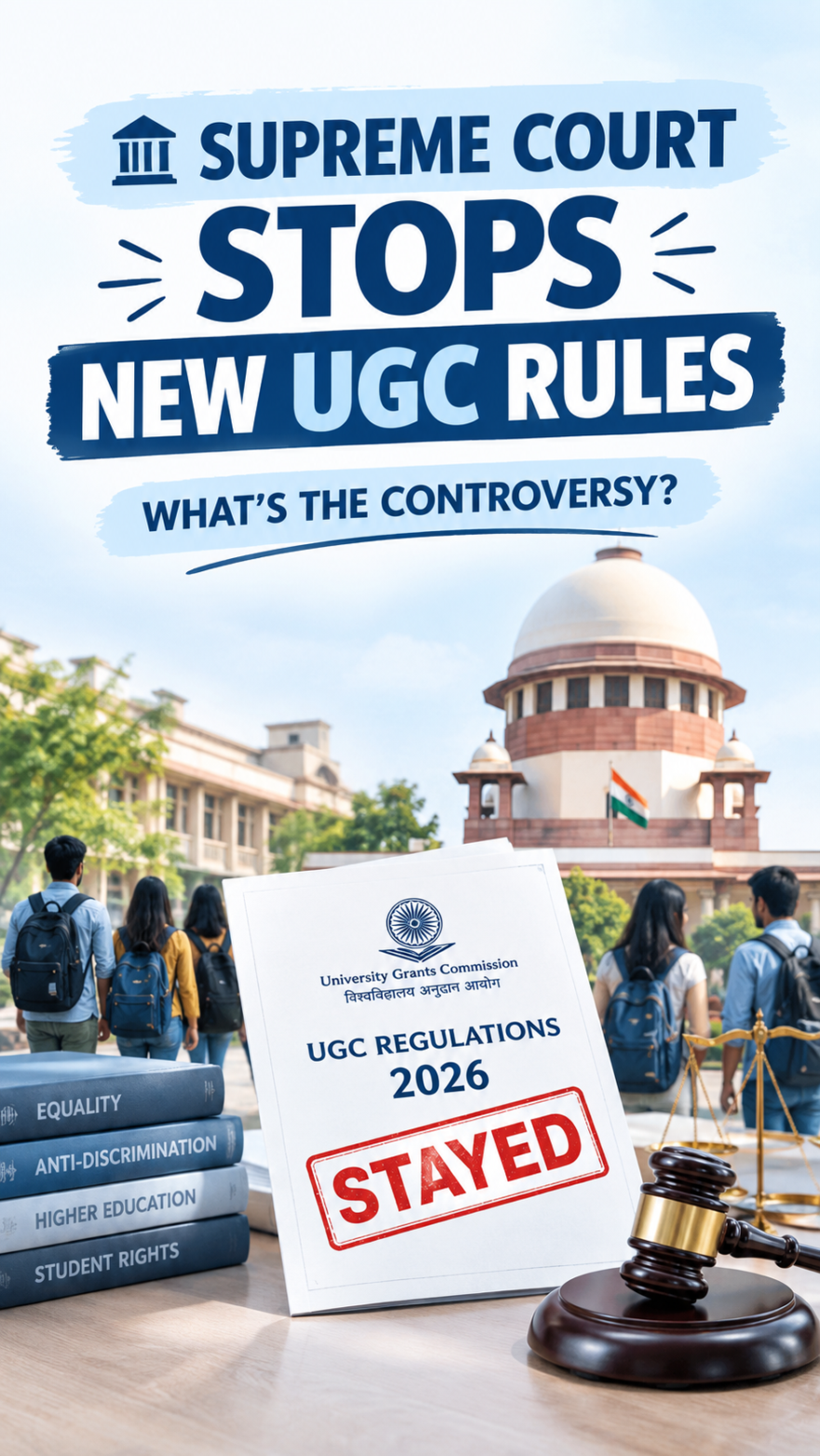
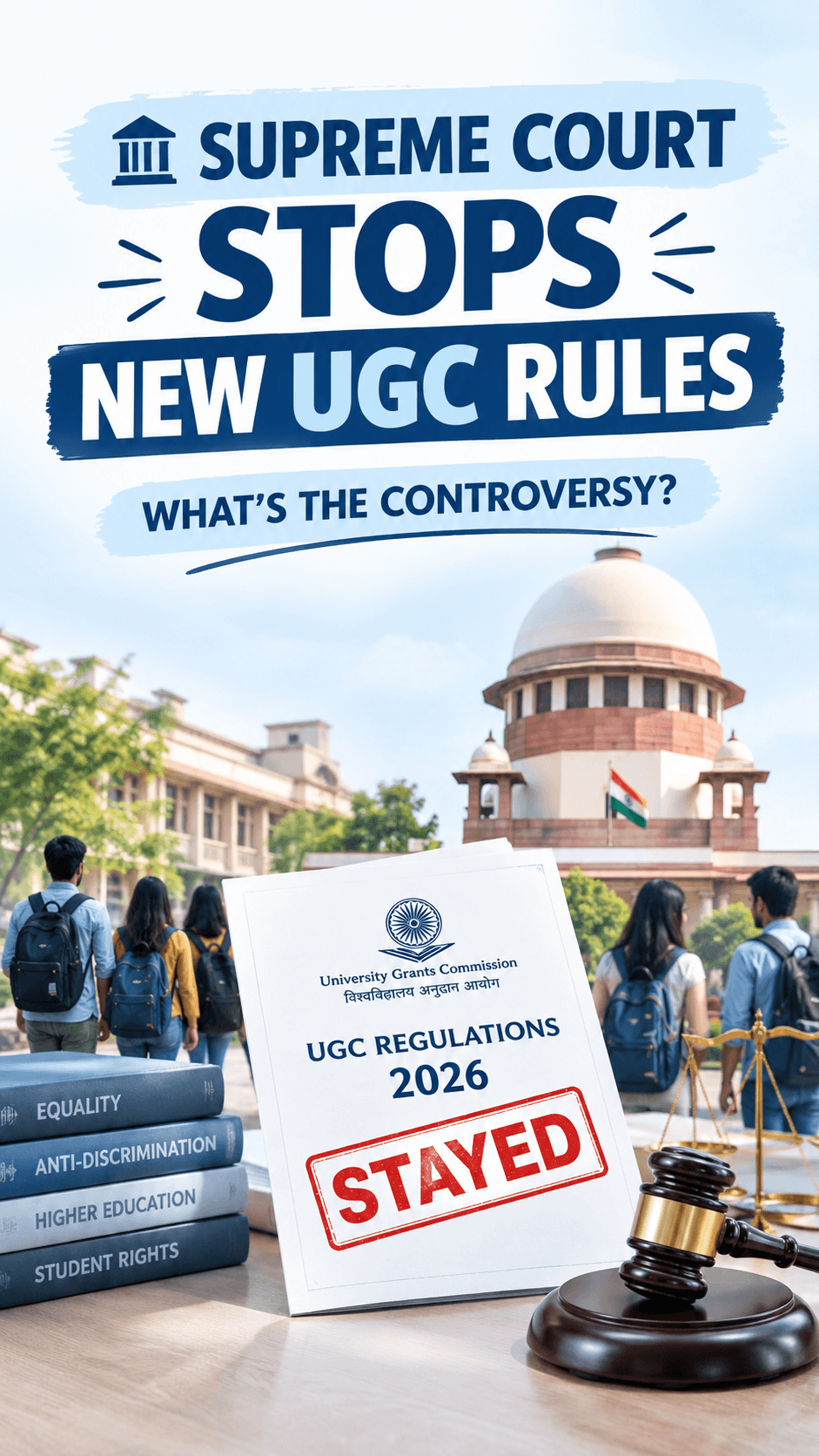
UGC Equity Regulations 2026: Why Did the Supreme Court Stay Them?
The University Grants Commission (UGC) notified the University Grants Commission (Promotion of Equity in Higher Education Institutions) Regulations, 2026 on 13 January 2026.
The Regulations were intended to address discrimination and promote equity in higher educational institutions. However, their provisions quickly became the subject of controversy and constitutional challenge.
On 29 January 2026, the Supreme Court of India stayed the operation of the 2026 Regulations and directed that the earlier UGC (Promotion of Equity in Higher Educational Institutions) Regulations, 2012 would continue to remain in force until further orders. :contentReference[oaicite:1]{index=1}
Why did the Supreme Court intervene? What were the concerns raised before the Court? And what happens to the older 2012 framework?
This article explains the issue in simple terms.
1. What Are the UGC Equity Regulations?
The University Grants Commission frames regulations governing various aspects of higher education in India.
The UGC (Promotion of Equity in Higher Educational Institutions) Regulations, 2012 were intended to promote equity and address discriminatory practices in higher educational institutions.
The 2026 Regulations were introduced as a new framework dealing with equity and discrimination in higher educational institutions. The UGC’s official website records the 2026 Regulations as having been published on 13 January 2026. :contentReference[oaicite:2]{index=2}
The new framework became particularly significant because it specifically defined “caste-based discrimination” and laid down provisions intended to address discriminatory practices in educational institutions.
2. Where Did the 2026 Regulations Come From?
The 2026 Regulations arose in the context of proceedings before the Supreme Court concerning caste-based discrimination and student suicides in higher educational institutions.
The litigation included proceedings in Abeda Salim Tadvi v. Union of India.
The petition was filed in 2019 by parents of students who had died by suicide, allegedly after facing caste-based discrimination. The petition also raised concerns regarding the implementation of the earlier UGC equity framework. :contentReference[oaicite:3]{index=3}
During those proceedings, the Supreme Court directed the UGC to frame new regulations addressing caste-based discrimination and related issues in higher educational institutions.
The 2026 Regulations were subsequently notified by the UGC.
3. What Did the 2026 Regulations Say About Caste-Based Discrimination?
One of the provisions that became central to the litigation was Clause 3(c).
It defined “caste-based discrimination” as discrimination based on caste or tribe against members of the Scheduled Castes, Scheduled Tribes and Other Backward Classes. :contentReference[oaicite:4]{index=4}
The petitioners challenging the Regulations argued that this definition excluded students belonging to the general category from the protection specifically provided under the definition of caste-based discrimination.
They argued that this could create problems where a student belonging to the general category alleged caste-based discrimination.
4. But There Was Also a Broader Definition of “Discrimination”
The controversy did not concern Clause 3(c) in isolation.
The petitioners also drew the Court’s attention to Clause 3(e), which contained a broader definition of “discrimination”.
According to the submissions recorded by the Supreme Court Observer, Clause 3(e) covered discrimination on grounds including religion, race, caste, gender, place of birth and disability. :contentReference[oaicite:5]{index=5}
This led to an important question before the Court:
The Bench indicated that the definitions needed to be examined not merely by their wording, but also by their practical impact.
5. The Challenge Before the Supreme Court
The Regulations were challenged before the Supreme Court by petitioners who raised concerns about their constitutional validity and their practical consequences.
One of the principal arguments was that the definition of caste-based discrimination was exclusionary because it specifically referred to discrimination against members of the Scheduled Castes, Scheduled Tribes and Other Backward Classes.
The petitioners argued that such a provision could leave students belonging to the general category without equivalent protection against caste-based discrimination.
They also questioned the absence of a specific mechanism dealing with what they described as false complaints.
The petitioners relied upon Article 14 of the Constitution and argued that the provision lacked a reasonable nexus with the objective of the Regulations and did not satisfy the requirements of an intelligible differentia. :contentReference[oaicite:6]{index=6}
6. What Concern Did the Supreme Court Raise?
The Supreme Court was concerned with whether the Regulations, as drafted, adequately addressed discrimination while avoiding unintended consequences.
During the hearing, the Bench considered examples involving discrimination based on geographical background, caste and other circumstances.
The Court also questioned whether the Regulations adequately dealt with discrimination occurring between different groups, including situations involving students belonging to different reserved categories.
These questions were important because the objective of an equity framework is to create an environment in which students are protected from discrimination rather than to create new forms of division.
The issue of ragging
Another concern raised during the hearing was the absence of an express reference to ragging in the 2026 Regulations.
A counsel appearing for the petitioners argued that ragging was a prevalent problem in educational institutions and suggested that situations involving ragging could potentially overlap with allegations of caste-based discrimination.
The Court also considered the fact that there were separate UGC regulations dealing with ragging, including the UGC Regulations on Curbing the Menace of Ragging in Higher Educational Institutions, 2009. :contentReference[oaicite:7]{index=7}
📘 Free Study Material for Judiciary Aspirants!
Download our FREE study material prepared by Delhi Law Academy’s expert faculty.
7. The Question of Separate Hostels
One of the more significant observations during the hearing concerned Regulation 7(d).
The provision stated that higher educational institutions should ensure that any selection, segregation or allocation for the purposes of hostels, classrooms, mentorship groups or other academic purposes is transparent, fair and non-discriminatory. :contentReference[oaicite:8]{index=8}
During the hearing, the Chief Justice expressed concern about the possibility of segregation in educational institutions and questioned the idea of separate hostels.
The concern was essentially that measures intended to promote equity should not inadvertently produce segregation among students.
This became another aspect of the Regulations that the Court indicated required careful examination.
8. Indira Jaising’s Intervention
Senior Advocate Indira Jaising, who appeared for the petitioners in the Abeda Salim Tadvi proceedings from which the Regulations had emerged, sought to make submissions before the Court.
She argued that the 2026 Regulations had to be understood in the context of the earlier proceedings and the directions issued by the Supreme Court.
She also explained the relationship between the provisions dealing with “caste-based discrimination” and the broader definition of “discrimination”.
Justice Joymalya Bagchi questioned whether Clause 3(c) became redundant in view of the broader provision contained in Clause 3(e).
The Bench also considered whether the definitions should be assessed by examining their practical impact and whether they furthered the constitutional vision of equality.
Jaising also pointed out that the 2009 UGC regulations already dealt with ragging. :contentReference[oaicite:9]{index=9}
9. The Supreme Court’s Interim Decision
After hearing the parties, the Supreme Court issued notice to the Union Government and the UGC.
The Bench also directed that the matter be considered together with the Abeda Salim Tadvi proceedings because of the connection between the two matters. :contentReference[oaicite:10]{index=10}
Most importantly, the Court placed the 2026 Regulations in abeyance.
This means that the 2026 Regulations were put on hold and were not to operate while the matter remained pending.
10. What Happened to the 2012 Regulations?
The 2026 Regulations had replaced the earlier 2012 framework. Once the Supreme Court stayed the new Regulations, a question arose: what regulatory framework would govern equity in higher educational institutions?
The Supreme Court addressed this directly.
Using its powers under Article 142 of the Constitution, the Court directed that the UGC (Promotion of Equity in Higher Educational Institutions) Regulations, 2012 would continue in force until further orders. :contentReference[oaicite:11]{index=11}
The 2026 Regulations are currently on hold. The earlier 2012 Regulations continue to operate until the Supreme Court issues further directions.
11. Why Did the Supreme Court Stay the Regulations?
The Court’s intervention was not a final decision declaring the 2026 Regulations unconstitutional.
Rather, the Court found that there were serious questions requiring examination before the Regulations could be allowed to operate.
The Supreme Court Observer reported that the Bench considered the Regulations to be prima facie vague in certain respects and expressed concern about the possibility of misuse. :contentReference[oaicite:12]{index=12}
The Court therefore chose to keep the Regulations in abeyance while the constitutional and practical issues were examined.
The stay should consequently be understood as an interim measure, rather than as a final judgment on the constitutional validity of the Regulations.
12. What Is the Present Position?
The UGC’s official website continues to list the UGC (Promotion of Equity in Higher Education Institutions) Regulations, 2026 among its regulations and records their publication date as 13 January 2026. :contentReference[oaicite:13]{index=13}
However, publication of the Regulations does not mean that they are presently operative.
The Supreme Court’s interim order of 29 January 2026 placed the 2026 Regulations in abeyance and directed that the 2012 Regulations continue in force until further orders. :contentReference[oaicite:14]{index=14}
Therefore, the key distinction is:
- 2026 Regulations: notified by the UGC but presently kept in abeyance pursuant to the Supreme Court’s order.
- 2012 Regulations: directed by the Supreme Court to continue in force until further orders.
13. Why This Case Matters
The case raises an important constitutional question about how regulations intended to promote equality and protect students from discrimination should be drafted and implemented.
At the heart of the dispute are questions concerning the meaning of equality, the scope of protection against discrimination, and the manner in which different forms of discrimination should be addressed in educational institutions.
The case also demonstrates that a regulation intended to protect a particular group can itself be subjected to constitutional scrutiny when questions arise about its classification, definitions or practical effects.
For students, teachers and educational institutions, the proceedings are also significant because the outcome may determine the regulatory framework governing equity and discrimination in higher education institutions across India.
14. Conclusion
The Supreme Court’s stay of the UGC (Promotion of Equity in Higher Education Institutions) Regulations, 2026 does not mark the end of the matter.
The Court has kept the new Regulations in abeyance while examining the constitutional and practical questions raised before it. At the same time, it has ensured that higher educational institutions continue to have an equity framework by directing that the 2012 Regulations remain in force until further orders.
The central question before the Court is therefore not simply whether discrimination should be prevented. The broader issue is how an effective and constitutionally sound framework for preventing discrimination should be designed.
The final outcome of the proceedings will determine whether the 2026 Regulations survive in their present form, require modification, or are replaced by another framework.
Explore More Free Resources from Delhi Law Academy
Stay updated with our monthly current affairs and explore more important legal and judicial-service articles from Delhi Law Academy.
Contact us
📍 Delhi Law Academy – Jaipur Branch
6C, Tower 2, Coaching Hub, Pratap Nagar, Jaipur – 302033
📞 Phone:
+91 9911916552
+91 8447285606
✉️ Email:
contactus@delhilawacademy.com