
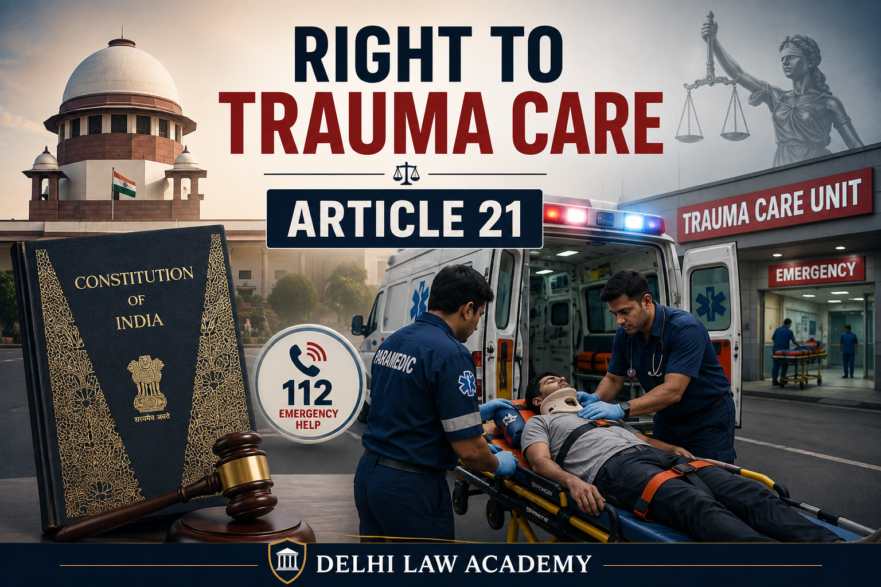
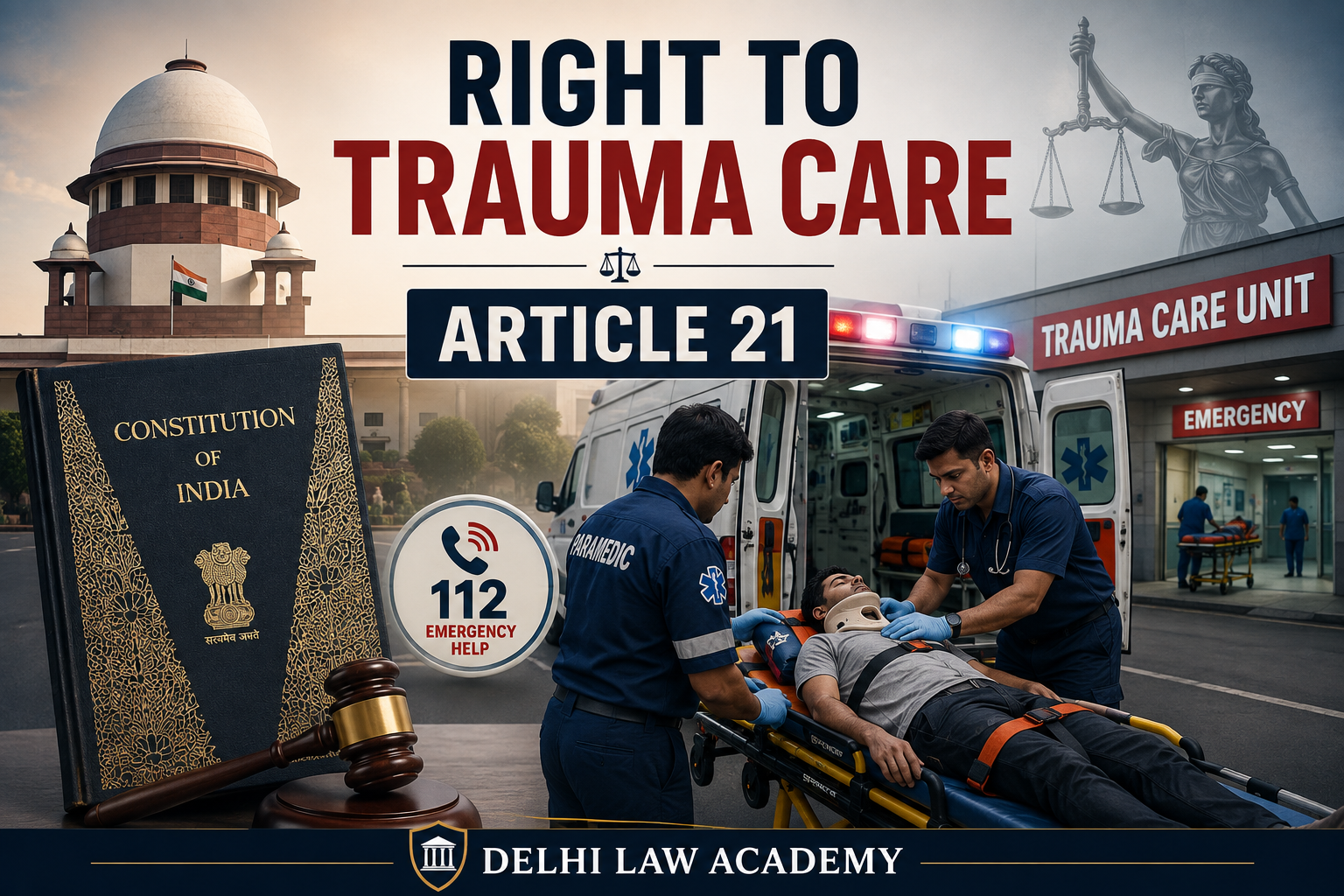
Right to Trauma Care Under Article 21: Supreme Court's 2026 Savelife Foundation Judgment
The right to life under Article 21 of the Constitution is not limited to protection from unlawful deprivation of life. Through decades of judicial interpretation, the Supreme Court has expanded Article 21 to encompass conditions necessary for a dignified and meaningful life.
In an important recent development, the Supreme Court has recognised that the right to trauma care is an integral part of the right to life under Article 21. The Court has also issued a series of directions aimed at creating a more uniform and effective emergency trauma-care system for road-accident victims.
Why in News?
On 26 May 2026, the Supreme Court passed an important order in Savelife Foundation & Anr. v. Union of India & Ors., Writ Petition (Civil) No. 726 of 2024.
The Court observed that the right to trauma care of citizens is an integral part of the right to life guaranteed under Article 21.
The Court also issued several interim directions to the Union Government and States/Union Territories to strengthen emergency medical response, road-accident trauma care and protection of Good Samaritans.
What Is the Right to Trauma Care?
Trauma care refers to the emergency medical treatment provided to a person suffering serious physical injury, particularly following incidents such as road accidents.
In cases involving severe injuries, the first few minutes and hours can be critical. Delays in emergency response, transportation or treatment can increase the risk of death or permanent disability.
The Supreme Court therefore treated access to an effective emergency trauma-care system as connected to the constitutional protection of life itself.
RJS Exam Point
Article 21 → Right to Life → Right to Trauma Care
The Supreme Court has recognised the right to trauma care as an integral part of the right to life under Article 21.
The Case: Savelife Foundation v. Union of India
The 2026 proceedings arose from a petition concerning the need for a comprehensive and effective system for emergency medical care of road-accident victims.
Among the issues before the Court were the integration of emergency helplines, protection and grievance redressal for Good Samaritans, emergency medical rescue protocols, ambulance standards and cashless treatment for road-accident victims.
The Court noted that the existing trauma-care framework remained fragmented across States and Union Territories and that a more uniform system was necessary to reduce preventable deaths.
Why Is Trauma Care a Constitutional Issue?
At first glance, emergency medical treatment may appear to be primarily a matter of health policy. However, the Supreme Court approached the issue from the perspective of Article 21.
Article 21 provides:
“No person shall be deprived of his life or personal liberty except according to procedure established by law.”
Article 21, Constitution of India
The Supreme Court has repeatedly interpreted the right to life broadly. It is not merely a right to exist physically; it encompasses various conditions necessary for living with dignity.
The recognition of the right to trauma care is another example of this expanding interpretation of Article 21.
Evolution of Article 21
The interpretation of Article 21 has undergone a significant transformation since the early years of the Constitution.
The Supreme Court has progressively recognised several rights and protections as being part of, or closely connected with, the right to life and personal liberty.
| Right / Protection | Constitutional Connection |
|---|---|
| Right to live with dignity | Article 21 |
| Right to privacy | Article 21 |
| Right to a clean environment | Article 21 |
| Right to health | Connected with Article 21 and Directive Principles |
| Right to emergency medical care | Article 21 jurisprudence |
| Right to trauma care | Recognised as integral to Article 21 in the 2026 Savelife Foundation proceedings |
Why Is Timely Trauma Care Important?
Road accidents can cause severe bleeding, head injuries, spinal injuries, fractures and other conditions requiring immediate medical intervention.
The constitutional significance of trauma care therefore lies not merely in the availability of hospitals. An effective trauma-care system must connect the entire chain:
Accident → Emergency Call → First Response → Ambulance → Trauma Facility → Treatment → Follow-up Care
A breakdown at any stage can delay treatment and potentially worsen the outcome for the injured person.
The Role of Good Samaritans
The Court also highlighted an important human element in emergency trauma care: the role of bystanders.
A person who witnesses a road accident may be the first individual capable of calling an ambulance or providing basic assistance before professional medical help arrives.
However, bystanders may hesitate because they fear being questioned by the police, being required to visit a police station or becoming involved in legal proceedings.
The Court noted that these concerns can discourage people from acting when immediate assistance could potentially save a life.
This is why Good Samaritan protections and grievance-redressal mechanisms form an important part of the trauma-care framework.
The 2016 Savelife Foundation Judgment
The 2026 proceedings should not be confused with the earlier Supreme Court judgment involving the same organisation.
In Savelife Foundation & Anr. v. Union of India & Anr., (2016) 7 SCC 194, the Supreme Court dealt with the protection of Good Samaritans who assist victims of road accidents.
The 2016 judgment recognised the need for a supportive legal framework to protect people who come forward to help accident victims.
These protections were subsequently reflected in legislation, including Section 134A of the Motor Vehicles Act, 1988.
The 2026 proceedings build upon this broader road-safety and emergency-care framework by addressing the right to trauma care itself and the need for a coordinated national system.
Supreme Court's Key Directions on Trauma Care
Recognising trauma care as an integral part of Article 21 is only one aspect of the Supreme Court's intervention. The Court also issued a series of directions aimed at strengthening the emergency response system and making trauma care more accessible and effective.
Some of the important directions include the following.
1. Integration of Emergency Helplines with 112
The Court directed steps towards integrating emergency helplines with the 112 Emergency Response Support System.
The objective is to create a more coordinated emergency response mechanism so that a person witnessing an accident does not have to navigate multiple emergency numbers before assistance reaches the victim.
A unified emergency-response system can help connect accident victims with police, ambulance and other emergency services more efficiently.
2. Operationalisation of PM RAHAT
The Court also addressed the implementation of the PM RAHAT scheme, which is intended to provide cashless treatment to road-accident victims.
The significance of such a mechanism is straightforward: an accident victim should not be denied or delayed emergency treatment merely because questions regarding payment or financial capacity arise at the point of admission.
The Court's directions seek to strengthen access to immediate treatment during the critical period following a road accident.
3. Good Samaritan Grievance-Redressal Mechanism
The Court also directed the establishment of appropriate grievance-redressal mechanisms for Good Samaritans.
A Good Samaritan is a person who voluntarily assists a victim of a road accident or emergency situation.
The protection of such individuals is important because bystanders are frequently among the first people to reach an accident scene. Fear of harassment, repeated questioning or unnecessary legal complications can discourage people from helping.
An effective grievance-redressal mechanism is therefore intended to reinforce confidence among members of the public who come forward to assist accident victims.
4. Strengthening Emergency Medical Response
The Court's directions also address the broader emergency medical-response infrastructure, including ambulances, trauma facilities and coordination between different agencies involved in treating accident victims.
The objective is to create a system in which emergency care does not depend entirely upon the location of the accident, the availability of individual facilities or the ability of the victim's family to arrange immediate payment.
5. Trauma Registries and Data
The Court also recognised the importance of reliable data in improving trauma care.
A systematic trauma registry can help identify patterns relating to accidents, injuries, treatment and outcomes. Such information can assist governments and medical institutions in identifying gaps in emergency care and planning appropriate interventions.
In this sense, data collection is not merely an administrative exercise. It can become an important tool for improving the effectiveness of the healthcare system.
Why the Judgment Is Important for Article 21
The significance of the judgment goes beyond road accidents.
By recognising trauma care as an integral component of the right to life, the Supreme Court has reinforced the principle that constitutional protection of life must have practical meaning when a person is facing a medical emergency.
Article 21 does not simply protect an individual against unlawful deprivation of life. Judicial interpretation has expanded the provision to encompass conditions necessary for living with dignity and accessing essential protections.
The trauma-care decision therefore forms part of the broader evolution of Article 21 jurisprudence.
Article 21 and the Expansion of the Right to Life
The Supreme Court's interpretation of Article 21 has expanded considerably over time.
Some important examples include:
| Case / Development | Principle |
|---|---|
| Maneka Gandhi v. Union of India | Expanded the interpretation of personal liberty and required the procedure affecting Article 21 rights to satisfy standards of fairness and reasonableness. |
| Olga Tellis v. Bombay Municipal Corporation | Recognised the connection between the right to livelihood and the right to life. |
| Subhash Kumar v. State of Bihar | Recognised the right to enjoy pollution-free water and air as part of Article 21. |
| Justice K.S. Puttaswamy v. Union of India | Recognised privacy as a constitutionally protected right. |
| Savelife Foundation v. Union of India | Right to trauma care recognised as an integral part of the right to life under Article 21. |
Trauma Care and the Directive Principles of State Policy
The constitutional significance of trauma care can also be understood alongside the Directive Principles of State Policy.
While Article 21 operates as a Fundamental Right, several Directive Principles place responsibilities upon the State concerning public health and the welfare of citizens.
Article 47, for example, directs the State to regard the raising of the level of nutrition and the standard of living of its people and the improvement of public health as among its primary duties.
The recognition of the right to trauma care under Article 21 therefore operates within a broader constitutional framework concerned with life, dignity, health and public welfare.
Why Timely Emergency Care Can Save Lives
The need for effective trauma care is particularly significant in the context of road accidents.
Accident victims may suffer from severe bleeding, traumatic brain injuries, spinal injuries, internal injuries and other life-threatening conditions. The outcome may depend heavily on how quickly appropriate medical assistance is provided.
The Law Commission of India, in its 201st Report, highlighted the potential for a substantial proportion of road-crash fatalities to be avoided through timely medical intervention.
Similarly, the NITI Aayog–AIIMS report on Emergency and Injury Care highlighted delays in emergency care as a significant contributor to trauma-related deaths.
These concerns provide important context for understanding why the Supreme Court has approached emergency trauma care as a matter connected with the constitutional right to life.
RJS Exam Perspective
This judgment is particularly important for RJS aspirants because it combines Article 21, constitutional interpretation, public health, judicial activism and recent Supreme Court jurisprudence.
A question can potentially be framed around:
- The constitutional basis of the right to trauma care.
- The expansion of Article 21.
- The Supreme Court's directions in Savelife Foundation v. Union of India.
- The role of Good Samaritans.
- The 112 emergency response system.
- PM RAHAT and cashless treatment for road-accident victims.
- Article 47 and public health.
Key Takeaways
- Article 21 guarantees the fundamental right to life and personal liberty.
- The Supreme Court has interpreted Article 21 broadly to include various rights necessary for a dignified life.
- In Savelife Foundation & Anr. v. Union of India & Ors., the Court recognised the right to trauma care as an integral part of the right to life.
- The Court issued directions concerning the 112 emergency response system.
- The Court addressed the operationalisation of PM RAHAT for cashless treatment of road-accident victims.
- Good Samaritan grievance-redressal mechanisms were also directed to be established.
- The judgment emphasises the need for coordinated emergency medical and trauma-care infrastructure.
- Article 47 provides an important Directive Principle concerning public health.
- The judgment is relevant to RJS preparation as a recent development in Article 21 jurisprudence.
Conclusion
The Supreme Court's recognition of the right to trauma care represents an important development in the constitutional understanding of the right to life. The judgment moves beyond the abstract protection of life and addresses the practical systems required to preserve life when a person suffers a serious injury.
By directing improvements in emergency response, cashless treatment, Good Samaritan protection and trauma-care infrastructure, the Court has emphasised that the constitutional guarantee under Article 21 must have practical meaning during medical emergencies.
For law students and RJS aspirants, the decision is an important example of the continuing expansion of Article 21 and demonstrates how constitutional rights can intersect with public health, road safety and the administration of justice.
Frequently Asked Questions (FAQs)
1. What is the Right to Trauma Care?
The Supreme Court has recognised access to trauma care as an integral part of the right to life guaranteed under Article 21 of the Constitution.
2. Which case recognised the Right to Trauma Care?
The right to trauma care was recognised by the Supreme Court in Savelife Foundation & Anr. v. Union of India & Ors., in proceedings concerning emergency trauma care for road-accident victims.
3. How is the Right to Trauma Care connected with Article 21?
The Supreme Court treated access to trauma care as an integral component of the constitutional protection of life under Article 21.
4. What is PM RAHAT?
PM RAHAT is a government mechanism aimed at facilitating cashless treatment for road-accident victims. The Supreme Court's directions addressed its operationalisation as part of improving emergency trauma care.
5. What is the role of Good Samaritans in trauma care?
Good Samaritans are members of the public who voluntarily assist accident victims. The Supreme Court's directions include grievance-redressal mechanisms intended to strengthen protection and confidence for people who come forward to help.
6. Why is the Right to Trauma Care important for RJS?
It is an important recent development in Article 21 jurisprudence and connects constitutional law with public health, road safety and emergency medical care, making it relevant for current-affairs and legal-awareness preparation for RJS.
📘 Stay Ahead with Delhi Law Academy!
Get access to free monthly current affairs, read our insightful blogs,
and explore free study resources prepared by experts at DLA Jaipur. 🚀