
⚖️ Removal of Supreme Court & High Court Judges in India: Constitutional Process Explained
The resignation of Justice Yashwant Varma during the pendency of impeachment proceedings has once again brought public attention to the constitutional mechanism for the removal of judges in India. The incident has highlighted the safeguards built into the Constitution to preserve judicial independence while ensuring accountability within the higher judiciary.
Interestingly, despite several attempts over the years, no judge of the Supreme Court or a High Court has ever been successfully removed through impeachment. This reflects the stringent constitutional procedure prescribed for the removal of judges, ensuring that the process is used only in exceptional circumstances involving proved misbehaviour or incapacity.
📰 Why is this Topic in News?
- Justice Yashwant Varma submitted his resignation to the President of India.
- The resignation came while impeachment proceedings had been initiated against him.
- His resignation resulted in the impeachment process not proceeding further.
- The incident has renewed discussions on the constitutional provisions relating to the removal of judges in India.
📚 Constitutional Basis for Removal of Judges
The Constitution of India provides a special procedure for removing judges of the higher judiciary. The objective is to balance two important constitutional values:
- Maintaining the independence of the judiciary.
- Ensuring accountability of judges in cases of proved misbehaviour or incapacity.
Separate constitutional provisions govern the removal of judges of the Supreme Court and the High Courts.
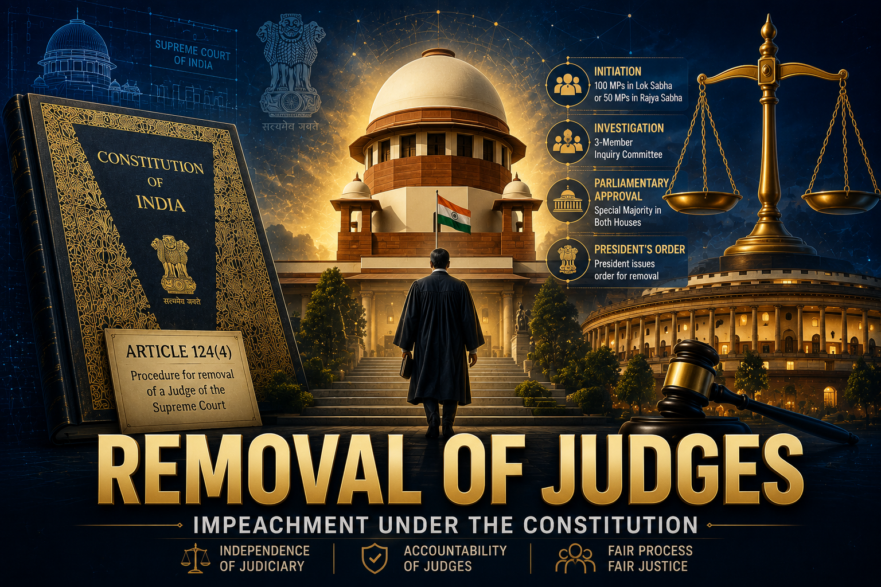
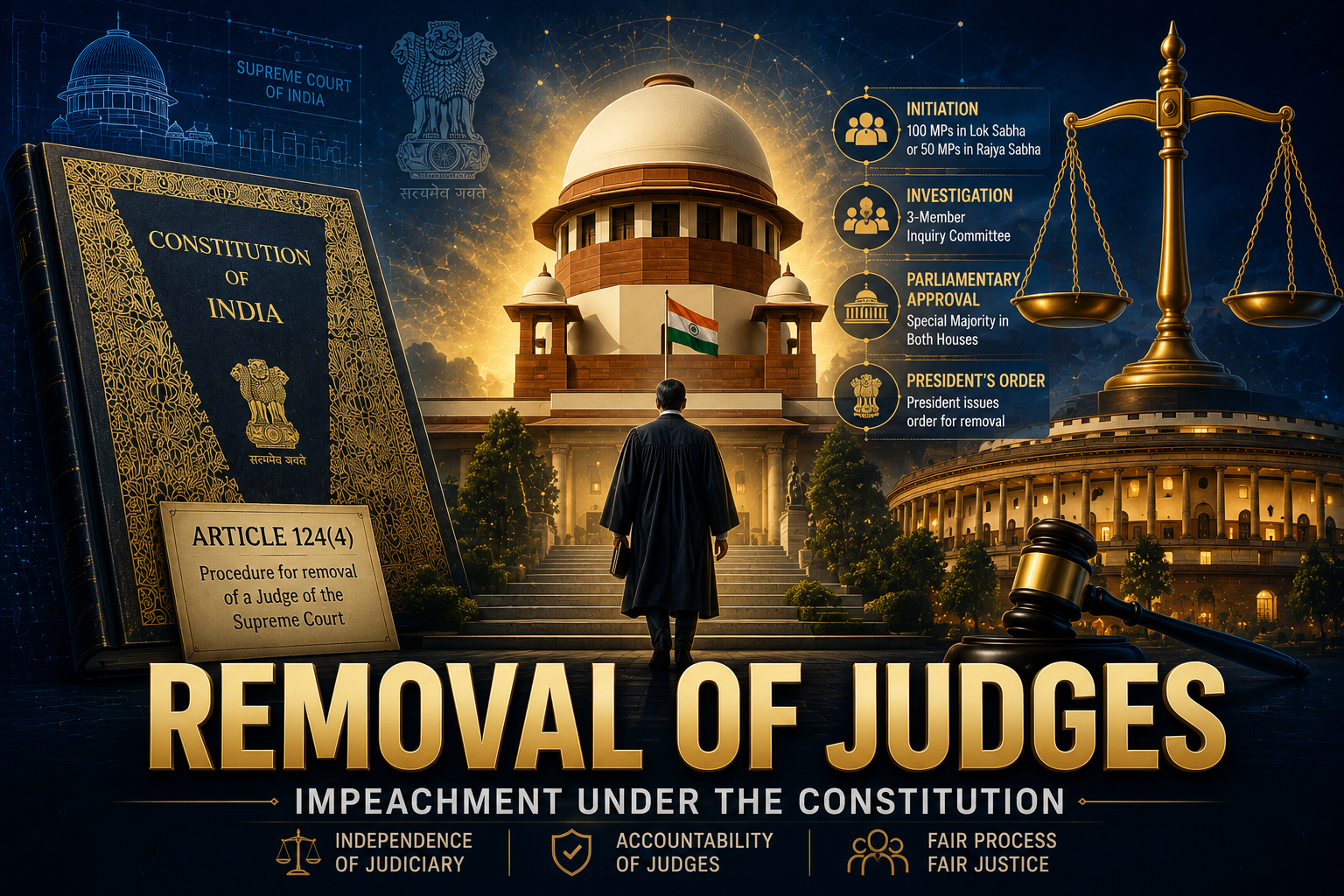
- Article 124(4) provides the procedure for removal of a Judge of the Supreme Court.
- Article 218 extends the same procedure to Judges of the High Courts.
📜 Judges (Inquiry) Act, 1968
While the Constitution lays down the broad framework, the detailed procedure for investigating allegations against judges is governed by the Judges (Inquiry) Act, 1968.
The Act prescribes the procedure for initiating removal proceedings, constituting an inquiry committee, conducting investigations, and placing the findings before Parliament.
⚖️ Grounds for Removal
A Judge of the Supreme Court or a High Court can be removed only on the following constitutional grounds:
- Proved Misbehaviour
- Incapacity
The Constitution deliberately prescribes narrow grounds for removal to prevent political interference with judicial functioning.
🏛️ Impeachment Process for Removal of Judges
Step 1 – Initiation of Motion
The impeachment process begins with a removal motion in either House of Parliament.
- Lok Sabha: Motion must be signed by at least 100 Members of Parliament.
- Rajya Sabha: Motion must be signed by at least 50 Members of Parliament.
The motion is then submitted to the Speaker of the Lok Sabha or the Chairman of the Rajya Sabha, who decides whether the motion should be admitted.
Step 2 – Investigation by Inquiry Committee
If the motion is admitted, a three-member inquiry committee is constituted under the Judges (Inquiry) Act, 1968.
The committee examines the allegations, considers evidence, and determines whether the charges of proved misbehaviour or incapacity are established.
Only if the committee finds the judge guilty does the removal process proceed further.
Step 3 – Approval by Parliament
If the inquiry committee reports that the charges are proved, the removal motion is taken up in both Houses of Parliament.
The motion must be passed separately by the Lok Sabha and the Rajya Sabha with a special majority, namely:
- A majority of the total membership of the House; and
- A majority of not less than two-thirds of the members present and voting.
Step 4 – Order of the President
After both Houses of Parliament pass the removal motion with the required special majority, the matter is forwarded to the President of India.
The President then issues an order removing the judge from office.
Only after the President's order does the removal become effective.
⭐ Why is the Removal Process So Difficult?
The framers of the Constitution intentionally made the removal process extremely rigorous to protect judges from political pressure and ensure the independence of the judiciary.
- Safeguards judicial independence.
- Prevents arbitrary removal by the executive.
- Ensures accountability only after a fair inquiry.
- Maintains public confidence in the justice delivery system.
📝 Key Takeaways for Exam
- 📜 Article 124(4): Provides the constitutional procedure for removal of a Judge of the Supreme Court.
- 📜 Article 218: Extends the same removal procedure to Judges of the High Courts.
- ⚖️ Governing Law: Judges (Inquiry) Act, 1968 regulates the impeachment process.
- 🏛️ Initiation: Removal motion requires signatures of 100 Lok Sabha MPs or 50 Rajya Sabha MPs.
- 🔍 Investigation: A three-member inquiry committee investigates allegations of proved misbehaviour or incapacity.
- 🗳️ Parliamentary Approval: Both Houses must pass the motion by a special majority.
- 🇮🇳 Final Removal: The President issues the order removing the judge after Parliament approves the motion.
- 📚 Exam Fact: No Judge of the Supreme Court or a High Court has ever been successfully removed through impeachment in India.
📌 Conclusion
The Constitution prescribes a rigorous and carefully balanced procedure for the removal of judges to preserve both judicial independence and judicial accountability. By requiring investigation by an independent committee, approval by both Houses of Parliament through a special majority, and a final order of the President, the Constitution ensures that judges are protected from arbitrary removal while remaining answerable for proved misbehaviour or incapacity.
The recent resignation of Justice Yashwant Varma has once again brought public attention to this constitutional mechanism. Understanding the impeachment process, the relevant constitutional provisions, and the Judges (Inquiry) Act, 1968 is essential for aspirants preparing for Judiciary, CLAT, CUET LLB, UPSC, State PSC and other competitive examinations.
❓ Frequently Asked Questions (FAQs)
📘 Stay Ahead with Delhi Law Academy!
Get access to free monthly current affairs, read our insightful blogs,
and explore free study resources prepared by experts at DLA Jaipur. 🚀