
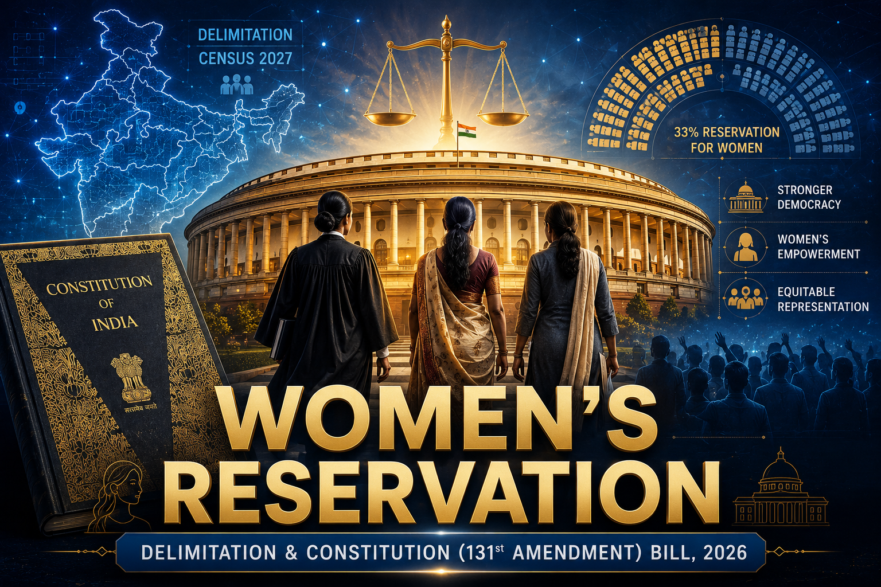
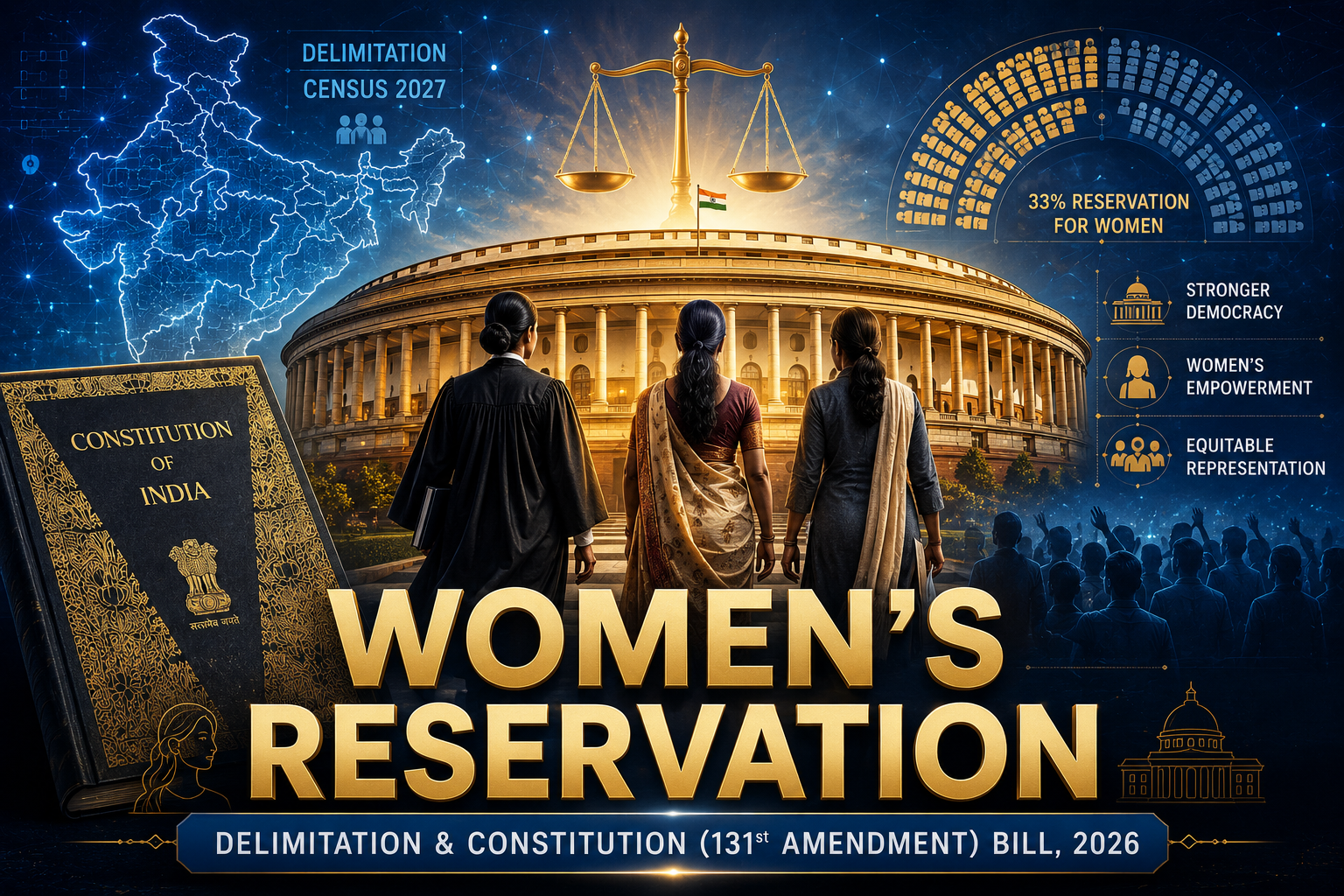
🏛️ Constitution (131st Amendment) Bill, 2026: Delimitation & Women's Reservation Explained
The Constitution (131st Amendment) Bill, 2026 has gained considerable attention due to its close connection with delimitation and the implementation of 33% reservation for women in the Lok Sabha and State Legislative Assemblies. Since the implementation of women's reservation has been linked to the next Census and the subsequent delimitation exercise, developments relating to this Bill have significant constitutional and political implications.
The proposed changes are expected to influence the future composition of Parliament and State Assemblies, making the Bill an important topic for students preparing for Judiciary, CLAT, UPSC, State PSC, CUET LLB and other competitive examinations.
📰 Why is the Constitution (131st Amendment) Bill, 2026 in News?
- The Bill has been discussed in connection with the upcoming Census 2027 and the future delimitation exercise.
- Its implementation is closely linked with the operationalisation of the Women's Reservation introduced through the Constitution (106th Amendment) Act, 2023.
- The proposed changes may significantly affect parliamentary representation, political balance among States, and reservation of seats for women.
📚 Background
The issue of women's representation in legislative bodies has remained a subject of constitutional and political debate for several decades. In order to improve women's participation in law-making institutions, Parliament enacted the Constitution (106th Amendment) Act, 2023.
The amendment provides for reservation of one-third of the total seats for women. However, the reservation does not come into effect immediately. Its implementation has been made conditional upon the completion of the next Census and the subsequent delimitation exercise.
👩 Women's Reservation under the Constitution (106th Amendment) Act, 2023
The Constitution (106th Amendment) Act, 2023 provides 33% reservation for women in elected legislative bodies.
- 🏛️ Lok Sabha
- 🏛️ State Legislative Assemblies
The reservation seeks to improve women's participation in governance and strengthen representative democracy. However, the reservation will become operational only after fresh delimitation based on the next Census.
🗺️ Link Between the Bill and Delimitation
The Constitution (131st Amendment) Bill, 2026 has been widely discussed in the context of the upcoming delimitation exercise.
Delimitation refers to the process of redrawing the boundaries of Parliamentary and Legislative Assembly constituencies based on changes in population. It also determines the allocation and redistribution of seats among different States.
Since women's reservation is proposed to be implemented only after delimitation, the Bill has acquired considerable constitutional significance.
⚖️ Key Issues Involved
The discussions surrounding the Bill focus primarily on three major constitutional and political questions.
- Future redistribution of Parliamentary seats based on the latest population data.
- Representation of different States after the completion of Census 2027.
- Implementation of women's reservation following the delimitation exercise.
⚠️ Concerns Raised
Several constitutional experts, policymakers and political parties have expressed concerns regarding the possible consequences of future delimitation.
- Possible regional imbalance in Parliamentary representation.
- States that successfully implemented population control measures may experience comparatively slower growth in representation.
- Redistribution of seats may alter the political balance between different regions of the country.
- The timing of implementing women's reservation through delimitation has also generated constitutional and political debate.
These concerns have made the issue one of the most significant constitutional discussions in recent years.
⭐ Significance of the Bill
The Constitution (131st Amendment) Bill, 2026 is important because it goes beyond seat redistribution and directly affects the future structure of representative democracy in India.
- Strengthens representative democracy.
- Facilitates implementation of women's political reservation.
- May reshape Parliamentary and State Legislative representation.
- Influences future electoral and constitutional reforms.
- Highlights the relationship between Census, delimitation and democratic representation.
❓ Frequently Asked Questions (FAQs)
📘 Stay Ahead with Delhi Law Academy!
Get access to free monthly current affairs, read our insightful blogs,
and explore free study resources prepared by experts at DLA Jaipur. 🚀