
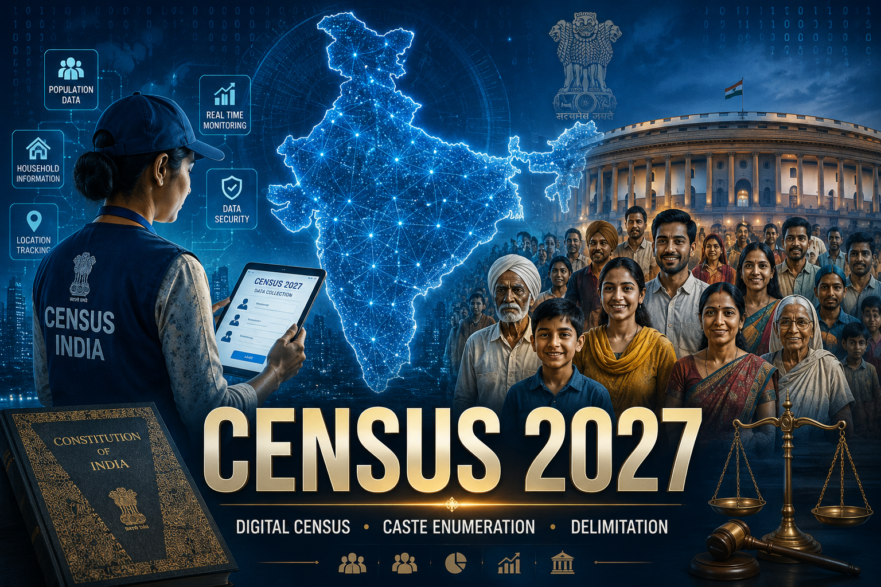
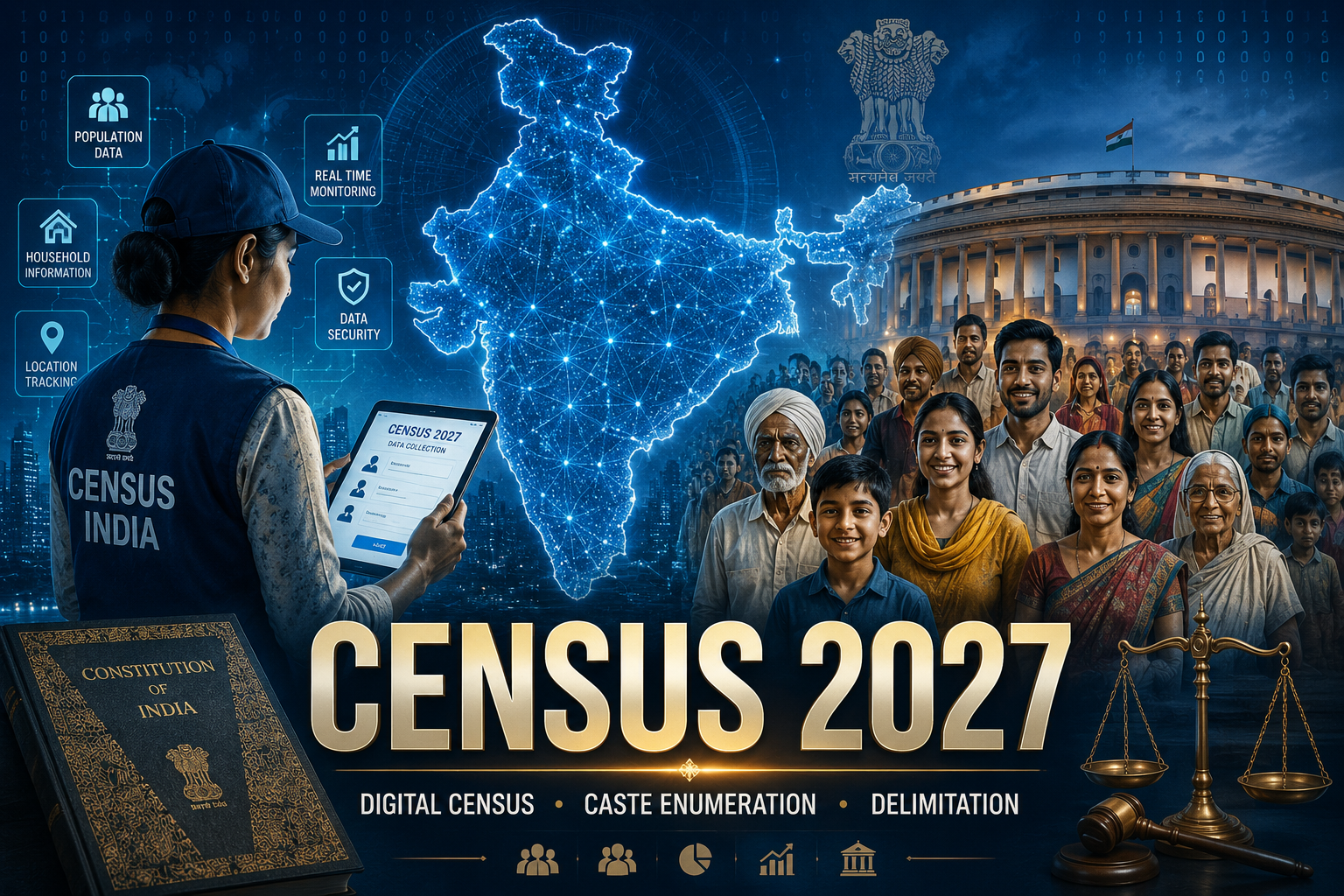
📊 Census 2027: Digital Census, Caste Enumeration & Delimitation Explained
The Government of India has announced that Census 2027 will be the country's first fully digital Census. Another major development is the inclusion of caste enumeration, making it one of the most significant Census exercises undertaken since Independence.
The Census is much more than a population count. It forms the backbone of governance, public policy, welfare planning, economic development, and political representation in India. The information collected influences everything from infrastructure planning to reservation policies and the delimitation of Parliamentary and State Assembly constituencies.
For aspirants preparing for Judiciary, CLAT, CUET LLB, UPSC, APO, JLO and other competitive examinations, understanding the constitutional, legal and administrative aspects of the Census is extremely important.
📰 Why is Census 2027 in News?
- India will conduct its first fully digital Census.
- Data will be collected through mobile applications and digital devices.
- The Census will also include caste enumeration.
- The collected data is expected to play an important role in future welfare policies and the next delimitation exercise.
📚 What is the Census?
A Census is the official process of collecting, compiling and publishing demographic, social and economic information relating to every individual living in the country.
It provides reliable statistical information regarding population size, age distribution, literacy, occupation, housing conditions, migration, language, religion and several other socio-economic indicators.
Governments rely upon Census data for long-term planning, implementation of welfare programmes and equitable distribution of public resources.
⚖️ Constitutional and Legal Basis
Although the Constitution of India does not expressly provide for the conduct of the Census, Parliament has enacted a comprehensive legislation governing the process.
- Census Act, 1948 provides the statutory framework for conducting the Census.
- The Census is administered by the Office of the Registrar General and Census Commissioner of India.
- The office functions under the Ministry of Home Affairs.
🏛️ Why is the Census Important?
The Census serves as the primary source of demographic information in India and supports evidence-based governance.
- Provides authentic demographic data.
- Assists governments in policy formulation.
- Supports implementation of welfare schemes.
- Helps identify regional development needs.
- Enables effective allocation of financial resources.
- Forms the basis for future planning at national, state and local levels.
Without accurate Census data, governments cannot effectively plan healthcare, education, infrastructure, employment generation or social welfare programmes.
💻 Key Features of Census 2027
1. India's First Fully Digital Census
One of the most significant reforms introduced in Census 2027 is the complete digitisation of data collection.
Instead of relying exclusively on paper schedules, enumerators will collect information using secure digital devices and mobile applications.
- Real-time data collection.
- Digital verification of information.
- Improved accuracy.
- Reduction in human errors.
- Faster processing and publication of Census results.
- Better monitoring of field operations.
Digital technology is expected to significantly improve efficiency while reducing the time required to compile and analyse population statistics.
2. Caste Enumeration
Another major feature of Census 2027 is the decision to collect caste-related information along with other demographic details.
Updated caste data is expected to assist governments in understanding the socio-economic status of various communities and designing more targeted welfare measures.
The issue has also generated considerable public and political debate because of its possible implications for reservation policies and social justice initiatives.
🗺️ Census and Delimitation
What is Delimitation?
Delimitation refers to the process of redrawing the territorial boundaries of Parliamentary and Legislative Assembly constituencies on the basis of changes in population.
The primary objective is to ensure that every constituency represents approximately the same number of people, thereby maintaining the principle of equal representation.
📜 Constitutional Provisions
- Article 82 empowers Parliament to enact a Delimitation Act after every Census.
- Article 170 provides for the readjustment of Legislative Assembly constituencies in the States.
The Census therefore plays a direct role in determining future political representation across the country.
📊 Importance of Census Data for Delimitation
- Determines representation in the Lok Sabha.
- Determines representation in State Legislative Assemblies.
- Influences allocation of Parliamentary seats among States.
- Ensures balanced democratic representation.
- Reflects changes in population distribution across regions.
Since population growth has not been uniform across India, future delimitation based on updated Census data may have significant constitutional and political implications.
⭐ Significance of Census 2027
Census 2027 is expected to become one of the most important administrative exercises in independent India because it combines technological innovation with comprehensive demographic data collection.
- Improves quality and reliability of official statistics.
- Supports evidence-based policymaking.
- Enables better implementation of welfare schemes.
- Strengthens development planning.
- Facilitates future delimitation exercises.
- Provides updated demographic information for governance and research.
📝 Key Takeaways for Exam
- 📜 Legal Basis: Census is conducted under the Census Act, 1948.
- 🏛️ Conducting Authority: Office of the Registrar General and Census Commissioner of India under the Ministry of Home Affairs.
- 📱 Census 2027: India's first fully digital Census using digital devices and mobile applications.
- 👥 New Feature: Census 2027 will include caste enumeration along with other demographic data.
- 📜 Article 82: Provides for enactment of a Delimitation Act after every Census.
- 📜 Article 170: Provides for readjustment of State Legislative Assembly constituencies.
- 🗳️ Importance: Census data forms the basis for welfare policies, development planning, resource allocation and future delimitation exercises.
📌 Conclusion
Census 2027 marks a significant milestone in India's administrative and governance framework by introducing digital data collection and caste enumeration. The information collected will influence policymaking, welfare programmes, political representation, and future delimitation exercises. As one of the largest population surveys in the world, the Census remains an indispensable tool for evidence-based governance and democratic planning.
For students preparing for Judiciary, CLAT, CUET LLB, UPSC, State PSC and other competitive examinations, understanding the constitutional provisions, legal framework and contemporary significance of Census 2027 is essential from both prelims and mains examination perspectives.
❓ Frequently Asked Questions (FAQs)
📘 Stay Ahead with Delhi Law Academy!
Get access to free monthly current affairs, read our insightful blogs,
and explore free study resources prepared by experts at DLA Jaipur. 🚀