
⚖️ Recusal of Judges in India: Meaning, Grounds & Legal Position Explained
The concept of recusal of judges has once again come into public discussion after a former Chief Minister of Delhi sought the recusal of a Delhi High Court judge from hearing a particular matter. Although requests for recusal occasionally arise in judicial proceedings, the decision ultimately rests with the concerned judge based on established principles of judicial ethics and natural justice.
Recusal plays an important role in preserving the fairness, impartiality and credibility of the judicial system. It ensures that justice is not only done but is also seen to be done, thereby strengthening public confidence in the administration of justice.
📰 Why is this Topic in News?
- A former Chief Minister of Delhi sought the recusal of a Delhi High Court judge in a pending matter.
- The incident has renewed discussions regarding the principles governing judicial recusal in India.
- It has also highlighted the absence of a codified law regulating recusal of judges.
📚 What is Recusal?
Recusal refers to the voluntary withdrawal of a judge from hearing or deciding a particular case because of a possible conflict of interest or a reasonable apprehension of bias.
The objective of recusal is to ensure that judicial decisions are delivered by an impartial and independent court, thereby preserving the integrity of the justice delivery system.
⚖️ Underlying Principle: Rule Against Bias
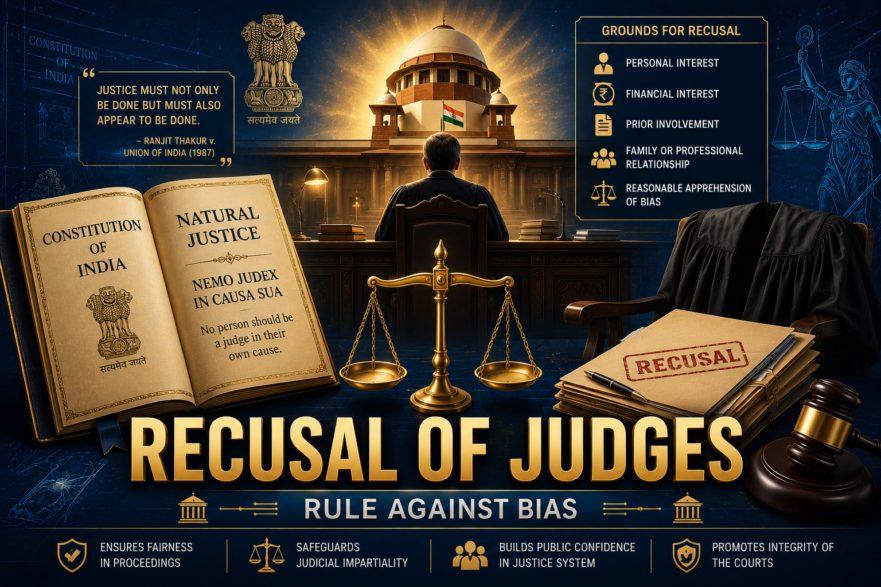
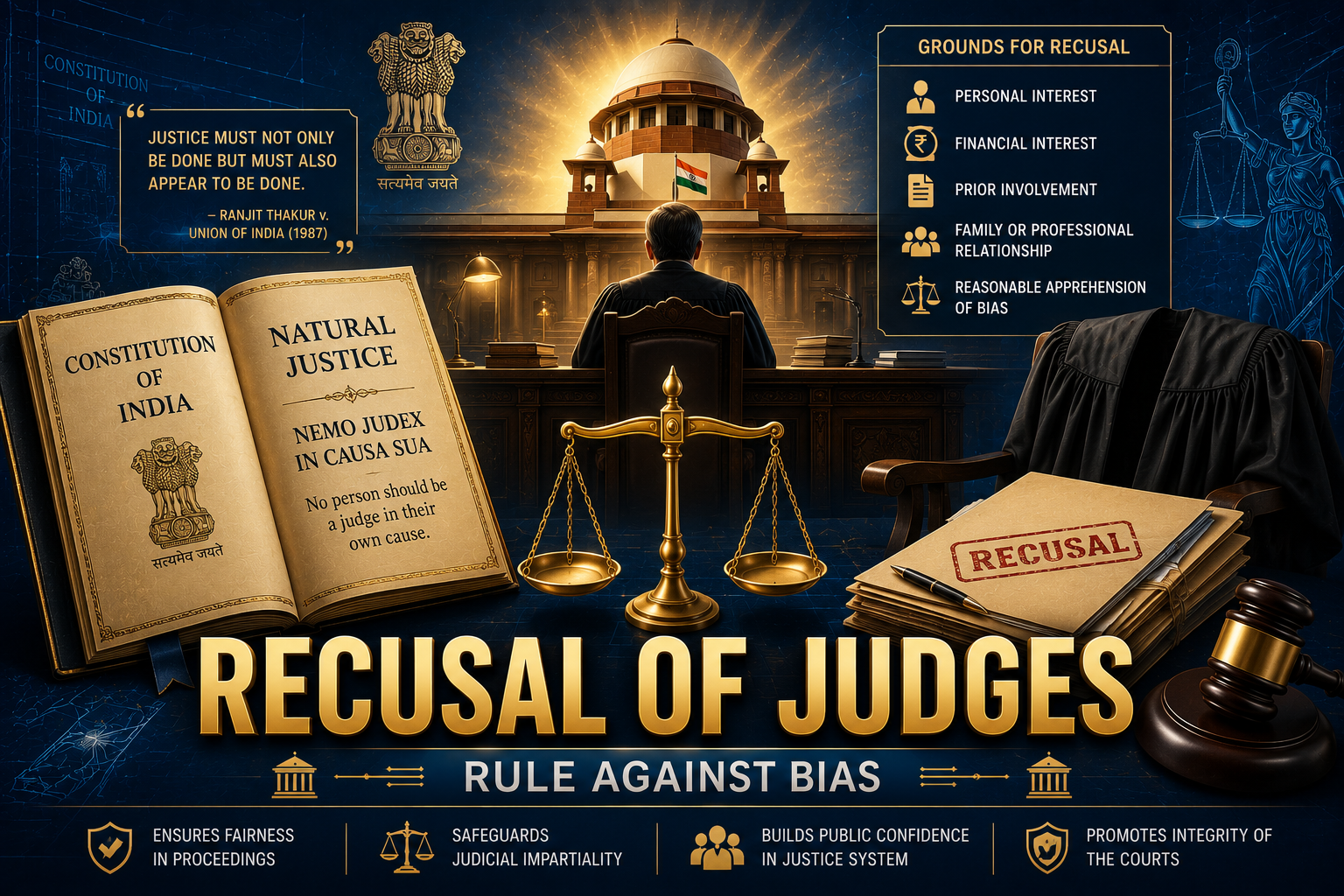
The doctrine of recusal is founded upon one of the fundamental principles of natural justice, namely the Rule Against Bias (Nemo Judex in Causa Sua).
"No person should be a judge in a cause in which he or she has a personal interest."
This principle ensures that judicial decisions are free from personal influence and are based solely upon law and evidence.
🏛️ Legal Position in India
Unlike several other jurisdictions, India does not have a specific statutory law or codified rules governing the recusal of judges.
Instead, recusal is regulated through constitutional conventions, judicial ethics, principles of natural justice and judicial precedents developed by the Supreme Court and High Courts.
📋 Grounds for Recusal
Although every case is decided on its own facts, judges generally consider recusal in situations where there exists a reasonable possibility of bias or conflict of interest.
- Personal interest in the outcome of the case.
- Financial interest in the dispute.
- Previous involvement in the matter.
- Family relationship with any of the parties.
- Professional association with litigants or advocates.
- Any circumstance giving rise to a reasonable apprehension of bias.
📖 Important Judicial Precedents
The principles governing judicial recusal have evolved primarily through judicial decisions rather than legislation.
- Ranjit Thakur v. Union of India (1987) — The Supreme Court emphasized that justice must not only be done but must also appear to be done.
- Chandraprabha v. Union of India (2025) — The Court discussed the principles governing recusal and judicial impartiality.
⭐ Importance of Recusal
Judicial recusal strengthens the legitimacy of the judicial process by ensuring that cases are decided by impartial judges.
- Promotes fairness in judicial proceedings.
- Protects judicial independence and impartiality.
- Strengthens public confidence in courts.
- Preserves the credibility of the justice delivery system.
- Ensures compliance with principles of natural justice.
⚠️ Concerns and Challenges
While recusal is an important safeguard, it is not without challenges.
- Frequent recusals may delay judicial proceedings.
- Absence of codified rules may lead to inconsistent practices.
- Strategic recusal requests may sometimes be used to delay litigation.
- Balancing judicial independence with accountability remains an ongoing challenge.
Therefore, courts are expected to exercise the power of recusal carefully, ensuring that it serves the interests of justice without undermining judicial efficiency.
📝 Key Takeaways for Exam
- ⚖️ Meaning: Recusal refers to the withdrawal of a judge from hearing a case due to a possible conflict of interest or reasonable apprehension of bias.
- 📜 Principle: Based on the Rule Against Bias (Nemo Judex in Causa Sua)—no person should be a judge in their own cause.
- 🏛️ Legal Position: India has no specific statutory law governing judicial recusal.
- 📚 Basis: Guided by principles of natural justice, judicial ethics and judicial precedents.
- ⚖️ Grounds: Personal interest, financial interest, prior involvement, family or professional relationship, or any circumstance creating a reasonable apprehension of bias.
- 📖 Landmark Case: Ranjit Thakur v. Union of India (1987) emphasized that justice must not only be done but must also appear to be done.
- ⭐ Importance: Protects judicial impartiality, fairness and public confidence in the justice system.
📌 Conclusion
Judicial recusal is an essential safeguard for maintaining the fairness and credibility of the Indian judicial system. Although India does not have codified rules governing recusal, the doctrine has evolved through constitutional principles, judicial ethics and landmark judgments. The objective is to ensure that every litigant receives an impartial hearing before an unbiased judge.
At the same time, recusal must be exercised cautiously. While it protects judicial integrity and public confidence, unnecessary or strategic recusal requests can delay proceedings and affect judicial efficiency. Therefore, striking the right balance between impartiality and judicial responsibility remains an important aspect of constitutional governance.
❓ Frequently Asked Questions (FAQs)
📘 Stay Ahead with Delhi Law Academy!
Get access to free monthly current affairs, read our insightful blogs,
and explore free study resources prepared by experts at DLA Jaipur. 🚀