

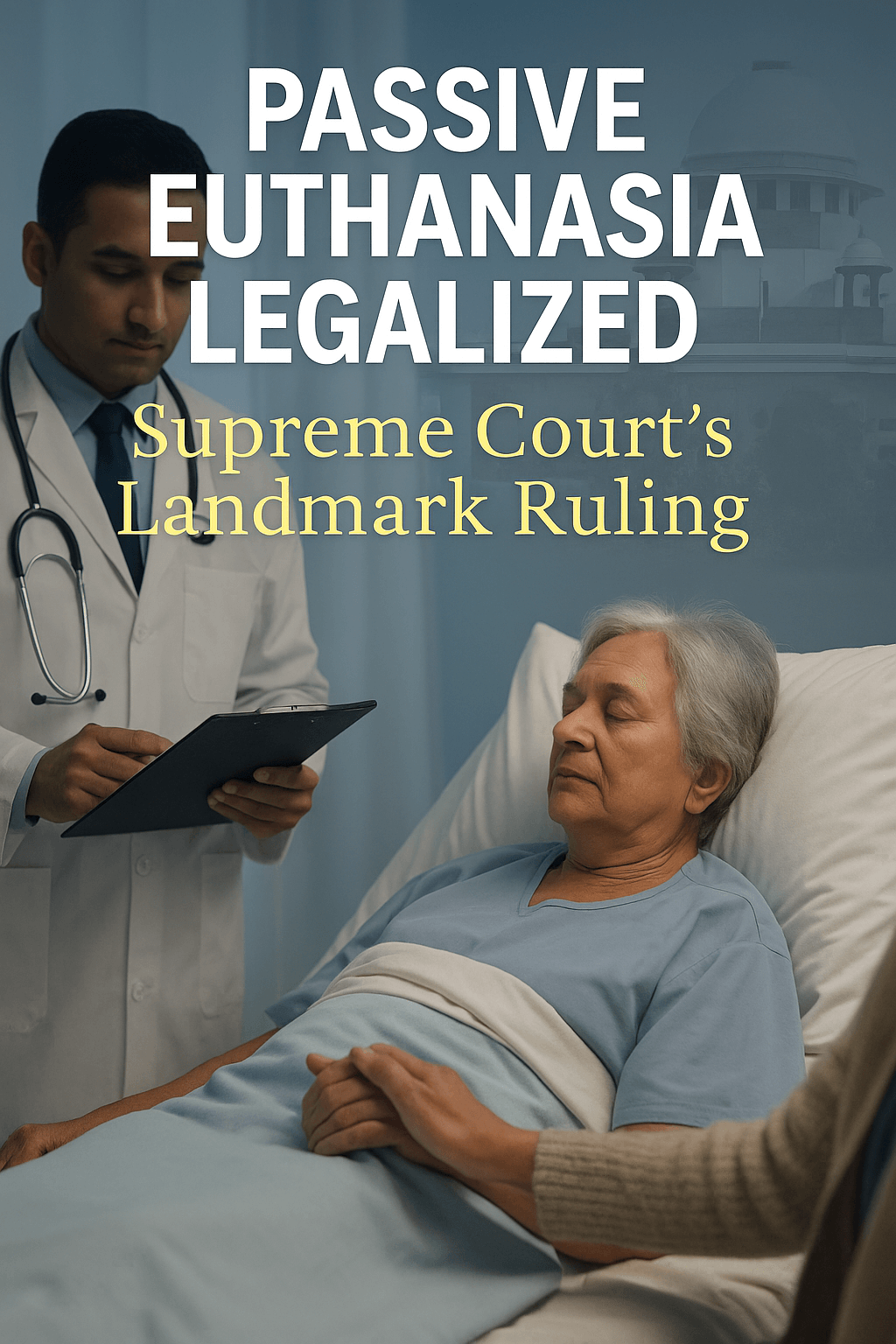
Harish Rana v. Union of India (2026): India's First Court-Approved Passive Euthanasia Case
The Supreme Court's judgment in Harish Rana v. Union of India (2026) marks a historic milestone in India's constitutional and medical jurisprudence. For the first time, the Supreme Court permitted the withdrawal of life-sustaining treatment in an individual case by applying the legal framework laid down in Common Cause v. Union of India (2018). The decision reaffirmed that the constitutional guarantee of dignity under Article 21 extends not only to life but also to the process of dying with dignity.
Related Reading:
If you wish to understand the legal concepts of passive euthanasia, active euthanasia, living wills and the evolution of the right to die with dignity, read our detailed explainer:
"Passive Euthanasia in India: Supreme Court Guidelines Explained."
This article focuses specifically on the Harish Rana judgment and its legal significance.
Why in News?
On 11 March 2026, the Supreme Court of India allowed the withdrawal of life-sustaining medical treatment for Harish Rana, a man who had remained in a Permanent Vegetative State (PVS) for over thirteen years following a traumatic brain injury. The judgment is widely regarded as the first practical implementation of India's passive euthanasia framework established in Common Cause v. Union of India (2018). :contentReference[oaicite:1]{index=1}
Background of the Case
Harish Rana suffered a devastating brain injury in 2013 after falling from the fourth floor of his accommodation while he was a young engineering student. The accident left him in a Permanent Vegetative State (PVS), with complete paralysis and no meaningful neurological recovery despite years of intensive medical treatment. His family continued to care for him for over thirteen years, exhausting their financial resources and hoping for improvement that never came. :contentReference[oaicite:2]{index=2}
Medical experts consistently concluded that Harish had no realistic possibility of regaining consciousness. He survived only because he received Clinically Assisted Nutrition and Hydration (CANH) through a surgically inserted feeding tube.
Journey Through the Courts
| Year | Development |
|---|---|
| 2013 | Harish Rana suffered severe traumatic brain injury. |
| 2024 | Delhi High Court declined permission to withdraw life-sustaining treatment. |
| 2025 | Supreme Court constituted Primary and Secondary Medical Boards for expert evaluation. |
| 11 March 2026 | Supreme Court permitted withdrawal of treatment under Article 21. |
Facts of the Case
- Harish Rana remained in a Permanent Vegetative State for more than thirteen years.
- He required continuous clinically assisted nutrition and hydration through a PEG tube.
- His parents approached the Court seeking permission to discontinue life-sustaining treatment.
- Multiple Medical Boards unanimously concluded that recovery was medically impossible.
- The patient's family supported withdrawal of treatment after years of prolonged suffering.
Legal Issues Before the Supreme Court
The Supreme Court had to determine several important constitutional and medical questions:
- Whether Clinically Assisted Nutrition and Hydration (CANH) constitutes medical treatment or merely basic care.
- Whether life-sustaining treatment could be withdrawn when no living will existed.
- Whether surrogate consent by close family members could be accepted.
- How Article 21's guarantee of dignity should apply at the end of life.
- Whether the existing passive euthanasia guidelines adequately covered such situations.
Earlier Legal Position
- Gian Kaur v. State of Punjab (1996) — recognised that while there is no general right to die, the concept of dying with dignity could arise in exceptional circumstances.
- Aruna Shanbaug v. Union of India (2011) — recognised passive euthanasia under strict judicial safeguards.
- Common Cause v. Union of India (2018) — recognised the right to die with dignity under Article 21 and validated Living Wills.
- 2023 Guidelines — simplified the procedure for implementation of Living Wills and withdrawal of life support.
What Did the Supreme Court Hold?
The Bench comprising Justice J.B. Pardiwala and Justice K.V. Viswanathan held that continuing life-sustaining treatment in Harish Rana's condition merely prolonged biological existence without offering any realistic prospect of recovery. The Court therefore permitted withdrawal of treatment while directing that the entire process be carried out through a structured palliative care plan to preserve the patient's dignity. :contentReference[oaicite:3]{index=3}
To understand the legal concept in detail, you can also read our guide on
Passive Euthanasia in India: Law, Supreme Court Judgments and Living Will.
Key Directions Issued by the Supreme Court
While allowing the withdrawal of life-sustaining treatment, the Supreme Court ensured that the process would be carried out in a humane, transparent, and medically supervised manner. The judgment emphasised that passive euthanasia is not an act of causing death but a carefully regulated decision to discontinue extraordinary medical intervention when recovery is medically impossible.
- Permission was granted to withdraw Clinically Assisted Nutrition and Hydration (CANH).
- The procedure was directed to be carried out under the supervision of qualified medical professionals.
- A comprehensive palliative care plan was ordered to ensure comfort, dignity, and pain management.
- The Court relied heavily upon the unanimous opinion of expert Medical Boards.
- The dignity and best interests of the patient remained the overriding consideration throughout the decision-making process.
Best Interest of the Patient Principle
One of the most significant aspects of the judgment is the Court's reaffirmation of the "Best Interest of the Patient" principle. When a patient is permanently incapable of expressing informed consent, courts must determine whether continued medical treatment genuinely serves the patient's welfare.
The Court observed that merely prolonging biological existence, without any realistic possibility of recovery or conscious life, cannot always be regarded as protecting the patient's interests. Human dignity remains central to Article 21 even during the final stage of life.
Important Principle
The judgment does not recognise a general "Right to Die." Instead, it reiterates the constitutional right to die with dignity in exceptional circumstances where continued life-sustaining treatment no longer serves any therapeutic purpose.
Importance of Medical Boards
The Supreme Court placed considerable reliance on the findings of independent Medical Boards constituted for evaluating Harish Rana's medical condition. These Boards unanimously concluded that there was no reasonable possibility of neurological recovery and that continuation of life-support would merely prolong irreversible suffering.
This demonstrates that decisions relating to passive euthanasia are based not only upon legal principles but also upon objective medical expertise.
Need for Parliamentary Legislation
Although passive euthanasia is presently governed through judicial precedents and procedural guidelines, the Supreme Court expressed the need for Parliament to enact a comprehensive statutory framework governing end-of-life decisions.
A dedicated legislation would provide greater clarity regarding:
- Preparation and registration of Living Wills.
- Rights and duties of hospitals.
- Constitution and functioning of Medical Boards.
- Safeguards against misuse.
- Protection of doctors acting in good faith.
- Uniform procedures across all States and Union Territories.
Constitutional Significance
| Constitutional Principle | Significance |
|---|---|
| Article 21 | Expanded the concept of dignity to include dignified end-of-life care. |
| Right to Privacy | Recognises personal autonomy in medical decision-making. |
| Human Dignity | Places dignity above mere biological survival in exceptional cases. |
| Judicial Review | Ensures independent scrutiny before permitting withdrawal of treatment. |
How is the Harish Rana Case Different?
| Earlier Cases | Harish Rana Case (2026) |
|---|---|
| Laid down legal principles for passive euthanasia. | Applied those principles in an actual case involving withdrawal of life support. |
| Focused mainly on constitutional interpretation. | Focused on practical implementation of the constitutional framework. |
| Established legal safeguards. | Demonstrated how those safeguards operate in practice. |
Why is this Judgment Important for Judiciary Aspirants?
- Illustrates the practical application of Article 21.
- Strengthens the doctrine of human dignity.
- Clarifies passive euthanasia jurisprudence after Common Cause.
- Highlights the role of Medical Boards in constitutional adjudication.
- Raises important ethical questions balancing life, autonomy and dignity.
Exam Focus
Prelims
- Article 21.
- Passive vs Active Euthanasia.
- Living Will.
- Permanent Vegetative State (PVS).
- Medical Boards.
- Common Cause Case (2018).
- Aruna Shanbaug Case (2011).
- Harish Rana Case (2026).
Mains / Interview
- Right to Die with Dignity under Article 21.
- Judicial balancing between sanctity of life and individual autonomy.
- Need for a comprehensive legislation on end-of-life decisions.
- Ethical and constitutional dimensions of passive euthanasia.
Key Takeaways
- Harish Rana is India's first major judicial implementation of the passive euthanasia framework.
- The judgment reaffirmed that Article 21 includes the right to die with dignity in limited circumstances.
- Medical Board opinions remain central to decisions on withdrawal of life support.
- The Court prioritised the patient's best interests and dignity over mere biological survival.
- The Supreme Court highlighted the need for a comprehensive Parliamentary law on end-of-life care.
- The decision builds upon Aruna Shanbaug (2011) and Common Cause (2018), rather than replacing them.
Conclusion
The judgment in Harish Rana v. Union of India (2026) represents a significant milestone in India's constitutional and medical jurisprudence. By applying the passive euthanasia framework to a real-life case, the Supreme Court transformed principles laid down in earlier decisions into practical safeguards for patients, families, and medical professionals. The ruling reinforces that the Constitution protects not only the right to live with dignity but also, in exceptional circumstances, the right to experience a dignified end to life. At the same time, the judgment underscores the urgent need for Parliament to enact a comprehensive law governing end-of-life medical decisions.
Frequently Asked Questions (FAQs)
1. Why is the Harish Rana case considered landmark?
It is the first major case in which the Supreme Court practically implemented the passive euthanasia framework developed in earlier judgments.
2. Did the Supreme Court legalise active euthanasia?
No. Active euthanasia remains illegal in India. The judgment concerns only passive euthanasia under strict judicial safeguards.
3. What is a Permanent Vegetative State (PVS)?
It is a medical condition in which a patient loses conscious awareness permanently while basic bodily functions may continue with medical support.
4. Which constitutional provision formed the basis of the judgment?
Article 21 of the Constitution, which guarantees the right to life and has been judicially interpreted to include the right to die with dignity in exceptional circumstances.
5. Does this judgment replace the Common Cause decision?
No. It applies and reinforces the principles laid down in Common Cause v. Union of India (2018).
6. Why is this case important for RJS and other judiciary examinations?
It combines constitutional law, medical jurisprudence, Article 21, judicial precedent, ethics, and current affairs, making it highly relevant for prelims, mains, and interviews.
📘 Stay Ahead with Delhi Law Academy!
Get access to free monthly current affairs, read our insightful blogs,
and explore free study resources prepared by experts at DLA Jaipur. 🚀