
CONSTITUTIONAL VALIDITY OF ABROGATION OF ARTICLE 370
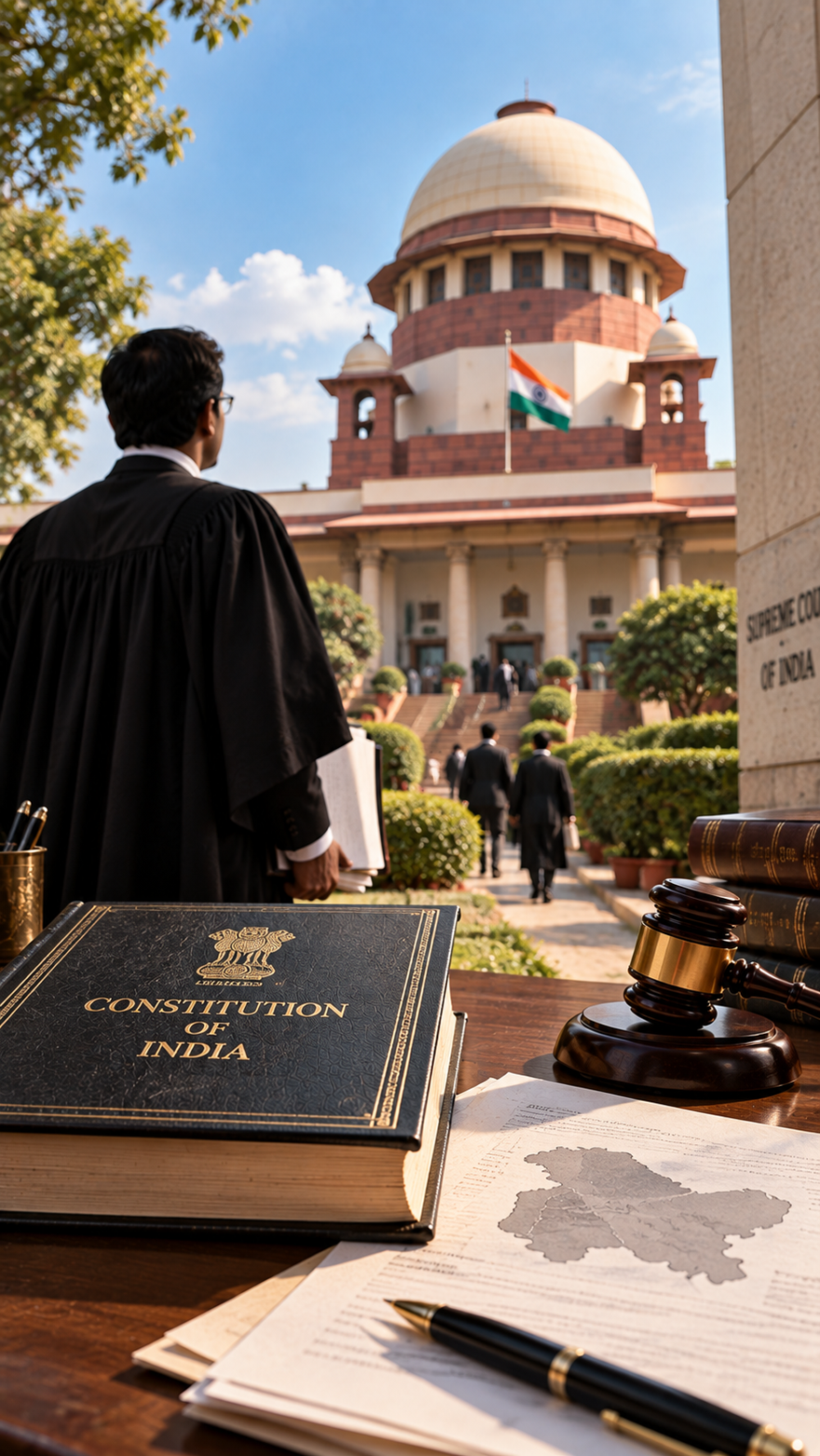
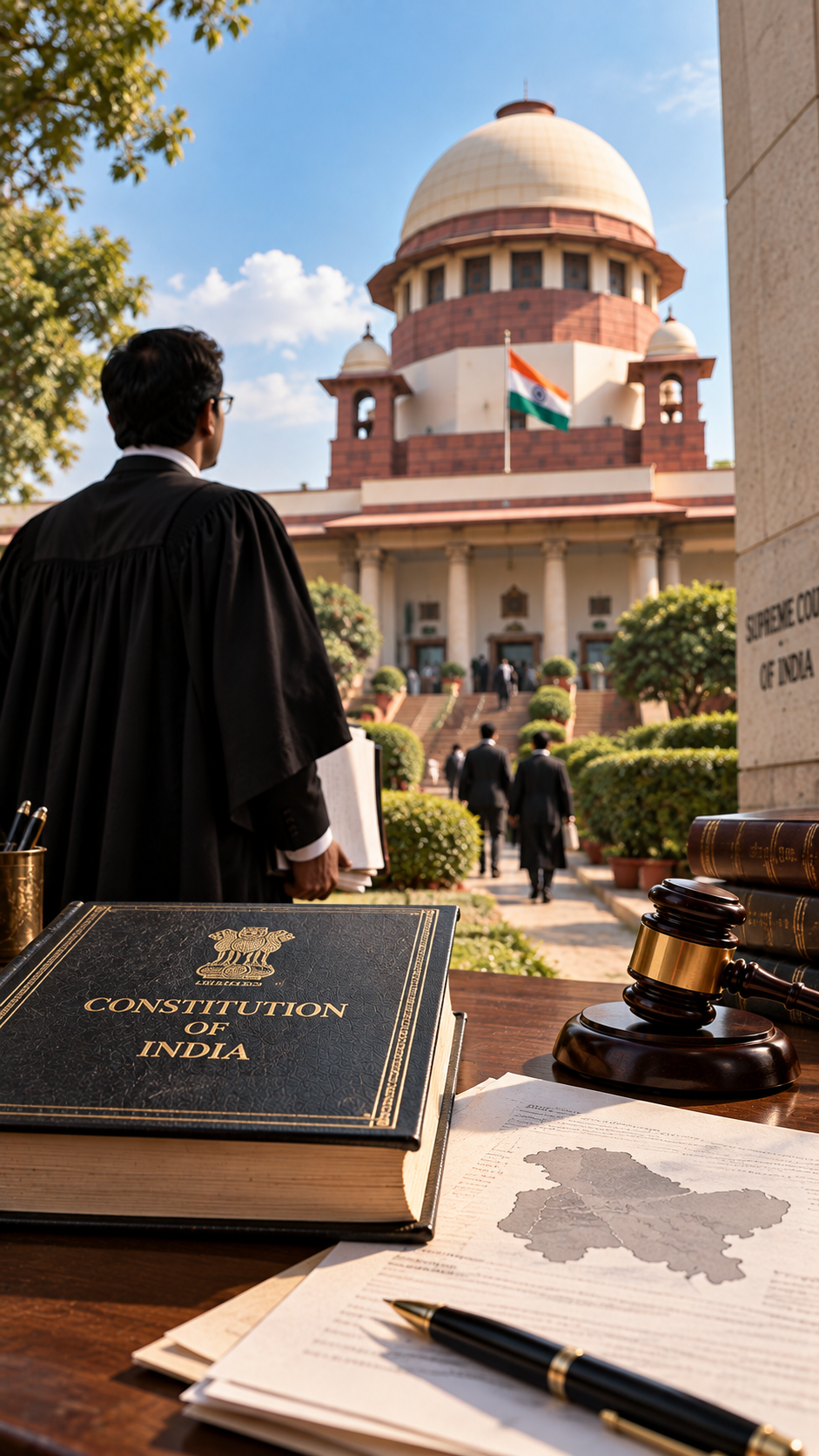
Delhi Law Academy Jaipur presents below for aspirants of Rajasthan Judicial Service (RJS), DJS, PCS (J) and other Judicial Services throughout India a very important judgment of the Supreme Court of India on Constitutional validity of Abrogation of Article 370 delivered on December 11, 2023.
Presented below: Summarized version by Delhi Law Academy Jaipur of the Supreme Court Judgment in the case of In Re: Article 370 of the Constitution [2023 INSC 1058] delivered on December 11, 2023.
Original language of the judgment has been maintained; without any substitution or replacement.
This judgment running in 476 pages has been summarized in just about 6 pages by Delhi Law Academy while retaining the original language and original content.
IN RE: ARTICLE 370 OF THE CONSTITUTION [2023 INSC 1058]
J U D G M E N T
2. Article 370 of the Constitution of India incorporated special arrangements for the governance of the State of Jammu and Kashmir. The President issued Constitutional Orders 272 and 273 during the subsistence of a Proclamation under Article 356(1)(b). These orders have the effect of applying the entire Constitution of India to the State of Jammu and Kashmir and abrogating Article 370. Contemporaneously, Parliament enacted the Jammu and Kashmir Reorganisation Act 20191 which bifurcated the State into two Union territories. The petitioners have challenged the constitutionality of these actions.
4. On 28 November 2018, the Governor submitted a report to the President recommending the invocation of Article 356 of the Constitution since six months since the issuance of the Proclamation under Section 92(3) was to end. On 19 December 2018, the President issued a Proclamation under Article 356 promulgating President’s rule in the State upon considering the report from the Governor of Jammu and Kashmir and other information. The Proclamation, inter alia, contained the following declarations:
a. The functions of the Government of the State and the powers vested in or exercisable by the Governor of that State under the Constitution of India and the State Constitution are assumed by the President;
b. The powers of the Legislature of the State shall be exercisable by or under the authority of Parliament; and
c. The first proviso and second provisos to Article 3 of the Constitution stand suspended.
5. The Proclamation was approved by the Lok Sabha on 28 December 2018 and by the Rajya Sabha on 3 January 2019.
6. The extension of President’s rule was approved by the Lok Sabha on 28 June 2019 and by the Rajya Sabha on 1 July 2019. President’s rule was extended on 3 July 2019. The duration of President’s rule in terms of Article 356(4) in its application to the State of Jammu and Kashmir was six months after the second of the resolutions was passed by the Rajya Sabha on 3 July 2019.
7. On 5 August 2019, the President issued CO 272, the Constitution (Application to Jammu and Kashmir) Order 2019. By the CO, the President in exercise of powers under Article 370(1), applied:
a. All the provisions of the Constitution of India by superseding all previous Constitution Orders by which select provisions of the Constitution were made applicable to Jammu and Kashmir either with or without modifications; and
b. Article 367(4) in which a modification was made, changing the term “Constituent Assembly” in the proviso to Article 370(3) to “Legislative Assembly.”
8. On 5 August 2019, Parliament undertook the following exercise in its capacity as the legislature of the State, since the Proclamation under Article 356 was subsisting:
a. The Rajya Sabha recommended to the President under Article 370(3) that all clauses of Article 370 shall cease to operate:
b. Simultaneously, the Rajya Sabha expressed its views on the Jammu and Kashmir Reorganisation Bill 20193 which was sent to the House under the proviso to Article 3
c. Simultaneously, the Lok Sabha also accepted the Jammu and Kashmir Reorganisation Bill 2019:
9. On 6 August 2019, Parliament discharged its functions as the legislature of the State of Jammu and Kashmir and proceeded with the following legislative business:
a. The Lok Sabha recommended to the President under Article 370 (3) that the special provision in Article 370 shall cease to be operative and the provision would instead apply all the provisions of the Constitution to the State of Jammu and Kashmir without any modifications and exceptions:
10. Both Houses of Parliament passed the Reorganisation Bill (after expressing their views in favour of such an exercise as stipulated in the proviso to Article 3) bifurcating the State of Jammu and Kashmir into:
a. the Union Territory of Jammu and Kashmir with the Legislative Assembly;
b. the Union Territory of Ladakh without the Legislative Assembly.
11. The Appendix to the Reorganisation Bill contained a Schedule listing out central legislations enacted under the Union List and the Concurrent List by Parliament which would thereafter be applicable to the two Union Territories.
12. On 6 August 2019, pursuant to the recommendation by the Lok Sabha, the President of India issued CO 273 under Article 370(3) of the Constitution as amended by CO 272 by which Article 370 ceased to apply with effect from 6 August 2019. On 9 August 2019, the Union Ministry of Home Affairs issued a notification, S.O. 2889 (E), in exercise of the powers conferred by Section 2(a) of the Reorganisation Act bringing the provisions of the Act into force with effect from 31 October 2019 following Presidential assent. Pursuant to this notification, the State of Jammu and Kashmir stood bifurcated on 31 October 2019 into the Union Territory of Ladakh and the Union Territory of Jammu and Kashmir. President’s rule was revoked.
13. On 19 August 2019, the jurisdiction of this Court was invoked under Article 32 of the Constitution in Dr Shah Faesal v. Union of India.
📘 Free Study Material for Judiciary Aspirants!
Download our FREE study material prepared by Delhi Law Academy’s expert faculty.
CONCLUSIONS
514. In view of the above discussion, the following are the conclusions:
a. The State of Jammu and Kashmir does not retain any element of sovereignty after the execution of the IoA and the issuance of the Proclamation dated 25 November 1949 by which the Constitution of India was adopted. The State of Jammu and Kashmir does not have ‘internal sovereignty’ which is distinguishable from the powers and privileges enjoyed by other States in the country. Article 370 was a feature of asymmetric federalism and not sovereignty;
b. The petitioners did not challenge the issuance of the Proclamations under Section 92 of the Jammu and Kashmir Constitution and Article 356 of the Indian Constitution until the special status of Jammu and Kashmir was abrogated. The challenge to the Proclamations does not merit adjudication because the principal challenge is to the actions which were taken after the Proclamation was issued;
c. The exercise of power by the President after the Proclamation under Article 356 is issued is subject to judicial review. The exercise of power by the President must have a reasonable nexus with the object of the Proclamation. The person challenging the exercise of power must prima facie establish that it is a mala fide or extraneous exercise of power. Once a prima facie case is made, the onus shifts to the Union to justify the exercise of such power;
d. The power of Parliament under Article 356(1)(b) to exercise the powers of the Legislature of the State cannot be restricted to law-making power thereby excluding non-law making power of the Legislature of the State. Such an interpretation would amount to reading in a limitation into the provision contrary to the text of the Article;
e. It can be garnered from the historical context for the inclusion of Article 370 and the placement of Article 370 in Part XXI of the Constitution that it is a temporary provision;
f. The power under Article 370(3) did not cease to exist upon the dissolution of the Constituent Assembly of Jammu and Kashmir. When the Constituent Assembly was dissolved, only the transitional power recognised in the proviso to Article 370(3) which empowered the Constituent Assembly to make its recommendations ceased to exist. It did not affect the power held by the President under Article 370(3);
g. Article 370 cannot be amended by exercise of power under Article 370(1)(d). Recourse must have been taken to the procedure contemplated by Article 370(3) if Article 370 is to cease to operate or is to be amended or modified in its application to the State of Jammu and Kashmir. Paragraph 2 of CO 272 by which Article 370 was amended through Article 367 is ultra vires Article 370(1)(d) because it modifies Article 370, in effect, without following the procedure prescribed to modify Article 370. An interpretation clause cannot be used to bypass the procedure laid down for amendment;
h. The exercise of power by the President under Article 370(1)(d) to issue CO 272 is not mala fide. The President in exercise of power under Article 370(3) can unilaterally issue a notification that Article 370 ceases to exist. The President did not have to secure the concurrence of the Government of the State or Union Government acting on behalf of the State Government under the second proviso to Article 370(1)(d) while applying all the provisions of the Constitution to Jammu and Kashmir because such an exercise of power has the same effect as an exercise of power under Article 370(3) for which the concurrence or collaboration with the State Government was not required;
i. Paragraph 2 of CO 272 issued by the President in exercise of power under Article 370(1)(d) applying all the provisions of the Constitution of India to the State of Jammu and Kashmir is valid. Such an exercise of power is not mala fide merely because all the provisions were applied together without following a piece-meal approach;
j. The President had the power to issue a notification declaring that Article 370(3) ceases to operate without the recommendation of the Constituent Assembly. The continuous exercise of power under Article 370(1) by the President indicates that the gradual process of constitutional integration was ongoing. The declaration issued by the President under Article 370(3) is a culmination of the process of integration and as such is a valid exercise of power. Thus, CO 273 is valid;
k. The Constitution of India is a complete code for constitutional governance. Following the application of the Constitution of India in its entirety to the State of Jammu and Kashmir by CO 273, the Constitution of the State of Jammu and Kashmir is inoperative and is declared to have become redundant;
l. The views of the Legislature of the State under the first proviso to Article 3 are recommendatory. Thus, Parliament’s exercise of power under the first proviso to Article 3 under the Proclamation was valid and not mala fide;
m. The Solicitor General stated that the statehood of Jammu and Kashmir will be restored (except for the carving out of the Union Territory of Ladakh). In view of the statement we do not find it necessary to determine whether the reorganisation of the State of Jammu and Kashmir into two Union Territories of Ladakh and Jammu and Kashmir is permissible under Article 3. However, we uphold the validity of the decision to carve out the Union Territory of Ladakh in view of Article 3(a) read with Explanation I which permits forming a Union Territory by separation of a territory from any State; and
n. We direct that steps shall be taken by the Election Commission of India to conduct elections to the Legislative Assembly of Jammu and Kashmir constituted under Section 14 of the Reorganisation Act by 30 September 2024. Restoration of statehood shall take place at the earliest and as soon as possible.
Explore More Free Resources from Delhi Law Academy
Stay updated with our monthly current affairs and explore more important legal and judicial-service articles from Delhi Law Academy.
Contact us
📍 Delhi Law Academy – Jaipur Branch
6C, Tower 2, Coaching Hub, Pratap Nagar, Jaipur – 302033
📞 Phone:
+91 9911916552
+91 8447285606
✉️ Email:
contactus@delhilawacademy.com