
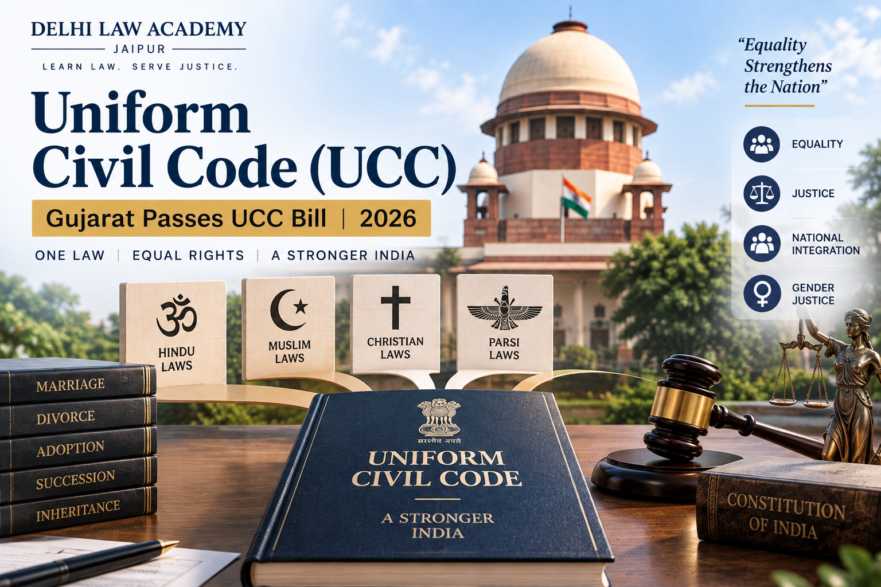
Uniform Civil Code (UCC): Gujarat Passes UCC Bill 2026
Gujarat became the second Indian state after Uttarakhand to pass a Uniform Civil Code (UCC) Bill.
Gujarat became the second Indian state after Uttarakhand to pass a Uniform Civil Code (UCC) Bill. The Gujarat Uniform Civil Code Bill, 2026 was introduced in the Gujarat Legislative Assembly in March 2026 and was subsequently passed by the State. The Union Government also formally noted Gujarat’s passage of the UCC Bill after Uttarakhand. :contentReference[oaicite:0]{index=0}
About Uniform Civil Code (UCC)
• UCC aims to replace diverse personal laws governing marriage, divorce, adoption, succession and inheritance with a common, secular legal framework to promote equality, national integration, and gender justice.
• Constitutional provision: Under Article 44 under Part IV as Directive Principles of State Policy (DPSP) provides that the State shall endeavor to secure for the citizens a uniform civil code throughout the territory of India.
Article 44 is a Directive Principle of State Policy and provides that the State shall endeavour to secure for the citizens a uniform civil code throughout the territory of India.
Personal Laws in India
• Currently, different religious communities in India follow separate personal laws:
o Hindu Personal Laws: For Hindus, Buddhists, Jains, and Sikhs (Hindu Marriage Act, 1955; Hindu Succession Act, 1956, etc.).
o Muslim Personal Laws: The Muslim Personal law (Shariat) Application Act, 1937 regulates matters related to marriage, divorce, inheritance, and maintenance among Muslims.
o Christian Personal Laws: Indian Christian Marriage Act, 1872; The Divorce Act, 1869, etc.
o Parsi Personal Laws: Parsi Marriage and Divorce Act, 1936
Special Marriage Act, 1954
• Special Marriage Act, 1954: Allows any Indian citizen to marry irrespective of religion, under civil laws, providing an option outside religious laws.
Law Commission and the UCC Debate
• While the 21st Law Commission (2018) underlined that UCC is neither necessary nor desirable at this stage, Law Commission of India (2022) sought public and religious input on UCC.
The Law Commission’s records show that the issue of a Uniform Civil Code has been the subject of public notices and consultations over different periods. The Commission issued a public notice on UCC in 2023 seeking the views of stakeholders. :contentReference[oaicite:1]{index=1}
UCC in Different Parts of India
• Apart from Uttarakhand and Gujarat, Goa also has a form of common civil code is in practice i.e. the Portuguese Civil Code of 1867.
Gujarat UCC 2026
The Gujarat Uniform Civil Code, 2026 is intended to govern and regulate laws relating to marriage and divorce, succession, live-in relationships and matters related thereto. The Bill was published as Gujarat Bill No. 17 of 2026. :contentReference[oaicite:2]{index=2}
📘 Free Study Material for Judiciary Aspirants!
Download our FREE study material prepared by Delhi Law Academy’s expert faculty.
Judicial Pronouncements Related to UCC
Mohd. Ahmed Khan v. Shah Bano Begum (1985)
• Mohd. Ahmed Khan v. Shah Bano Begum Case (1985): Supreme Court (SC) directed the Parliament to make law related to the Uniform Civil Code.
Sarla Mudgal Case v. Union of India (1995)
• Sarla Mudgal Case Vs. the Union of India (1995): SC stressed the necessity of UCC for gender equality among religions.
John Vellamettom v. Union of India (2003)
• John Vellamettom Vs. Union of India (2003): SC reiterated that UCC would help in establishing national integration by avoiding contradictions on the grounds of ideologies.
Shayara Bano v. Union of India (2017)
• Shayara Bano v. Union of India (2017): SC declared the practice of instant triple talaq (talaq-e-biddat) unconstitutional, marking a shift in state action towards protecting women’s rights in personal law.
Exam Focus
Article 44 — Uniform Civil Code
Part IV — Directive Principles of State Policy
Hindu Personal Laws — Hindu Marriage Act, Hindu Succession Act, etc.
Muslim Personal Law — Muslim Personal Law (Shariat) Application Act, 1937
Special Marriage Act, 1954 — Civil marriage irrespective of religion
Uttarakhand — First State to enact a UCC framework
Gujarat — Second State to pass a UCC Bill in 2026
Goa — Portuguese Civil Code framework in operation
Key Takeaways
✔ Article 44 directs the State to endeavour to secure a Uniform Civil Code throughout India.
✔ Article 44 forms part of the Directive Principles of State Policy.
✔ India has historically had different personal-law systems for different religious communities.
✔ The Special Marriage Act provides a secular civil-law route for marriage irrespective of religion.
✔ Uttarakhand was the first State to enact a UCC law, followed by Gujarat’s passage of the UCC Bill in 2026.
✔ UCC has been considered by the Supreme Court in several important judgments including Shah Bano, Sarla Mudgal, John Vallamattom and Shayara Bano.
Frequently Asked Questions
What is Uniform Civil Code?
Uniform Civil Code refers to the idea of a common civil-law framework governing matters such as marriage, divorce, succession and inheritance for citizens irrespective of religion.
Which Article of the Constitution deals with UCC?
Article 44 of the Constitution deals with the Uniform Civil Code and forms part of the Directive Principles of State Policy.
Which State was the first to implement a Uniform Civil Code?
Uttarakhand was the first State in independent India to enact a comprehensive Uniform Civil Code framework.
Which State became the second to pass a UCC Bill?
Gujarat became the second State after Uttarakhand to pass a Uniform Civil Code Bill in 2026. :contentReference[oaicite:3]{index=3}
Does Goa have a common civil code?
Goa follows a common civil-law framework historically derived from the Portuguese Civil Code of 1867.
What is the significance of Article 44?
Article 44 expresses a constitutional objective of securing a Uniform Civil Code for citizens throughout India. It is contained in Part IV and therefore forms part of the Directive Principles of State Policy.
Explore More Free Resources from Delhi Law Academy
Stay updated with our monthly current affairs and explore more important legal and judicial-service articles from Delhi Law Academy.
Contact us
📍 Delhi Law Academy – Jaipur Branch
6C, Tower 2, Coaching Hub, Pratap Nagar, Jaipur – 302033
📞 Phone:
+91 9911916552
+91 8447285606
✉️ Email:
contactus@delhilawacademy.com