
IBC Completes 10 Years: Key Features and 2026 Amendment
Insolvency and Bankruptcy Code, 2016 completes 10 years of implementation.
Insolvency and Bankruptcy Code (IBC) Completes 10 Years of Implementation
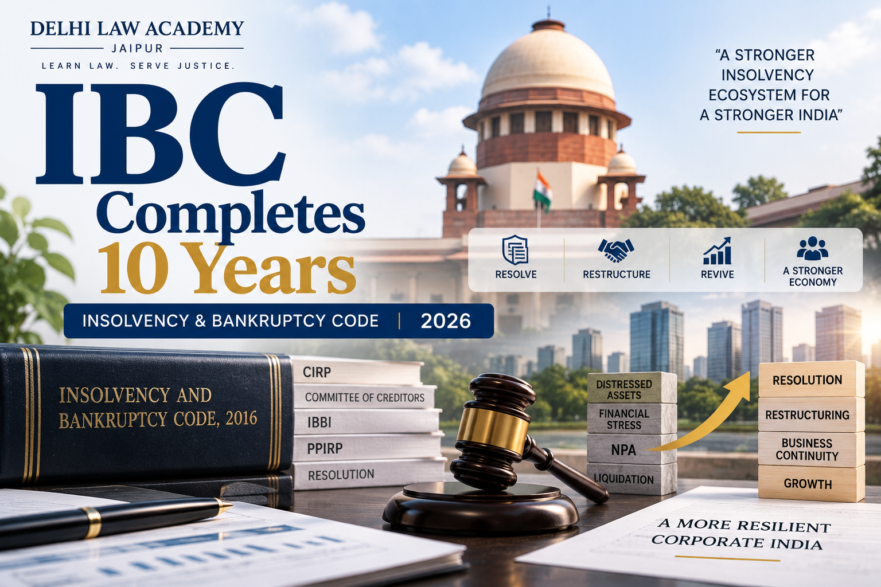
The Insolvency and Bankruptcy Code (IBC), 2016 has completed 10 years of its existence in 2026. The Code came into force in 2016 and was introduced as a major reform to India’s insolvency framework. :contentReference[oaicite:0]{index=0}
More on the News
• The Ministry of Corporate Affairs recently notified the IBC Amendment Act, 2026.
The Insolvency and Bankruptcy Code (Amendment) Act, 2026 received Presidential assent on 6 April 2026. The IBBI subsequently published the Act and, on 25 May 2026, notified the provision relating to its commencement. :contentReference[oaicite:1]{index=1}
About Insolvency and Bankruptcy Code, 2016
Genesis
• Genesis: Enacted on the recommendations of the Bankruptcy Law Reforms Committee (BLRC), chaired by Dr. T.K. Viswanathan.
Objective
• Objective: To establish a unified framework for resolving insolvency across companies, partnership firms and individuals.
Key Features
• Key Features: It consolidated multiple insolvency laws into a single structure.
o Earlier, following dealt with the Insolvency- Companies Act, the Sick Industrial Companies Act (SICA), debt recovery mechanisms and secured creditor frameworks including SARFAESI.
o It shifted the credit paradigm from a fragmented, debtor-friendly debtor-in-possession era to a unified, time bound creditor-in-control model.
Why the IBC Was Significant
The IBC was introduced to replace a fragmented insolvency framework with a unified and time-bound mechanism for resolving financial distress. Ten years after its enactment, the Ministry of Corporate Affairs described the Code as a major institutional reform affecting credit markets, corporate behaviour, investor confidence and economic efficiency. :contentReference[oaicite:2]{index=2}
Resolution Mechanism
• Resolution Mechanism: Corporate Insolvency Resolution Process (CIRP), which provides a structured mechanism for resolving corporate insolvency.
o The Committee of Creditors (CoC), comprising financial creditors, evaluates resolution plans.
o They then make important commercial decisions regarding the future of the stressed entity.
Pre-Packaged Insolvency Resolution Process
• Pre-Packaged (PPIRP): A faster, hybrid framework designed specifically for MSMEs, requiring completion within 120 days.
The pre-packaged insolvency resolution process was introduced for MSMEs as an alternative, quicker and less disruptive insolvency-resolution mechanism. :contentReference[oaicite:3]{index=3}
Key Successful Resolution Case Studies
• Key Successful resolution case study of IBC: Essar Steel Resolution (creditors recovered decent claims), Bhushan Steel and Power (successful turnaround of distressed assets), etc.
📘 Free Study Material for Judiciary Aspirants!
Download our FREE study material prepared by Delhi Law Academy’s expert faculty.
Insolvency and Bankruptcy Board of India
• Statutory body under the Insolvency and Bankruptcy Code, 2016.
• Regulates both Insolvency profession as well as processes.
• Regulatory oversight over IPs, Insolvency Professional Agencies, IPEs and Information Utilities.
• Composition: Chairperson, 3 ex-officio members of Central Government, 1 ex-officio member of RBI, and 5 other members (at least 3 full-time) nominated by centre.
IBBI at a Glance
Full Name: Insolvency and Bankruptcy Board of India
Nature: Statutory body
Role: Regulation of the insolvency profession and insolvency processes
Legal Basis: Insolvency and Bankruptcy Code, 2016
IBC After a Decade
The completion of ten years marks an important milestone for India’s insolvency framework. According to the Ministry of Corporate Affairs, the IBC resolution process had facilitated realisation of more than ₹4 lakh crore for creditors by May 2026. The Government has described the Code as a major institutional transformation in India’s approach to insolvency resolution. :contentReference[oaicite:4]{index=4}
The IBC has also continued to evolve through amendments and regulatory changes. The Insolvency and Bankruptcy Code (Amendment) Act, 2026 is part of this continuing reform process, while IBBI continues to update the regulations governing corporate insolvency, liquidation, pre-packaged insolvency and related processes. :contentReference[oaicite:5]{index=5}
Exam Focus
IBC, 2016 — Unified insolvency framework
BLRC — Bankruptcy Law Reforms Committee
CIRP — Corporate Insolvency Resolution Process
CoC — Committee of Creditors
PPIRP — Pre-Packaged Insolvency Resolution Process
IBBI — Insolvency and Bankruptcy Board of India
2026 Amendment — Insolvency and Bankruptcy Code (Amendment) Act, 2026
10-year milestone — IBC completed ten years in May 2026
Key Takeaways
✔ The Insolvency and Bankruptcy Code was enacted in 2016 as a unified insolvency framework.
✔ The Code was enacted on the recommendations of the Bankruptcy Law Reforms Committee chaired by Dr. T.K. Viswanathan.
✔ CIRP provides the principal structured mechanism for corporate insolvency resolution.
✔ The Committee of Creditors plays a central role in evaluating resolution plans and taking commercial decisions.
✔ PPIRP provides a faster insolvency-resolution framework for MSMEs.
✔ IBBI is the statutory regulatory body established under the IBC.
✔ The Insolvency and Bankruptcy Code (Amendment) Act, 2026 marks another stage in the evolution of India’s insolvency framework.
Further Reading
For more legal current affairs and important developments relevant to law and competitive examinations, explore the Delhi Law Academy blog and monthly current affairs resources.
Frequently Asked Questions
What is the Insolvency and Bankruptcy Code?
The Insolvency and Bankruptcy Code, 2016 provides a consolidated legal framework for dealing with insolvency and bankruptcy in India.
When did the IBC complete 10 years?
The IBC completed ten years of existence in May 2026. The Ministry of Corporate Affairs marked the milestone on 28 May 2026. :contentReference[oaicite:6]{index=6}
What is CIRP?
CIRP stands for Corporate Insolvency Resolution Process and provides a structured mechanism for resolving the insolvency of corporate debtors.
What is the role of the Committee of Creditors?
The Committee of Creditors evaluates resolution plans and takes important commercial decisions concerning the future of a stressed corporate entity.
What is PPIRP?
PPIRP stands for Pre-Packaged Insolvency Resolution Process. It provides an alternative insolvency-resolution framework designed for eligible MSMEs.
What is IBBI?
IBBI is the Insolvency and Bankruptcy Board of India, the statutory regulatory body established under the Insolvency and Bankruptcy Code.
Explore More Free Resources from Delhi Law Academy
Stay updated with our monthly current affairs and explore more important legal and judicial-service articles from Delhi Law Academy.
Contact us
📍 Delhi Law Academy – Jaipur Branch
6C, Tower 2, Coaching Hub, Pratap Nagar, Jaipur – 302033
📞 Phone:
+91 9911916552
+91 8447285606
✉️ Email:
contactus@delhilawacademy.com