
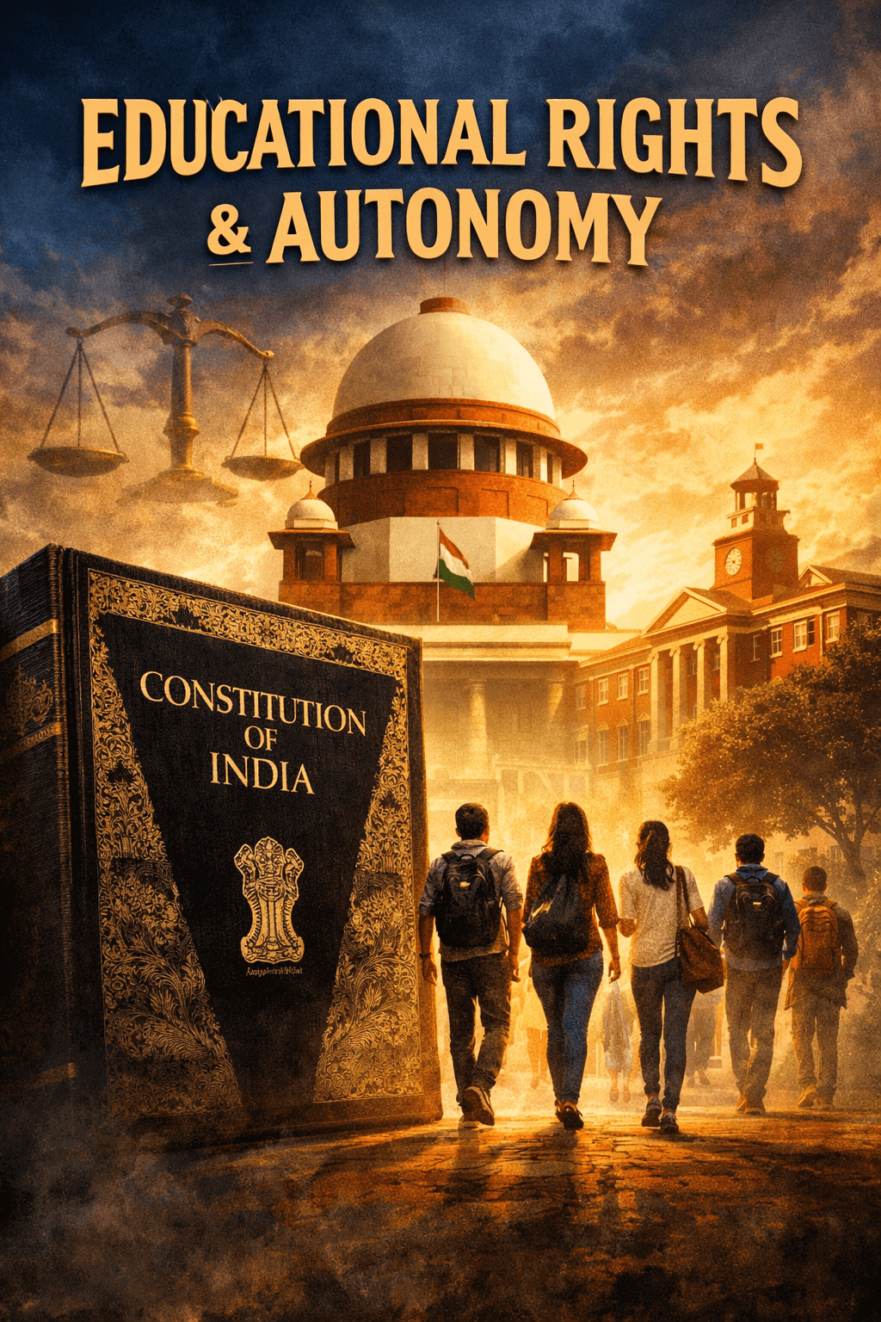
Unni Krishnan v State of Andhra Pradesh (1993): Right to Education and Regulation Explained
The Unni Krishnan case is one of the most significant judgments in Indian constitutional law relating to education. This case clarified the scope of the right to education and defined the extent of government regulation over private educational institutions.
The judgment also modified the earlier Mohini Jain decision and laid the foundation for the later insertion of Article 21A in the Constitution.
Read the full constitutional framework here:
Reservation and Autonomy of Educational Institutions in India: Constitutional Framework
📚 Background of the Case
Following the Mohini Jain judgment, many private professional colleges challenged state laws regulating admissions and fee structures.
The states of Andhra Pradesh, Karnataka, Maharashtra, and Tamil Nadu had introduced laws to regulate admissions and prevent exploitation through capitation fees.
Private colleges argued that these regulations violated their fundamental right to carry on occupation under Article 19(1)(g).
👨 Facts of the Case
Several private medical and engineering colleges filed petitions challenging state laws controlling admissions and fees.
The petitioners argued that such regulations interfered with their autonomy.
The case was heard by a Constitution Bench of the Supreme Court.
⚖️ Legal Issues Before the Supreme Court
- Whether the right to education is a fundamental right under Article 21.
- Whether the State can regulate admissions and fees in private educational institutions.
- Whether private institutions have absolute autonomy.
🏛️ Arguments of the Petitioners (Private Colleges)
- Running educational institutions is protected under Article 19(1)(g).
- State regulations interfered with institutional autonomy.
- Fee restrictions violated their fundamental rights.
🏛️ Arguments of the State
- Education is a public welfare activity.
- State regulation is necessary to prevent exploitation.
- Capitation fees violate equality principles.
👨⚖️ Supreme Court Judgment
The Supreme Court partly upheld and partly modified the Mohini Jain judgment.
The Court held that the right to education is a fundamental right under Article 21, but only up to the age of 14 years.
Beyond this level, the right depends on the economic capacity of the State.
⚖️ Key Observations of the Court
- The right to education flows from the right to life under Article 21.
- The State has a duty to provide free education up to age 14.
- Private institutions cannot charge arbitrary capitation fees.
- The State has the authority to regulate admissions and fees.
- Institutional autonomy is not absolute.
📜 The Unni Krishnan Scheme
The Court introduced a structured admission scheme.
- A portion of seats was reserved for merit-based admission.
- Remaining seats could be filled by management.
- Fee structure was regulated.
This scheme aimed to balance autonomy and fairness.
📊 Constitutional Provisions Discussed
- Article 21 – Right to Life
- Article 19(1)(g) – Freedom of occupation
- Article 14 – Right to Equality
- Directive Principles relating to education
📈 Impact of the Judgment
The judgment had long-term constitutional and legislative impact.
- It formally recognized right to education up to age 14.
- It allowed reasonable state regulation.
- It prevented commercialization of education.
- It led to insertion of Article 21A in 2002.
⚖️ Later Developments
The Unni Krishnan scheme was later modified in the T.M.A. Pai case (2002).
However, its recognition of education as a fundamental right remains significant.
📚 Importance for Law Students and Judiciary Aspirants
This case is frequently asked in judicial service and constitutional law exams.
It explains the balance between institutional autonomy and state regulation.
📌 Conclusion
The Unni Krishnan judgment clarified the scope of the right to education in India.
It ensured that education remains accessible while allowing reasonable institutional freedom.
This case remains a cornerstone of Indian education law.
📘 Stay Ahead with Delhi Law Academy!
Get access to free monthly current affairs, read our insightful blogs,
and explore free study resources prepared by experts at DLA Jaipur. 🚀
❓ Frequently Asked Questions (FAQs)
1. What did the Unni Krishnan case decide?
The Supreme Court held that the right to education is a fundamental right up to age 14 under Article 21.
2. How did Unni Krishnan case modify Mohini Jain case?
It limited the fundamental right to education to children up to 14 years.
3. What is the Unni Krishnan scheme?
It was a structured admission and fee regulation system for private colleges.
4. Which Article guarantees right to education?
Initially Article 21 through interpretation, later Article 21A was added.
5. Why is Unni Krishnan case important?
It shaped education law and led to Article 21A.
6. Which case later modified Unni Krishnan judgment?
The T.M.A. Pai Foundation case (2002).
Contact us
📍 Delhi Law Academy – Jaipur Branch
6C, Tower 2, Coaching Hub, Pratap Nagar, Jaipur – 302033
📞 Phone:
+91 9911916552
+91 8447285606
✉️ Email:
contactus@delhilawacademy.com