
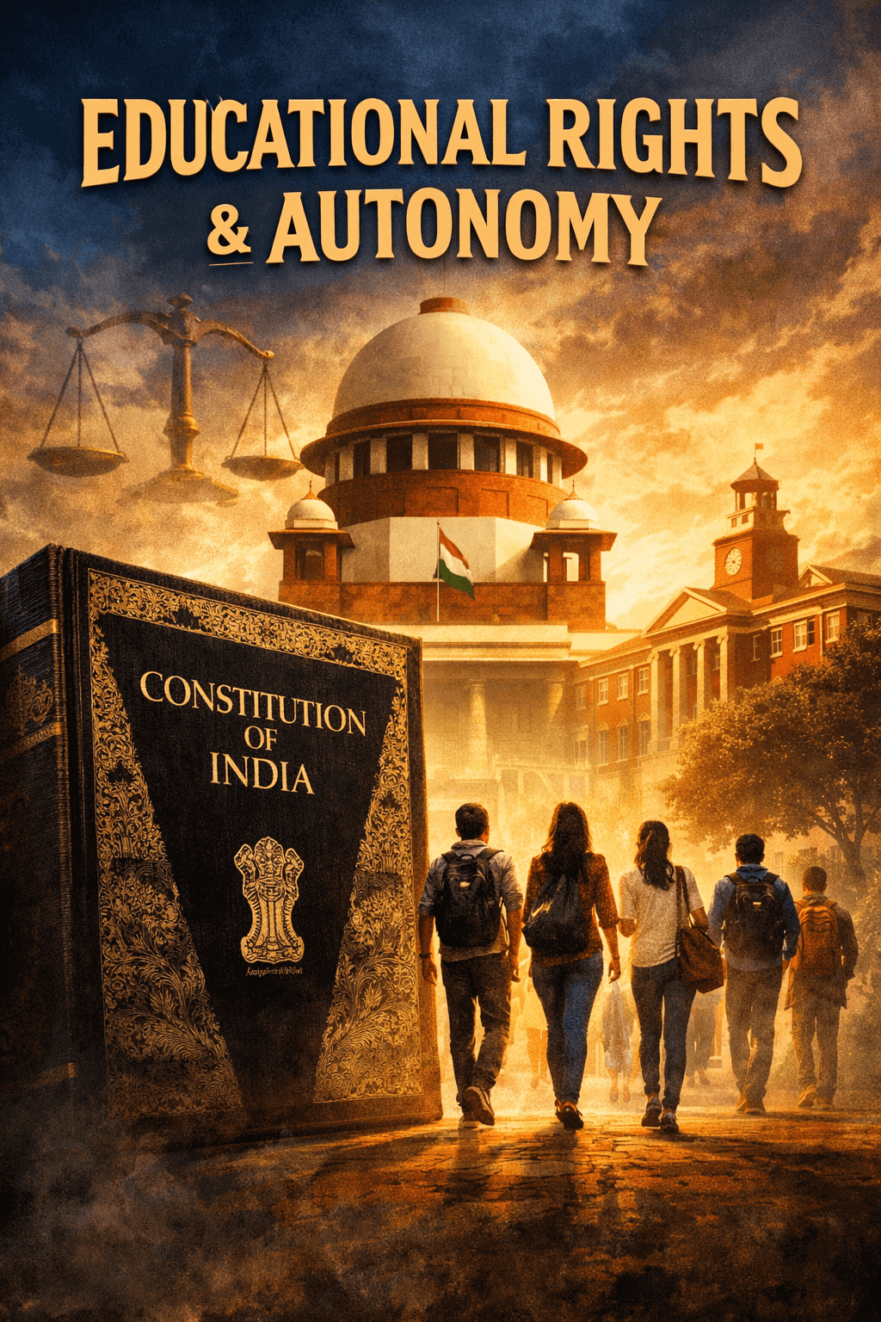
T.M.A. Pai Foundation v State of Karnataka (2002): Autonomy of Educational Institutions Explained
The T.M.A. Pai Foundation case is the most important judgment in Indian education law. Decided by an 11-judge Constitution Bench of the Supreme Court, this case clarified the extent of autonomy of private educational institutions and the rights of minority institutions under the Constitution.
This judgment fundamentally reshaped the relationship between the State and educational institutions.
Read the full constitutional framework here:
Reservation and Autonomy of Educational Institutions in India: Constitutional Framework
📚 Background of the Case
After the Unni Krishnan judgment, many private educational institutions challenged excessive government control over admissions and fees.
Private institutions argued that state regulations violated their fundamental rights under Article 19(1)(g) and Article 30.
The Supreme Court referred the matter to an 11-judge bench due to its constitutional importance.
👨⚖️ Legal Issues Before the Court
- Whether private educational institutions have autonomy in administration.
- Whether the State can impose reservation in private institutions.
- What rights minority institutions have under Article 30.
- Whether the Unni Krishnan scheme was constitutionally valid.
⚖️ Constitutional Provisions Involved
- Article 19(1)(g) – Freedom to practice any profession
- Article 26 – Freedom to manage religious affairs
- Article 29 – Protection of minority interests
- Article 30 – Right of minorities to establish and administer institutions
- Article 14 – Equality before law
🏛️ Arguments of Private Institutions
- Running educational institutions is a fundamental right.
- Government interference violated institutional autonomy.
- The Unni Krishnan scheme imposed excessive restrictions.
🏛️ Arguments of the State
- Education is a public welfare activity.
- State regulation is necessary to ensure fairness.
- Regulation prevents commercialization of education.
👨⚖️ Supreme Court Judgment
The Supreme Court held that private educational institutions have the right to establish and administer institutions under Article 19(1)(g).
The Court struck down the rigid Unni Krishnan admission scheme.
The Court recognized institutional autonomy while allowing reasonable state regulation.
⚖️ Key Principles Established by the Court
1. Right to Establish Educational Institutions
Citizens have the fundamental right to establish educational institutions under Article 19(1)(g).
2. Minority Rights Under Article 30
Minorities have the fundamental right to establish and administer educational institutions of their choice.
This right is strongly protected.
3. Institutional Autonomy
Educational institutions have autonomy in:
- Admission procedures
- Fee structure
- Administration
However, reasonable regulation is allowed.
4. State Regulation Is Permissible but Limited
The State can regulate educational institutions to:
- Prevent maladministration
- Ensure fairness
- Maintain academic standards
But excessive control is unconstitutional.
📊 Minority vs Non-Minority Institutions
Minority Institutions
- Enjoy stronger constitutional protection
- Have greater autonomy
- Protected under Article 30
Non-Minority Institutions
- Have autonomy under Article 19(1)(g)
- Subject to reasonable regulation
📈 Impact of the Judgment
The T.M.A. Pai judgment had major consequences:
- Recognized autonomy of educational institutions
- Strengthened minority rights
- Limited excessive state interference
- Overruled parts of Unni Krishnan scheme
- Became the foundation of modern education law
⚖️ Subsequent Related Judgments
This judgment was clarified in later cases:
- Islamic Academy Case (2003)
- P.A. Inamdar Case (2005)
📚 Importance for Judiciary Exams and Law Students
This case is one of the most frequently asked constitutional law judgments.
It explains the balance between institutional autonomy and state regulation.
📌 Conclusion
The T.M.A. Pai Foundation judgment is the cornerstone of education law in India.
It established that educational institutions have autonomy while allowing reasonable state regulation.
This balance continues to guide Indian education law today.
📘 Stay Ahead with Delhi Law Academy!
Get access to free monthly current affairs, read our insightful blogs,
and explore free study resources prepared by experts at DLA Jaipur. 🚀
❓ Frequently Asked Questions (FAQs)
1. What is the T.M.A. Pai case famous for?
It established autonomy of educational institutions and clarified minority rights.
2. Which bench decided T.M.A. Pai case?
An 11-judge Constitution Bench of the Supreme Court.
3. What rights do minority institutions have?
They have the right to establish and administer institutions under Article 30.
4. Can government regulate private colleges after T.M.A. Pai?
Yes, but only reasonable regulation is allowed.
5. Did T.M.A. Pai overrule Unni Krishnan case?
Yes, it overruled parts of the Unni Krishnan scheme.
6. Why is T.M.A. Pai case important?
It is the foundation of modern education and autonomy law in India.
Contact us
📍 Delhi Law Academy – Jaipur Branch
6C, Tower 2, Coaching Hub, Pratap Nagar, Jaipur – 302033
📞 Phone:
+91 9911916552
+91 8447285606
✉️ Email:
contactus@delhilawacademy.com