
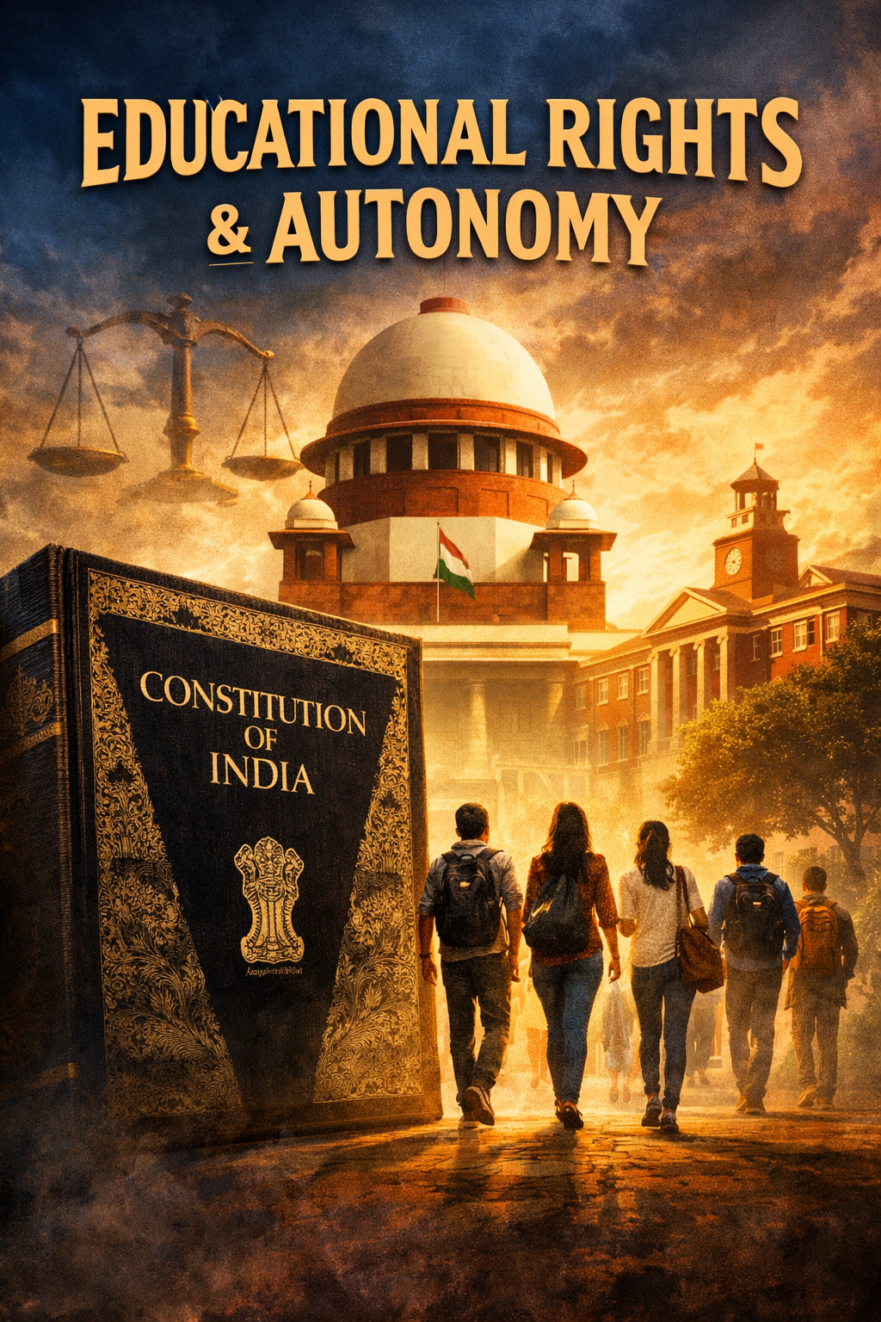
Reservation and Autonomy of Educational Institutions in India: Constitutional Framework
The Indian Constitution seeks to balance two important objectives in the field of education: ensuring equality through reservation policies and protecting the autonomy of educational institutions. Over time, the Supreme Court of India has played a crucial role in defining the extent of state regulation, institutional freedom, and minority rights.
This article explains the constitutional provisions, legal principles, and landmark judgments governing reservation and autonomy in educational institutions in India.
📚 Constitutional Foundations of Educational Rights
The Constitution of India contains several provisions that regulate education, equality, and minority rights.
Article 14 – Right to Equality
Article 14 guarantees equality before law and equal protection of laws. Reservation policies must comply with this principle and cannot be arbitrary.
Article 15 – Prohibition of Discrimination and Reservation
Article 15 prohibits discrimination on grounds of religion, race, caste, sex, or place of birth. However, it allows the State to make special provisions for socially and educationally backward classes, Scheduled Castes (SC), and Scheduled Tribes (ST).
The 93rd Constitutional Amendment introduced Article 15(5), allowing reservation in private educational institutions, except minority institutions.
Article 19(1)(g) – Freedom to Practice Profession
This Article guarantees the right to practice any profession or carry on any occupation. Running educational institutions is considered a protected occupation, subject to reasonable restrictions.
Article 21 and Article 21A – Right to Education
The Supreme Court interpreted Article 21 (Right to Life) to include the right to education. Later, Article 21A was inserted to make education a fundamental right for children aged 6 to 14 years.
Articles 29 and 30 – Minority Educational Rights
Articles 29 and 30 protect the cultural and educational rights of minorities. Minority communities have the right to establish and administer educational institutions of their choice.
⚖️ Concept of Institutional Autonomy
Institutional autonomy refers to the freedom of educational institutions to manage their internal affairs, including admissions, fee structure, and administration.
The Supreme Court has recognized that autonomy is essential for maintaining academic standards and institutional independence.
However, autonomy is not absolute and is subject to reasonable state regulation.
🏛️ State Regulation and Reservation Policy
The State has the authority to regulate educational institutions in the interest of fairness, transparency, and social justice.
Reservation policies aim to provide equal opportunities to disadvantaged communities.
However, excessive state interference may violate institutional autonomy.
The Supreme Court has repeatedly emphasized the need to balance these competing interests.
👨⚖️ Minority vs Non-Minority Educational Institutions
Minority Institutions
Minority institutions enjoy special protection under Article 30.
- They have greater autonomy in administration.
- The State cannot impose reservation policies in certain circumstances.
- Their fundamental right to administer institutions is strongly protected.
Non-Minority Institutions
Non-minority institutions are subject to broader regulatory powers of the State.
Reservation policies and admission regulations may be applied.
⚖️ Evolution Through Supreme Court Judgments
The Supreme Court has clarified these principles through several landmark judgments.
These decisions have shaped modern education law in India.
🔗 Landmark Supreme Court Judgments on Educational Autonomy and Reservation
Mohini Jain v State of Karnataka (1992): Right to Education and Capitation Fees
Unni Krishnan v State of Andhra Pradesh (1993): Right to Education and State Regulation
T.M.A. Pai Foundation v State of Karnataka (2002): Autonomy of Educational Institutions
- Islamic Academy v State of Karnataka (2003): Regulation of Private Educational Institutions
P.A. Inamdar v State of Maharashtra (2005): Reservation in Private Educational Institutions
Ashoka Kumar Thakur v Union of India (2008): Validity of OBC Reservation in Education
⚖️ Key Legal Principles Established
Based on constitutional provisions and Supreme Court judgments, the following principles have emerged:
- Right to education is part of the right to life.
- Educational institutions have autonomy in administration.
- State regulation must be reasonable and not excessive.
- Minority institutions have special protection.
- Reservation policies must comply with constitutional principles.
- Balance must be maintained between equality and autonomy.
📊 Importance for Students and Judiciary Aspirants
This topic is highly relevant for law students, CLAT aspirants, and judicial service candidates.
Questions on T.M.A. Pai, Inamdar, and Unni Krishnan frequently appear in examinations.
Understanding these principles is essential for constitutional law.
📌 Conclusion
The constitutional framework governing education in India reflects a careful balance between institutional autonomy and social justice.
The Supreme Court has played a vital role in interpreting these rights and ensuring fairness.
This balance continues to evolve as education remains central to India’s democratic and social development.
📘 Stay Ahead with Delhi Law Academy!
Get access to free monthly current affairs, read our insightful blogs,
and explore free study resources prepared by experts at DLA Jaipur. 🚀
❓ Frequently Asked Questions (FAQs)
1. What is autonomy of educational institutions in India?
It refers to the freedom of institutions to manage admissions, fees, and administration without excessive government interference.
2. Can the government impose reservation in private colleges?
Reservation may be imposed in certain private institutions, but minority institutions have special protection.
3. What did the T.M.A. Pai case decide?
The Supreme Court held that educational institutions have autonomy, subject to reasonable regulation.
4. What is the role of Article 30 in education?
Article 30 protects the rights of minorities to establish and administer educational institutions.
5. What is the 93rd Constitutional Amendment in education?
It allowed reservation in private educational institutions, except minority institutions.
6. Why are Supreme Court judgments important in education law?
They clarify constitutional rights, reservation policies, and institutional autonomy.
Contact us
📍 Delhi Law Academy – Jaipur Branch
6C, Tower 2, Coaching Hub, Pratap Nagar, Jaipur – 302033
📞 Phone:
+91 9911916552
+91 8447285606
✉️ Email:
contactus@delhilawacademy.com