
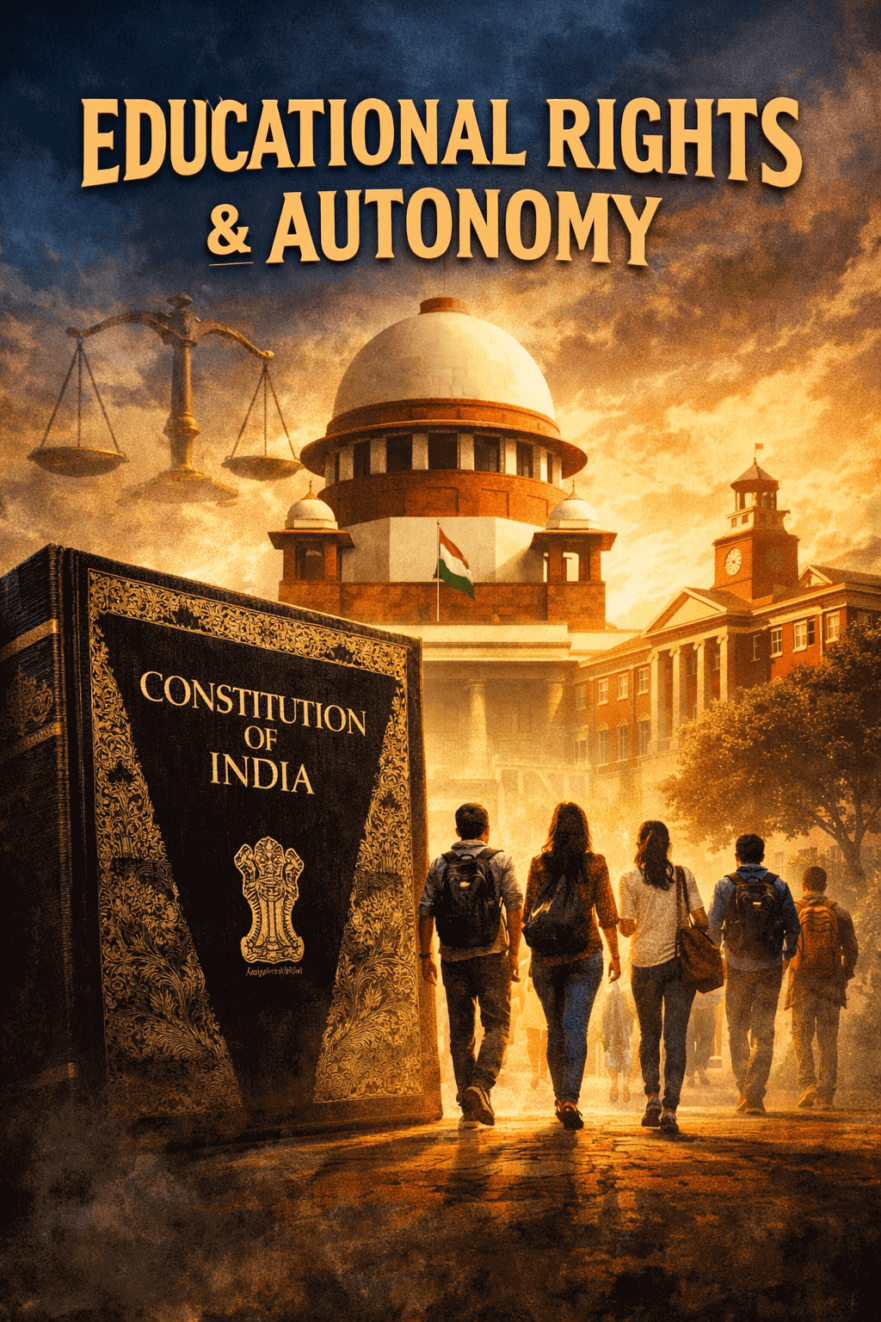
P.A. Inamdar v State of Maharashtra (2005): Reservation in Private Colleges Explained
The P.A. Inamdar case is a landmark Supreme Court judgment that clarified whether the government can impose reservation policies in private unaided educational institutions. This judgment strengthened the autonomy of private institutions, especially minority institutions.
This case further developed the principles laid down in T.M.A. Pai and Islamic Academy cases.
Read the full constitutional framework here:
Reservation and Autonomy of Educational Institutions in India: Constitutional Framework
📚 Background of the Case
After the Islamic Academy judgment, several state governments introduced laws imposing reservation quotas in private professional colleges.
These laws required private colleges to reserve seats for students nominated by the State.
Private institutions challenged these laws before the Supreme Court.
⚖️ Legal Issues Before the Court
- Whether the State can impose reservation in private unaided educational institutions.
- Whether such reservation violates institutional autonomy.
- Whether minority institutions are protected from such state interference.
🏛️ Arguments of Private Institutions
- Reservation interferes with institutional autonomy.
- Private institutions do not receive government funding.
- Forced reservation violates Articles 19(1)(g) and 30.
🏛️ Arguments of the State
- Reservation promotes social justice.
- The State has authority to regulate education.
- Reservation ensures equality.
👨⚖️ Supreme Court Judgment
The Supreme Court ruled in favor of private institutions.
The Court held that the State cannot impose reservation in private unaided educational institutions.
This applies especially to minority institutions.
⚖️ Key Principles Established
1. No State-Imposed Reservation in Private Unaided Institutions
The State cannot force private unaided institutions to reserve seats.
This protects institutional autonomy.
2. Protection of Minority Rights
Minority institutions have strong protection under Article 30.
The State cannot interfere with their admission process.
3. Institutional Autonomy Is a Fundamental Right
Private institutions have the right to administer their institutions.
This includes control over admissions.
4. Reasonable Regulation Is Allowed
The State can regulate to prevent malpractice.
But it cannot impose reservation.
📜 Constitutional Provisions Discussed
- Article 19(1)(g) – Freedom of occupation
- Article 30 – Minority educational rights
- Article 14 – Equality
📊 Impact of the Judgment
- Strengthened autonomy of private institutions
- Protected minority institutions
- Limited state power in education
- Prevented forced reservation in private unaided institutions
⚖️ Later Constitutional Amendment
After this judgment, the 93rd Constitutional Amendment introduced Article 15(5).
This allowed reservation in private institutions except minority institutions.
📚 Importance for Law Students and Judiciary Aspirants
This case is frequently asked in constitutional law examinations.
It explains limits of state power over private institutions.
📌 Conclusion
The P.A. Inamdar judgment is a major milestone in protecting institutional autonomy.
It ensured that private institutions retain control over admissions.
This case continues to influence education law in India.
📘 Stay Ahead with Delhi Law Academy!
Get access to free monthly current affairs, read our insightful blogs,
and explore free study resources prepared by experts at DLA Jaipur. 🚀
❓ Frequently Asked Questions (FAQs)
1. What did P.A. Inamdar case decide?
The Supreme Court held that the State cannot impose reservation in private unaided institutions.
2. Can private colleges have reservation after Inamdar case?
Only voluntary reservation, not forced by the State.
3. Does Inamdar case protect minority institutions?
Yes, minority institutions have strong protection under Article 30.
4. Which amendment changed Inamdar position?
The 93rd Constitutional Amendment introduced Article 15(5).
5. Can government regulate private colleges?
Yes, but cannot impose reservation forcibly.
6. Why is Inamdar case important?
It defined limits of state power and strengthened institutional autonomy.
Contact us
📍 Delhi Law Academy – Jaipur Branch
6C, Tower 2, Coaching Hub, Pratap Nagar, Jaipur – 302033
📞 Phone:
+91 9911916552
+91 8447285606
✉️ Email:
contactus@delhilawacademy.com