
OFFENCES UNDER THE SC/ST ACT
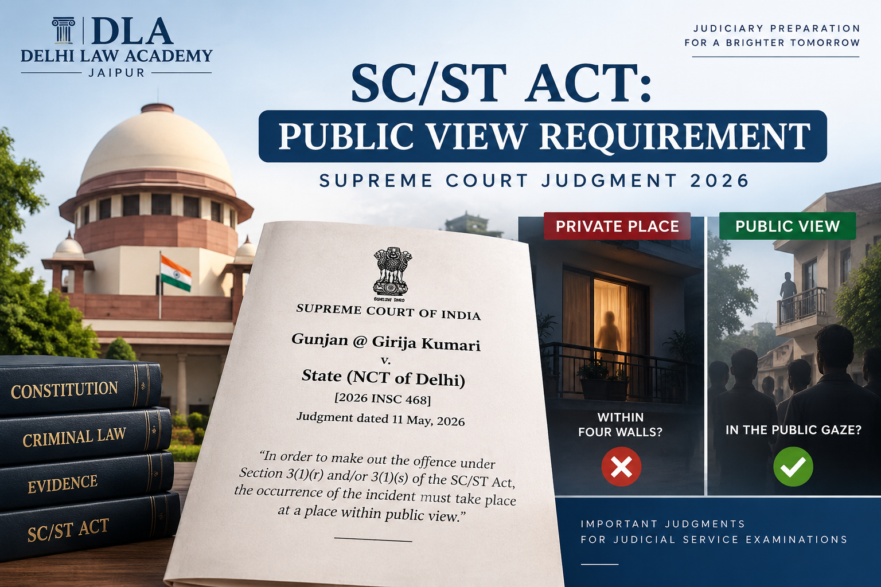
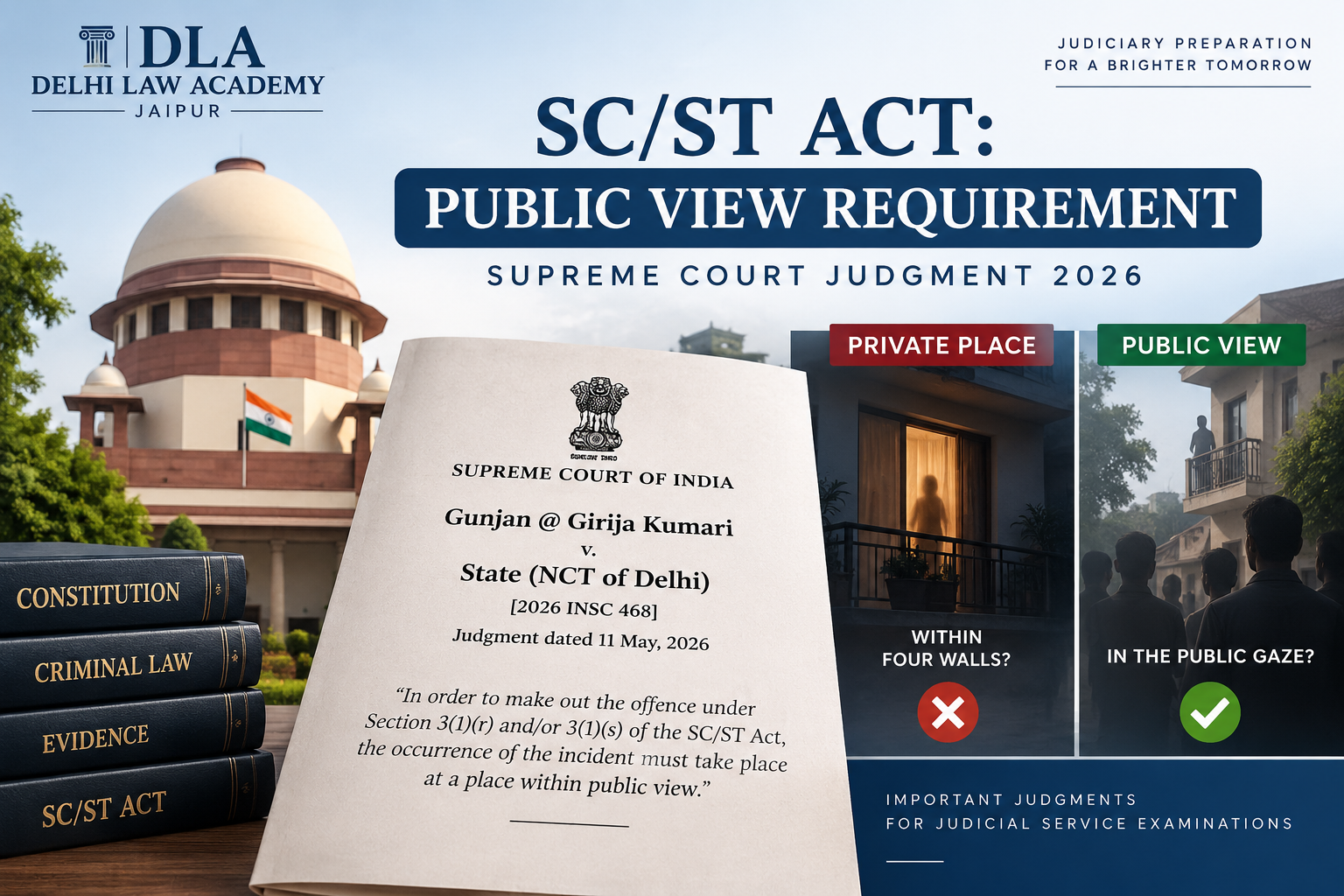
Supreme Court Judgment on the requirement of “public view” under Sections 3(1)(r) and 3(1)(s) of the SC/ST Act
TOPIC: OFFENCES UNDER THE SC/ST ACT
Delhi Law Academy Jaipur presents below for aspirants of Rajasthan Judicial Service (RJS), DJS, PCS (J) and other Judicial Services throughout India a very important judgment of the Supreme Court of India, delivered on 11 May, 2026.
Presented below: Summarized version [by Delhi Law Academy Jaipur] of the Supreme Court Judgment in the case of Gunjan @ Girija Kumari v. State (NCT of Delhi) [2026 INSC 468] delivered on 11 May, 2026.
[Original language of the judgment has been maintained; it has not been disturbed or replaced]
Gunjan @ Girija Kumari v. State (NCT of Delhi)
J U D G M E N T
2.1
In the Criminal Revision Petition, what was called in question, was the order passed by the Court of Additional Sessions Judge-02, Tis Hazari Court, Delhi dated 26.11.2022 on framing of charges as well as order dated 30.11.2022, whereby the charges were framed. Against appellant No.1-accused No.1 Smt. Gunjan @ Girija Kumari w/o Shri Laxman Dass, charge came to be framed by the trial court in respect of the offences under Sections 3(1)(r) and 3(1)(s) of the Scheduled Castes and Scheduled Tribes (Prevention of Atrocities) Act, 19893, whereas against all the appellants-accused including appellant No.1, charge was also framed under Section 506 read with Section 34 of the Indian Penal Code, 18604. The prayer of the appellants to quash the said orders was rejected and the Criminal Revision Petition came to be dismissed by the High Court.
3.
The complainant and the accused persons happen to be family members. Appellant Nos.2 and 3 and respondent No.2-complainant are real brothers. Appellant Nos.1 and 4 are legally wedded wives of appellant Nos.2 and 3 respectively. The wives hail from castes other than Scheduled Castes or Scheduled Tribes. Their husbands, that is appellant Nos.2 and 3 as well as respondent No.2- complainant, belong to Scheduled Castes. By virtue of marriage, the wives, it was contended, also stood to belong to caste and community of their husband’s as well as that of respondent No.2-complainant. The facts on record and the pleadings suggest that a dispute existed between the parties in respect of the properties of their late father named Shri Nand Kishore, situated at Hari Nagar and Ramesh Nagar.
3.1
First Information Report No.42 of 2021 came to be registered on 30.01.2021 with the Kirti Nagar Police Station, pursuant to a complaint lodged by respondent No.2- complainant. It was inter-alia stated that on the day of the incident, that is on 28.01.2021, the appellants misbehaved with the complainant. According to the complainant, appellant No.1 hurled casteist abuses against respondent No.2-complainant and the other appellants gave threats.
3.1.1
It was stated in the complaint that when the friends of respondent No.2-complainant named Chandra Prakash @ Chini and Bobby had come to meet him, appellant No.1, by making caste-based slurs, using words like chura, chamar, harijan, dirty drain etc., addressed and insulted the complainant and his wife. It was stated that the accused were trying to break open the lock of the house when the incident took place.
3.1.2
The narration in the complaint was prefaced by mentioning that appellant No.1, who belonged to a particular upper caste, was in the habit of using abusive words as above and that it was for over one year that appellant No.1 had been harassing by addressing the complainant, his wife and their child with derogatory words as above, from her balcony or from the ground floor in the house particularly when some friends or other persons would come.
5.1.1
The offence under Section 3(1)(r) of the SC/ST Act can be said to have been committed when a person not belonging to Scheduled Caste or Scheduled Tribe intentionally insults or intimidates with an intent to humiliate a person belonging to Scheduled Caste or Scheduled Tribe in any place within public view. Offence under Section 3(1)(s) of the SC/ST Act is made out when any member of the Scheduled Caste or Scheduled Tribe is abused by caste name in any place within public view.
5.2
The ingredients of the offences are that there has to be an intentional insult or intimidation which has to be with an intent to humiliate a member of Scheduled Caste or Scheduled Tribe or that such member of Scheduled Caste or Scheduled Tribe is abused by caste name by a person who does not belong to Scheduled Caste or Scheduled Tribe. The common essential for constituting the offence under both the Sections is that the insult or intimidation under sub- clause (r) or hurling of abuses under sub-clause (s) have taken place “in any place within public view”.
5.9
A conclusive statement of law that emanates from the ratio of the decisions of this Court discussed above is that in order to make out the offence under Section 3(1)(r) and/or Section 3(1)(s) of the SC/ST Act, the occurrence of the incident and the act and conduct of hurling of caste- based abuses must take place at “a place within public view”. It must be a place within the public gaze. Even happens to be a private place, then in such eventuality a public-eye must have an access to be able to notice what happens there or what is taking place that will only make the “place within public view”.
6.1
In the FIR, while referring to the incident of abuse, on 28.01.2021, the statements were made by respondent No.2-complainant that the appellants were in the habit of harassing and hurling caste-based slurs at him for over a year and that they used to do it when some other persons or friends come to meet him, by using the abusive words from their balcony or at the ground floor of the house.
6.4
It was noticeable that in the complaint/FIR, nowhere it was stated that the said incident wherein appellant No.1 and other appellants are stated to have abused and threatened respondent No.1-complainant, took place where there was a public gaze. The necessary ingredient of occurrence of the incident “in a place within public view” was conspicuously absent.
6.5
Not only that it was not stated that it was “a place within public view” or that the outsiders or the members of the family were present at the time, the details mentioned in the FIR clearly indicated that the place of occurrence of the incident was inside the residential house.
6.7
All material facts go to suggest that the alleged incident took place in a private place and within four walls of the house of respondent No.2-complainant and the appellants, who all are family members.
📘 Free Study Material for Judiciary Aspirants!
Download our FREE study material prepared by Delhi Law Academy’s expert faculty.
9.1
It could be said that the occurrence of the incident to become an offence under the SC/ST Act must have happened “in a place within public view”, is in a way, a principal requirement amongst the other ingredients. The other aspects namely “intentional insult or intimidation” and “an intent to humiliate”, gathers a kind of intensity when the insult, intimidation, humiliation or abusive utterances, as the case may be, takes place in “a place within public view”, in the presence of members of the public. The requirement that the place must be one “within public view” can be said to be substantiating the other elements of the offence under the SC/ST Act. It is therefore a sine qua non for making out the offence under the SC/ST Act.
11.
For the aforesaid reasons and discussion, it is evident that the charge could not have framed and was wrongly framed by the trial court against the appellants- accused for the offences under Sections 3(1)(r) and 3(1)(s) of the SC/ST Act and under Section 506 read with Section 34, IPC.
13.
FIR No. 42 of 2021 dated 30.01.2021 registered with the Police Station, Kirti Nagar, Delhi and the charge-sheet filed against the appellants-accused for the offences under Sections 3(1)(r) and 3(1)(s) of the SC/ST Act as well as for the offences under Section 506 read with Section 34, IPC stand quashed.
************************
End of Judgment Extract
Delhi Law Academy Jaipur
This judgment is important for judicial service aspirants studying the Scheduled Castes and Scheduled Tribes (Prevention of Atrocities) Act, particularly Sections 3(1)(r) and 3(1)(s), and the requirement that the alleged act occur at a place “within public view”.
Explore More Free Resources from Delhi Law Academy
Stay updated with our monthly current affairs and explore more important legal and judicial-service articles from Delhi Law Academy.
Contact us
📍 Delhi Law Academy – Jaipur Branch
6C, Tower 2, Coaching Hub, Pratap Nagar, Jaipur – 302033
📞 Phone:
+91 9911916552
+91 8447285606
✉️ Email:
contactus@delhilawacademy.com