
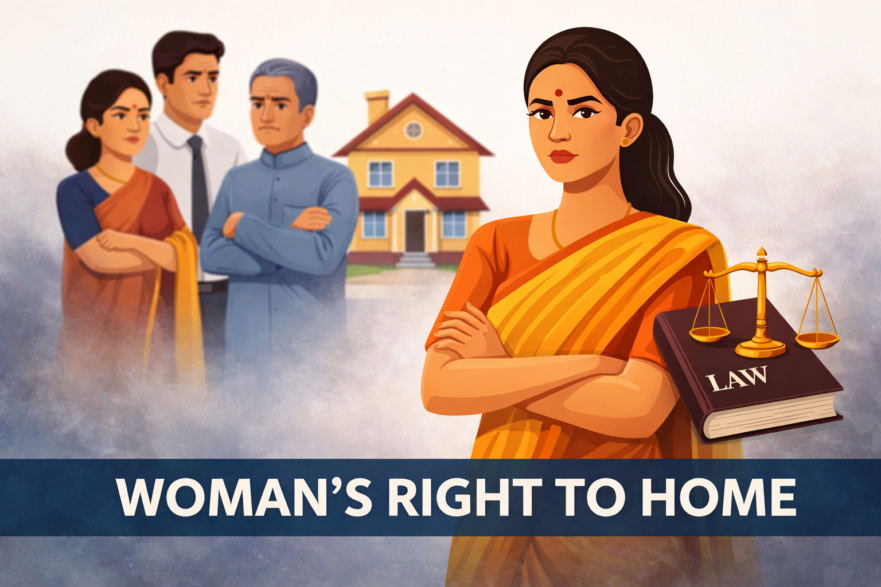
Residence Rights of Wife After Separation or Divorce
After separation or divorce, many women face uncertainty regarding their right to stay in the matrimonial home. Husbands and in-laws often claim that residence rights end once the relationship breaks down.
Indian law, however, provides continued protection to women even after separation or during divorce proceedings.
📚 Introduction
Marital disputes often lead to physical separation between spouses. In some cases, divorce proceedings may also be initiated.
During this period, women are frequently asked to vacate the matrimonial home.
This article explains the legal position regarding residence rights after separation or divorce.
⚖️ Residence Rights During Pending Proceedings
During pendency of divorce or maintenance cases, a wife continues to have residence rights.
Courts generally protect the shelter of women until disputes are finally decided.
Eviction without court orders is illegal.
📜 Protection Under Domestic Violence Act
The Domestic Violence Act protects a woman’s right to reside in the shared household even after separation.
Section 17 applies as long as a domestic relationship existed.
Past cohabitation is sufficient to claim protection.
⚖️ Residence Rights After Divorce
After divorce, residence rights may continue depending on circumstances.
Courts may allow continued residence or order alternative accommodation.
The objective is to prevent destitution and hardship.
🏠 Alternative Accommodation and Maintenance
In many cases, courts direct the husband to provide separate accommodation.
This is often linked with maintenance and alimony orders.
Financial capacity and standard of living are considered.
⚖️ When Residence Rights May End
In certain situations, residence rights may be restricted.
- When adequate alternative housing is provided
- When court passes specific eviction order
- When misuse of protection is proved
- When woman voluntarily leaves permanently
Even then, legal process is mandatory.
⚠️ Illegal Eviction After Separation
Forcible removal after separation is unlawful.
Women may approach Magistrate courts under the DV Act.
Police protection may also be granted.
📝 Importance for Judiciary Exams
Questions on post-separation residence rights appear in family law papers.
Aspirants must remember the interaction of DV Act and personal laws.
📌 Conclusion
Separation or divorce does not automatically end a woman’s right to shelter.
Indian law continues to protect her dignity and security.
Courts ensure that women are not rendered homeless due to marital disputes.
📘 Stay Ahead with Delhi Law Academy!
Get access to free monthly current affairs, read our insightful blogs,
and explore free study resources prepared by experts at DLA Jaipur. 🚀
❓ Frequently Asked Questions (FAQs)
1️⃣ Does separation end residence rights? ⚖️
No, separation alone does not end residence rights.
2️⃣ Can a wife stay during divorce case? 📜
Yes, courts usually protect residence during proceedings.
3️⃣ Can residence continue after divorce? 🏠
Yes, depending on court orders and circumstances.
4️⃣ Can husband evict after divorce? 🚫
No, eviction requires proper legal orders.
5️⃣ Is alternative accommodation compulsory? 💼
Courts may order it if staying together is not possible.
6️⃣ Which law protects post-separation residence? 📚
The Domestic Violence Act mainly provides protection.