
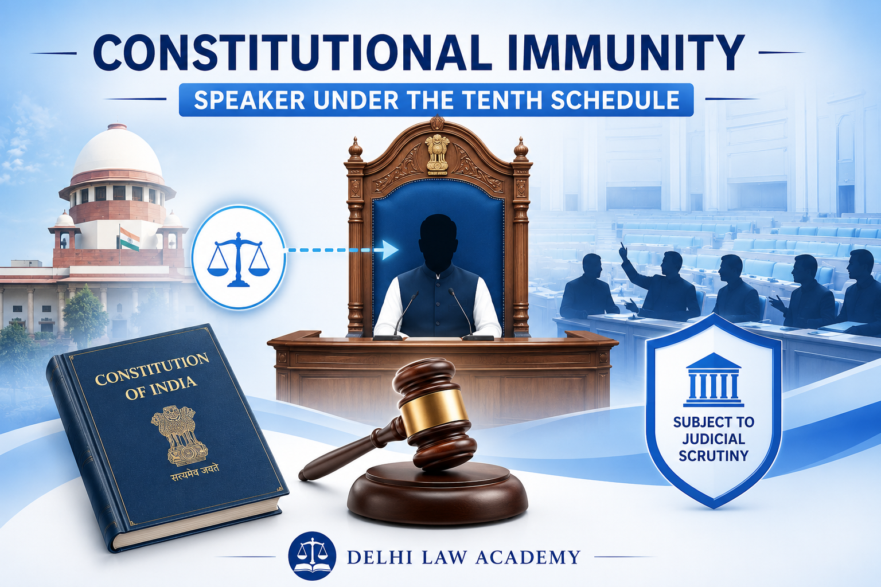
CONSTITUTIONAL IMMUNITY OF A LEGISLATIVE ASSEMBLY SPEAKER
Summarized version [by Delhi Law Academy Jaipur] of the Supreme Court Judgment in the case of Padi Kaushik Reddy v. State of Telangana [2025 INSC 912] delivered on 31 July 2025:
Fundamental question of law decided by the Supreme Court in this Judgment:
“Whether the Speaker of a Legislative Assembly enjoys constitutional immunity under Articles 122 or 212 when acting as an adjudicating authority under the Tenth Schedule (Anti-Defection Law)”
Ans: NO
Padi Kaushik Reddy v. State of Telangana
JUDGMENT
3. Shorn of unnecessary details, the facts leading to the appeals are as under:
3.1. On 3rd November 2023, on the recommendation of the Election Commission of India, the Hon’ble Governor of the State of Telangana issued the notification for General Election to the State Legislative Assembly.
3.2. Pursuant to the notification, one Danam Nagender filed his nomination as a candidate of the Bharat Rashtra Samithi from the Khairatabad Assembly Constituency on 6th November 2023. Similarly, two others namely Venkata Rao Tellam and Kadiyam Srihari filed their nomination from Bhadrachalam Assembly Constituency and Ghanpur Station Constituency as candidates of BRS on 9th November 2023.
3.3. Thereafter, on 30th November 2023, the elections were held and the results were declared on 3rd December 2023.
3.4. The aforementioned Danam Nagender, Venkata Rao Tellam and Kadiyam Srihari won the election from their respective constituency. The Indian National Congress emerged as the single largest party and it along with its ally formed the Government.
3.5. It is the allegation of the appellants that on 15th March 2024, Danam Nagender joined the INC. It is further their allegation that the other two BRS Members of Legislative Assembly4 namely Kadiyam Srihari and Venkata Rao Tellam also joined the INC on 31st March 2024 and 7th April 2024 respectively.
3.6. Subsequently, the Appellants in the lead matter namely Padi Kaushik Reddy and Kuna Pandu Vivekanand, who are themselves MLAs belonging to BRS, filed separate petitions under Paragraph 2(1) of the Tenth Schedule read with Article 191(2) of the Constitution of India and Rules 6(1) and 6(2) of the Members of Telangana Legislative Assembly (Disqualification on ground of Defection) Rules, 19865 before the Telangana State Legislative Assembly on 18th March 2024.
The common prayer in all the three petitions was for a declaration from the Speaker of the Telangana Legislative Assembly that the MLAs from BRS who joined the INC be declared as disqualified from continuing as members of the Telangana Legislative Assembly.
3.8. Thereafter, aggrieved by the inaction/delay on part of the Speaker in deciding the disqualification petitions, the Appellants filed three separate Writ Petitions before the High Court being Writ Petition Nos. 9472, 11098 & 18553 of 2024.
Constitutional Immunity & Tenth Schedule
30. It can thus be seen that this Court, in unequivocal terms, has held that it was inappropriate to claim that the determinative jurisdiction of the Speaker/Chairman in the Tenth Schedule to the Constitution was not a judicial power and was within the non-justiciable legislative area. This Court, in no unclear terms, held that the power to decide disputed disqualification under Paragraph 6(1) of the Tenth Schedule to the Constitution was pre-eminently of a judicial complexion. This Court, thereafter, referred to the provision of Articles 122(1) and 212(1) of the Constitution and the fiction in Paragraph 6(2) of the Tenth Schedule to the Constitution. This Court observed that these provisions attract immunity from mere irregularities of procedures. Then, in paragraph 98, this Court posed a question as to whether the Speaker/Chairman, acting in Paragraph 6(1) of the Tenth Schedule to the Constitution, is a Tribunal or not.
97. That apart, even after 1986 when the Tenth Schedule was introduced, the Constitution did not evince any intention to invoke Article 122 or 212 in the conduct of resolution of disputes as to the disqualification of members under Articles 191(1) and 102(1). The very deeming provision implies that the proceedings of disqualification are, in fact, not before the House; but only before the Speaker as a specially designated authority. The decision under Paragraph 6(1) is not the decision of the House, nor is it subject to the approval by the House. The decision operates independently of the House. A deeming provision cannot by its creation transcend its own power. There is, therefore, no immunity under Articles 122 and 212 from judicial scrutiny of the decision of the Speaker or Chairman exercising power under Paragraph 6(1) of the Tenth Schedule.
DIRECTIONS AND CONCLUSION
102. In the result, we pass the following order:
(i) The present appeals/petition are allowed;
(ii) The impugned judgment and final order dated 22nd November 2024 passed by the Division Bench of the High Court is quashed and set aside;
(iii) We direct the Speaker to conclude the disqualification proceedings pending against the 10 MLAs pertaining to the present appeals/petition as expeditiously as 2025 INSC 912 possible and in any case, within a period of three months from the date of this judgment;
(iv) We further direct that the Speaker would not permit any of the MLAs who are sought to be disqualified to protract the proceedings. In the event, any of such MLAs attempt to protract the proceedings, the Speaker would draw an adverse inference against such of the MLAs.
Key Constitutional Principle
The Speaker, while exercising powers under Paragraph 6(1) of the Tenth Schedule, is acting as a specially designated authority in deciding questions of disqualification.
There is, therefore, no immunity under Articles 122 and 212 from judicial scrutiny of the Speaker’s decision under Paragraph 6(1) of the Tenth Schedule.
************************************
📘 Free Study Material for Judiciary Aspirants!
Download our FREE study material prepared by Delhi Law Academy’s expert faculty.
Contact us
📍 Delhi Law Academy – Jaipur Branch
6C, Tower 2, Coaching Hub, Pratap Nagar, Jaipur – 302033
📞 Phone:
+91 9911916552
+91 8447285606
✉️ Email:
contactus@delhilawacademy.com