
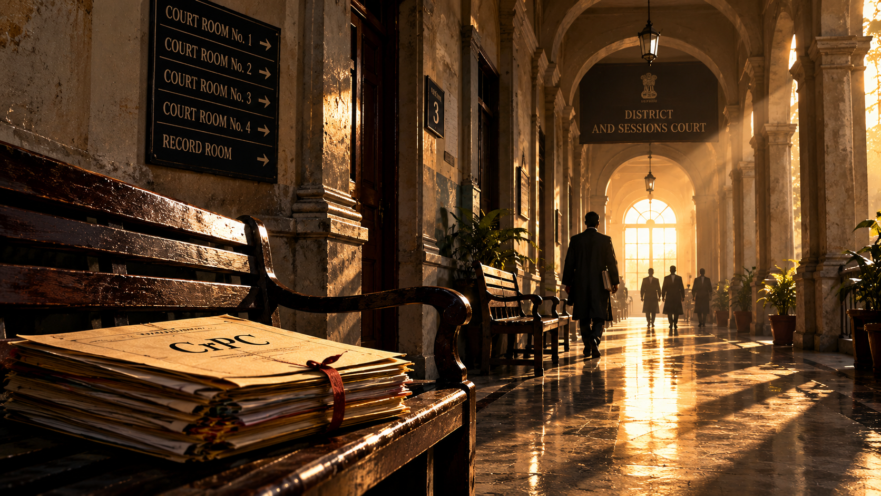

INVESTIGATION OF COGNIZABLE CASES UNDER CrPC
SECTIONS 155 – 157
CODE OF CRIMINAL PROCEDURE EXPLAINED
The Code of Criminal Procedure forms the bedrock of any and every Judicial Service exam in the country. Its thorough knowledge is a must for all aspirants of RJS, DJS, PCS (J) and every other Judicial Service exam. To help such aspirants DELHI LAW ACADEMY JAIPUR has launched a series of study material modules on all important aspects of this vital part of their syllabus:
CODE OF CRIMINAL PROCEDURE
CHAPTER XII – POLICE INVESTIGATION
Section 155(3)
- Any police officer receiving such order
- may exercise same powers of investigation
- as an officer in charge of a police station may exercise in a cognizable case
- except the power to arrest without warrant
Section 155(4)
- Where
- a case relates to two or more offences
- of which at least one is cognizable
- it shall be deemed
- to be a cognizable case
- notwithstanding that
- other offences are non-cognizable
Explanatory Notes by DLA on section 155(4):
- Section 155(4) creates a legal fiction and provides that although a case may comprise of several offences of which some are cognizable and others are not, it would not be open to the police to investigate the cognizable offences only and omit the non-cognizable offences.
- Since the whole case (comprising of cognizable and non-cognizable offences) is to be treated as cognizable, the police has no option but to investigate the whole of the case and to submit a charge-sheet in respect of all the offences, cognizable or non-cognizable both, provided it is found by the police during investigation that the offences appear, prima facie, to have been committed.
- Section 155(4) is a new provision introduced for the first time in the Code in 1973. This was done to overcome the controversy about investigation of non-cognizable offences by the police without the leave of the Magistrate. The statutory provision is specific, precise and clear and there is no ambiguity in the language.
📘 Free Study Material for Judiciary Aspirants!
Download our FREE study material prepared by Delhi Law Academy’s expert faculty.
Investigation of a cognizable case: Section 156(1)
- An officer in-charge of a police station
- may investigate any cognizable case without order of a Magistrate
- which a Court would have power to inquire into or try under Chapter XIII
Section 156(3)
- Any Magistrate empowered u/s 190
- may order an investigation as above-said
Explanatory Notes by DLA on section 156:
- Whenever a Magistrate directs an investigation on a “complaint” the police has to register a cognizable case on that complaint treating the same as the FIR. Therefore, the direction of a Magistrate asking the police to “register a case” can not make an order of investigation under Section 156(3) legally unsustainable.
- Indeed, even if a Magistrate does not pass a direction to register a case, still in view of the provisions of Section 156(1) of the Code which empowers the police to investigate into a cognizable “case” and the Rules framed under the Indian Police Act, 1861, the police is duty-bound to formally register a case and then investigate into the same.
- The provisions of the Code, therefore, do not in any way stand in the way of a Magistrate to direct the police to register a case at the police station and then investigate into the same. When an order for investigation under Section 156(3) of the Code is to be made the proper direction to the police would be “to register a case at the police station treating the complaint as the first information report and investigate into the same”.
Procedure for investigation: Section 157
- If officer in-charge of a police station
- has reason to suspect commission of an offence from information received or otherwise
- which he is empowered u/s 156 to investigate
- he shall forthwith
- send a report to the Magistrate empowered to take cognizance and
- proceed in person to the spot or depute his subordinate to so proceed
- to investigate facts and circumstances of the case and
- to take measures for discovery and arrest of the offender, if necessary
Explore More Free Resources from Delhi Law Academy
Stay updated with our monthly current affairs and explore more important legal and judicial-service articles from Delhi Law Academy.
Contact us
📍 Delhi Law Academy – Jaipur Branch
6C, Tower 2, Coaching Hub, Pratap Nagar, Jaipur – 302033
📞 Phone:
+91 9911916552
+91 8447285606
✉️ Email:
contactus@delhilawacademy.com