
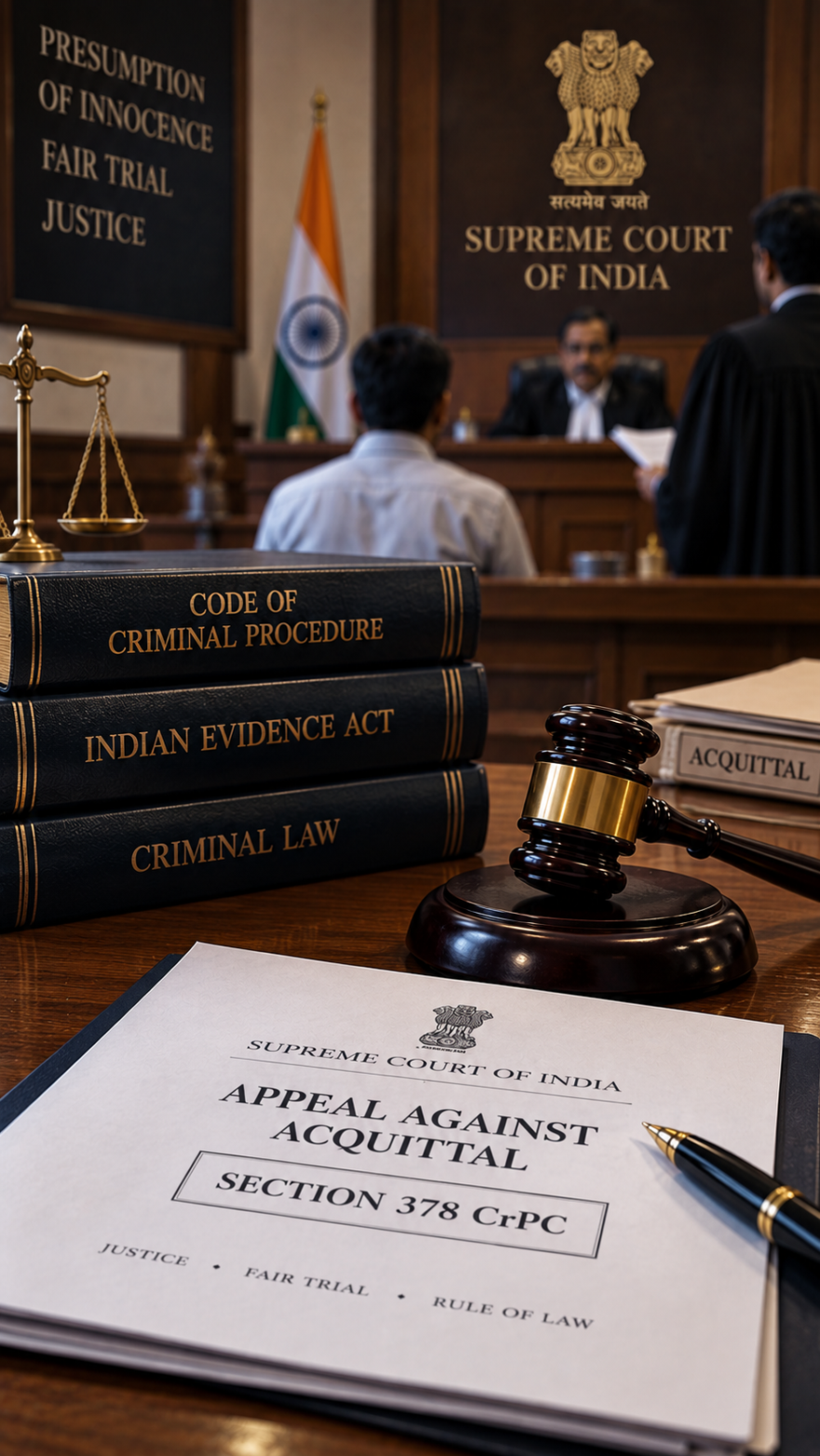
TOPIC: LAW RELATING TO APPEAL AGAINST ACQUITTAL U/S 378 CrPC
Supreme Court of India
An order of acquittal adds up to the presumption of innocence in favour of the accused.
Delhi Law Academy Jaipur presents below for aspirants of Rajasthan Judicial Service (RJS), DJS, PCS (J) and other Judicial Services throughout India a very important judgment of the Supreme Court of India on the law relating to appeal in a higher court against an order of acquittal from the lower courts delivered in 2022.
Presented below: Summarized version [by Delhi Law Academy Jaipur] of the Supreme Court Judgment in the case of Ravi Sharma v. State (Govt of NCT of Delhi).
Original language of the judgment has been maintained; without any substitution or replacement.
This judgment has been summarized in just about 3 pages by Delhi Law Academy while retaining the original language and original content.
RAVI SHARMA v. STATE (GOVT OF NCT OF DELHI)
J U D G M E N T
1. An order of acquittal passed on a scrutiny of evidence before it by the District and Sessions Judge, North-East District, Karkardooma Court, Delhi in S.C. No.6/12 got overturned by the impugned judgment of the Division Bench of the High Court of Delhi based upon the existence of motive along with the recovery made under Section 27 of the Indian Evidence Act.
FACTS IN BRIEF:
2. On 30.05.2011, the first information report was recorded on finding a dead body. PW2, brother of the deceased, identified the body. Statements of both PW1, father of the deceased and PW2 have been recorded, which did not indicate any specific suspect. The Investigating Officer conducted the inquest and prepared the map. On the next day, doubts were raised by PWs 1 and 2 pointing the finger of suspicion on the accused who happens to be a friend of the deceased. Upon securing the accused, recovery of the material in the form of firearm was made. Both the observation Mahazar along with the sketch and the recovery Mahazar under Section 27 of the Act were signed by the police officers with the exception that the latter one was signed by PW2 as well
4. Having found that the motive has not been proved and the recovery being doubtful despite the presence of scores of independent witnesses on both occasions, the Court in the first instance deemed it appropriate to extend the benefit of doubt in favour of the appellant.
5. The Division Bench of the Delhi High Court, despite concurring with the views expressed by the trial Court qua the last seen theory, nonetheless accepted the evidence of PW2 with respect to the motive coupled with the recoveries made. Though the trial Court eschewed the evidence of the Ballistic Expert, which remained inconclusive with respect to the bullet which caused the death, relatable to the gun belonging to the appellant, the High Court felt that it could be relied upon. Incidentally, it was held that the wooden piece of the butt did belong to the appellant. Therefore, the circumstances forming a chain were sufficient enough to point out guilt towards him and accordingly the High Court rendered a conviction.
8. Before venturing into the merits of the case, we would like to reiterate the scope of Section 378 of the Code of Criminal Procedure while deciding an appeal by the High Court, as the position of law is rather settled. We would like to quote the relevant portion of a recent judgment of this Court in Jafarudheen and Others v. State of Kerala (2022 SCC Online SC 495) as follows:
25. While dealing with an appeal against acquittal by invoking Section 378 of the Cr.PC, the Appellate Court has to consider whether the Trial Court’s view can be termed as a possible one, particularly when evidence on record has been analyzed. The reason is that an order of acquittal adds up to the presumption of innocence in favour of the accused. Thus, the Appellate Court has to be relatively slow in reversing the order of the Trial Court rendering acquittal. Therefore, the presumption in favour of the accused does not get weakened but only strengthened. Such a double presumption that enures in favour of the accused has to be disturbed only by thorough scrutiny on the accepted legal parameters
📘 Free Study Material for Judiciary Aspirants!
Download our FREE study material prepared by Delhi Law Academy’s expert faculty.
17. Similarly, the trial Court rightly doubted the recovery under Section 27 of the Act. There was no need to take PW2 and thereafter make him to sign. There are a lot of contradictions in the evidence rendered. PW2 has stated that many persons were available at the time of the recovery, but no statement has been obtained from any of them. PW11, the Head Constable says that the Investigating Officer PW14, did not ask any neighbor to join the investigation. PW8, who is the Sub-Inspector of Police has deposed that none was forthcoming. A similar statement was also made by the Investigating Officer. There is a discrepancy on the mode of traveling to the place from where the recovery under Section 27 of the Act was made, along with the witnesses, namely PWs 2, 8, 11 and 14. While PW2 has stated that the police team used a jeep and motorbike. The other witness has stated that it was either motorbike or by foot, while one witness says that it was a Gypsy. We do find contradictions with respect to the place of arrest followed by the disclosure statement.
18. The report of the Ballistic Expert is obviously a scientific evidence in the nature of an opinion. It is required to use this evidence along with the other substantive piece of evidence available. The report is inconclusive with respect to the firearm belonging to the appellant being used for committing the offence.
19. All the aforesaid aspects have been considered threadbare by the trial Court. We do not find any perversity in it and the law presumes double presumption in favour of the accused after a due adjudication by the trial Court. We do believe that the High Court could have been slower in reversing the order of acquittal rendered by the Court of First Instance.
********************
Explore More Free Resources from Delhi Law Academy
Stay updated with our monthly current affairs and explore more important legal and judicial-service articles from Delhi Law Academy.
Contact us
📍 Delhi Law Academy – Jaipur Branch
6C, Tower 2, Coaching Hub, Pratap Nagar, Jaipur – 302033
📞 Phone:
+91 9911916552
+91 8447285606
✉️ Email:
contactus@delhilawacademy.com